

Edition 03 · 2 July 2026 · covering 19 June–1 July 2026 · ~9 min read · Subscriber edition
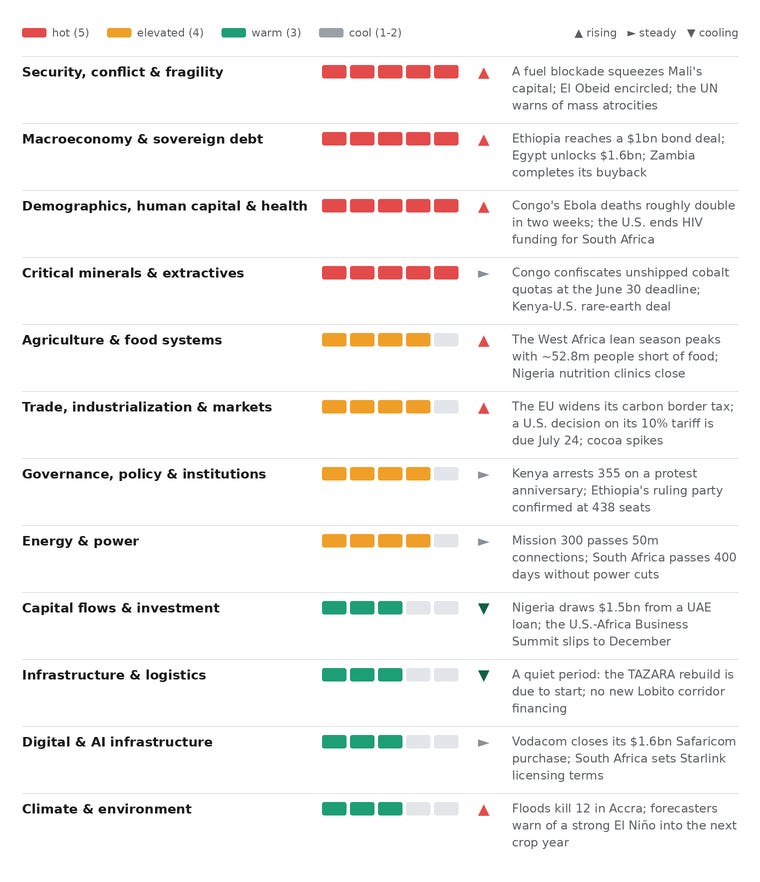
How to read this. We track the African continent as one system across twelve domains, the big moving parts of development, from money and minerals to food and security. Each gets a heat score from 1 (quiet) to 5 (very active) for the period, plus a trend arrow (▲ rising · ► steady · ▼ cooling). The edition leads with what moved most, then traces how a shock in one domain travels into others. Every claim links to its source; the full list is at the end.
The continental read
Two deadlines landed on June 30, and together they say where the continent is heading. Ethiopia and its bondholders agreed in principle to restructure a $1 billion bond, the last of Africa’s three big debt workouts to reach a deal (Ethiopia Ministry of Finance, 2026). The same day, the Democratic Republic of the Congo carried out its threat and confiscated every cobalt export allocation that had not shipped by the deadline (Reuters via Kitco, 2026).
The first deadline says money is returning. Egypt reached a $1.6 billion staff-level agreement with the International Monetary Fund on June 29 (IMF, 2026). Zambia completed the buyback of its 2053 bond after sweetening its offer to creditors (CNBC Africa, 2026). One market report puts the extra interest African governments pay over U.S. debt at its lowest since 2019 (Businessday, 2026).
The second deadline says the sellers now set terms. And beneath both, the human floor is dropping. An armed coalition is blocking fuel from reaching Mali’s capital (Critical Threats, 2026). The Rapid Support Forces have surrounded the Sudanese city of El Obeid, and the United Nations Security Council warns of an imminent risk of mass atrocities (UN News, 2026). Congo’s Ebola deaths roughly doubled in two weeks (World Health Organization, 2026).
These are not separate stories. The countries where the money is arriving and the countries where the floor is failing are, in several cases, the same ones.
The heat map
Deep dive: sovereign debt
Ethiopia’s bond deal reopens the market, on new terms
On June 30 Ethiopia reached an agreement in principle with holders of its $1 billion bond: a 12% cut to the amount owed, a new $880 million bond due 2029, and a tradable certificate that pays holders more if Ethiopia’s economy performs better than projected (Ethiopia Ministry of Finance, 2026; Ecofin Agency, 2026). What matters is what this closes: Ethiopia was the last of the three big African debt restructurings started under the G20 Common Framework, after Ghana and Zambia. The effect travels through investor confidence, and the lag is short. Bond prices move within weeks; new borrowing follows within months.
The direct winners are the governments waiting to borrow. Côte d’Ivoire and Angola are weighing new bonds of about $1.5 billion and up to $1.7 billion, into a market where Africa’s borrowing premium is near its lowest since 2019, though the exact date of that reading is not confirmed (Businessday, 2026). Egypt gains twice: the IMF staff agreement on June 29 unlocks about $1.6 billion, its next-to-last payment under the program (IMF, 2026), and its currency strengthened past 50 to the dollar during the period, by one market summary (IndexBox, 2026). The exposed party is whoever restructures next: bondholders publicly criticized how the IMF handled the Ethiopia case (Bloomberg, 2026), and that friction raises the cost of the next workout.
The second-order effect is in how the new money arrives. One report says the African Development Bank lent Zambia $600 million so it could retire its own expensive bond, a development balance sheet used for debt management rather than projects (FundsForNGOs, 2026). Nigeria drew $1.5 billion from a $5 billion collateralized loan arranged with a United Arab Emirates bank, a structure the IMF has flagged for transparency risk (Bloomberg, 2026; Nairametrics, 2026). Base case: the Ethiopia deal completes this year and more governments borrow. The alternative, at perhaps one chance in three, is that the U.S. tariff decision due July 24 (Carnegie Endowment, 2026) or renewed Middle East conflict pushes global risk premiums back up and shuts new borrowers out again. What would confirm the base case: Ethiopia launches its formal bondholder vote and Egypt’s IMF board approval lands. What would break it: holdout bondholders reject the terms.
Deep dive: security
Two encircled cities, one lesson about outside protection
As of July 1 neither Mali’s capital nor the Sudanese city of El Obeid has faced a direct assault, but both are surrounded: the armed coalition Jama’at Nusrat al-Islam wal-Muslimin (JNIM) is blocking fuel from reaching Bamako, and the paramilitary Rapid Support Forces have completed a ring around El Obeid (Critical Threats, 2026; Al Jazeera, 2026). In Mali the mechanism is economic. The country imports about 95% of its fuel by road, and conflict-event tracking counts more than 300 tanker trucks burned on the routes from Senegal and Côte d’Ivoire (ACLED, 2026). Fuel shortages become power cuts, then closed schools and businesses, then doubt about the government itself. That chain takes weeks to months, not days.
In Sudan the mechanism is air power first. June brought 27 drone-strike events around El Obeid, the highest monthly total of the war, hitting the power station and fuel depots of a city of about 600,000 people (UN News, 2026). The Security Council warned on June 20 of an imminent risk of mass atrocities (UN News, 2026), Human Rights Watch repeated the warning on June 26 (Human Rights Watch, 2026), and on June 27 the Rapid Support Forces attacked an aid convoy headed for the city (Sudan Tribune, 2026). The most exposed are the residents of both cities. Next come Senegal and Côte d’Ivoire, whose border trade the Mali blockade is choking off, and Russia, whose Africa Corps mercenaries left northern Mali and now mainly protect the capital (Critical Threats, 2026).
The second-order point connects to the money story above. The peace agreement the United States brokered between the DR Congo and Rwanda passed its first anniversary on June 27 with troops still in place and fighting continuing, and the U.S. answered by sanctioning mineral-smuggling networks on June 25 (Critical Threats, 2026). Across all three wars the pattern is the same: outside powers can finance, sanction, and warn, but none of them can stop a siege. Investors buying into African minerals are paying for protection that does not currently exist. Base case: both sieges continue through July without a final assault, because JNIM’s method is to exhaust the city, not to attack it. Scenario one, which the UN warnings treat as near-term and likely: the Rapid Support Forces assault El Obeid, repeating the fall of El Fasher in October 2025. Scenario two, less likely this year, perhaps one chance in five: Mali’s government gives way under the blockade. What would confirm the worse readings: ground movement at El Obeid, or the UN Security Council’s July session on the Sahel producing no relief plan. What would break them: a negotiated fuel corridor into Mali’s capital, or a Rapid Support Forces pullback.
Deep dive: health
The outbreak doubled while the funding fell
Congo’s Ebola outbreak roughly doubled in two weeks: the World Health Organization counted 896 cases and 232 deaths on June 17, and national health authorities reported about 1,333 cases and 399 deaths by June 29, figures that would make this the third-largest Ebola outbreak on record (World Health Organization, 2026; UN News, 2026). The mechanism that turns a bad outbreak into a very bad one is simple. There is no licensed vaccine for this strain, called Bundibugyo, and the WHO has restricted the candidate vaccines to clinical trials (World Health Organization, 2026). Containment therefore depends on finding and isolating contacts, which takes staff, and staff is what last year’s aid cuts removed. A missed contact becomes a new cluster in two to three weeks.
The exposure is wider than Ituri province, where 23 of 36 health zones are affected. Cases have reached North Kivu and South Kivu, where the M23 war limits access for health teams (UN News, 2026). The same country is fighting its worst cholera outbreak in 25 years, about 64,000 cases and 1,900 deaths this year (UNICEF, 2026). And the funding is still being withdrawn. South Africa’s Treatment Action Campaign reported on June 25 that the United States will end its HIV program funding there (Treatment Action Campaign, 2026); researchers project 60,000 to 74,000 additional HIV deaths in the region by 2030 (CIDRAP, 2026); and a second round of U.S. aid terminations names Burkina Faso, Cameroon, Malawi, Mali, Niger, Somalia, and Zimbabwe (Alliance Magazine, 2026).
The second-order effect crosses into the minerals story. Ituri and the Kivus sit in the same eastern region the United States is buying copper and cobalt from and policing smugglers in. An epidemic that closes roads and border posts there would reach the mineral supply chains far faster than investors assume. Base case: the outbreak keeps growing in eastern Congo but stays regional. The worse scenario, at perhaps one chance in four: spread into a major city such as Bunia or Goma, or across the border into Uganda. Uganda has reported no new cases since June 5, which supports the base case for now (UN News, 2026). What would confirm the worse reading: WHO situation reports adding new health zones. What would break it: the case count leveling off as trial vaccines are deployed.
Charter Subscriber — 50% Off. Lock in 50% off your subscription for your first three months when you join by September 30, 2026.
Chain of the month
How one export rule made in the DR Congo is deciding how full two railways run. This is the kind of cross-domain link the model is built to trace.
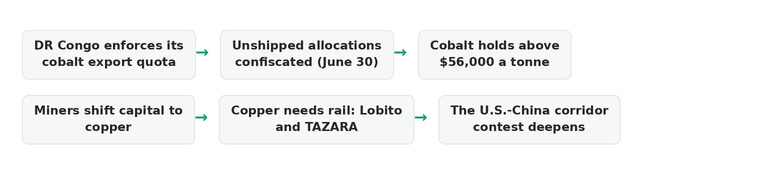
On June 29 Congo’s mining regulator withdrew every unshipped first-half cobalt allocation and moved the volume to the state reserve (Reuters via Kitco, 2026). The quota system caps exports at 96,600 tonnes a year (Benchmark Source, 2026), and it is working: cobalt traded between about $56,000 and $57,300 a tonne at the end of June, up roughly 160% since Congo’s first export block in February 2025 (Trading Economics, 2026; Reuters via Kitco, 2026). Because cobalt is capped and copper is not, one industry report says producers are moving capital into copper (OilPrice, 2026). Copper leaves by rail, and the two routes are being rebuilt with rival money: the U.S.-backed Lobito line, financed with a $553 million loan (U.S. International Development Finance Corporation, 2025; African Business, 2026), and the Chinese-financed $1.4 billion TAZARA rebuild scheduled to start work this year (TanzaniaInvest, 2026). One export rule in Congo is quietly allocating tomorrow’s cargo between an American-backed railway and a Chinese one.
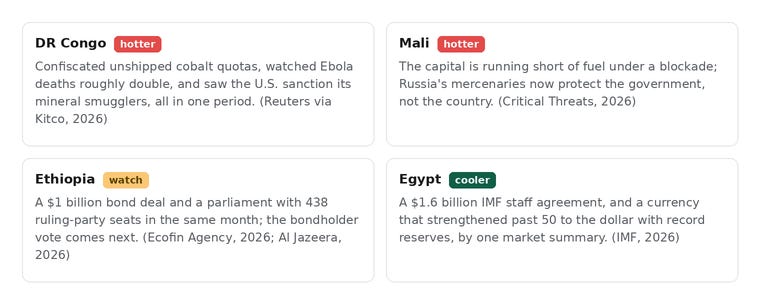
Country movers
What to watch next
El Obeid: whether the expected Rapid Support Forces ground assault lands. The UN calls the atrocity risk imminent; this would be July’s biggest single event. (UN News, 2026)
July 24: the United States decides whether its blanket 10% tariff lapses or is extended, with the AGOA trade preference set to expire December 31, 2026. (Carnegie Endowment, 2026)
Debt follow-through: Ethiopia’s formal bondholder vote, Egypt’s IMF board approval, and whether Côte d’Ivoire or Angola actually sells a new bond into the low-premium market. (Ecofin Agency, 2026; IMF, 2026)
Mali’s western lifeline: whether JNIM escalates against the Kayes corridor, the main import route from Senegal, as it did at the start of July last year. (Crisis Group, 2026)
Ebola: whether WHO situation reports add new health zones beyond Ituri and the Kivus, or the case count levels off as trial vaccines deploy. (World Health Organization, 2026)
The West Africa lean season, the hungry months between harvests, peaks through August with about 52.8 million people projected to be short of food. (FAO, 2026)
Sources
[14] Trading Economics: cobalt price data, accessed 1 Jul 2026. tradingeconomics.com.
[15] OilPrice: “DR Congo’s cobalt miners pivot to copper,” 2026. oilprice.com (accessed 1 Jul 2026).
[23] UN News: “Record drone attacks on El Obeid,” Jun 2026. news.un.org (accessed 1 Jul 2026).
Every material claim is verified to one primary source or two independent reputable sources. Items resting on a single secondary source are stated as such in the text.