

Edition 09 · 2 November 2026 · covering 18 October – 1 November 2026 · ~9 min read · Subscriber edition

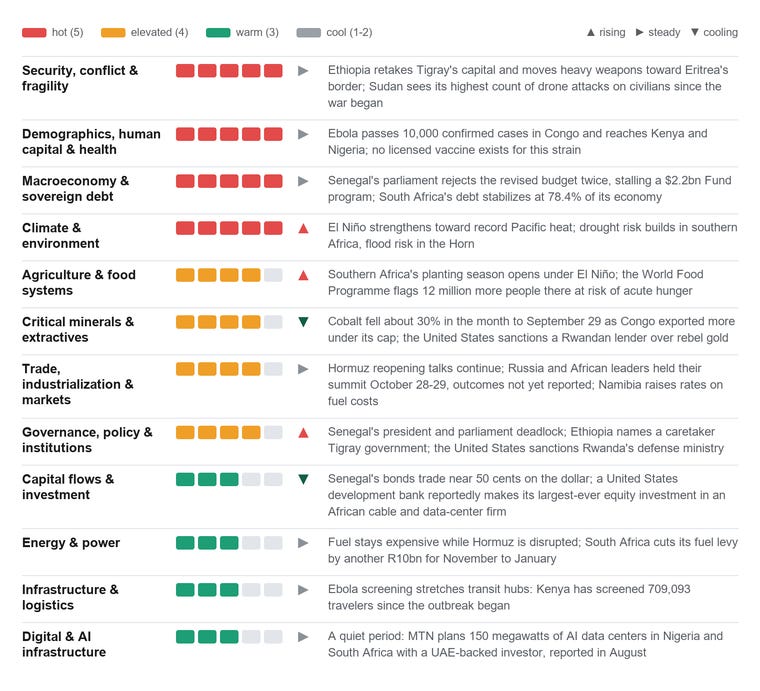
How to read this. We track the African continent as one system across twelve domains, the big moving parts of development. Each gets a heat score from 1 (quiet) to 5 (very active) and a trend arrow (▲ rising · ► steady · ▼ cooling) against our July reading.
The continental read
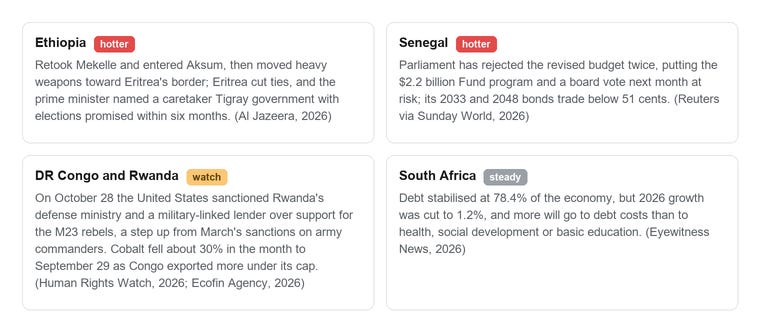
Last time we asked whether money was returning to Africa. The sharper question now is whether the people who made the promises can still keep them. In Senegal, parliament has rejected the revised budget twice, stalling a $2.2 billion rescue program from the International Monetary Fund (Reuters via Sunday World, 2026). South Africa shows the other path: debt has stopped rising at 78.4% of the economy, and the government will table a law in 2027 making debt control a legal duty (Eyewitness News, 2026).
Beneath that, health and war press on the same thin margin. Ebola has passed 10,000 confirmed cases in Congo and reached the capitals of Kenya and Nigeria (World Health Organization, 2026). Ethiopia’s army has retaken Tigray’s capital and moved heavy weapons toward Eritrea’s border (Al Jazeera, 2026). A strengthening El Niño, the Pacific warming that reorders African rainfall, is about to add drought risk in the south. The next month will show which gives first.
The heat map
Where it moved most
Ebola reaches two capital cities, and the warning gap is the danger
No licensed vaccine or treatment exists for this strain, so the only brake is finding every contact of every sick person. That brake is weakest where the fire is largest: 79.7% of contacts were followed up against a 95% target (World Health Organization, 2026). Kenya’s first patient died two days after landing in Nairobi, and four of the next eight infections were health workers. Nigeria’s patient was not confirmed until nine days after seeking care (European Centre for Disease Prevention and Control, 2026). Symptoms can take 21 days to show, so we put roughly two chances in three on both clusters burning out around November 10, and one in four on an undetected chain in a hub city.
The Horn’s wars now run as one system, and drones are the wiring
After retaking Mekelle and entering Aksum, Ethiopian forces moved tanks toward the Eritrean border (Al Jazeera, 2026). The link to Sudan is accusation and hardware: Ethiopia says Eritrea, Sudan and Egypt back Tigray’s rebels, and Sudan and Egypt deny it. In Sudan, drone strikes killed at least 306 people in the first three weeks of October (United Nations News, 2026). A ceasefire between two armies does not close the routes that feed them. Our base case, about three chances in five, is that Ethiopia holds its gains and the fight becomes an insurgency. The worse case, about one in four, is direct fighting with Eritrea.
Senegal’s problem is no longer the hidden debt. It is who has to vote for the fix.
The Fund lends only against a budget that matches its program, so its board vote cannot happen until parliament passes one. Meanwhile growth is forecast at 2.7%, down from about 5%, and the deficit has widened to 7.6% of the economy. The prime minister warns that firms the state already owes will go unpaid if the deadlock drags on (Africa Briefing, 2026). We put the odds near one in two on a November compromise, and one in three on a longer deadlock that forces a missed domestic payment.
Chain of the month
How a closed shipping lane in the Gulf reaches next season’s maize fields in southern Africa.

Talks to reopen the Strait of Hormuz were still under way on November 1 (Al Jazeera, 2026), so fuel and fertilizer stay expensive. Then the dry season arrives: Pacific sea temperatures are forecast to reach record levels from October to December (World Meteorological Organization, 2026), and the World Food Programme has flagged more than 12 million additional people at risk of acute hunger in southern Africa, according to press accounts of its August report (Briefly News, 2026). Relief bills then land on budgets already stretched by debt.
Country movers
What to watch next
Senegal: whether the National Assembly passes an amended budget in November, and whether the Fund sets a board date. (Reuters via Sunday World, 2026)
Ebola: the 21-day contact windows in Nairobi and Abuja close around November 10. (World Health Organization, 2026)
Tigray border: whether Ethiopian heavy weapons lead to fighting, or the call for calm holds. (Al Jazeera, 2026)
East Africa’s rains: forecast wetter than normal from October to December, raising flood risk just as Ebola teams are stretched. (World Meteorological Organization, 2026)
Read the full edition
The subscriber PDF goes further: the full reasoning behind each deep dive with the signs that would confirm or break it, a decision guide for lenders, operators, health planners and governments, a scenario board, notes on Egypt, minerals, capital and digital, a list of what we could not confirm, and all 26 sources. Paid subscribers ($5 a month for all newsletters) can download it here: