

August 2026 · covering 16 June – 3 August 2026 · ~9 min read · Subscriber edition
The continental read
Two decisions this period, one day apart, point in opposite directions:
On 30 June, Ethiopia and its bondholders agreed in principle to swap the country’s defaulted $1 billion bond for a new $880 million note, all but closing the last unresolved African default of the pandemic era [1][2].
On 1 July, the United States told the African Union it will stop paying for the logistics that keep peacekeepers supplied in Somalia when the mission’s mandate ends on 31 December [3][4].
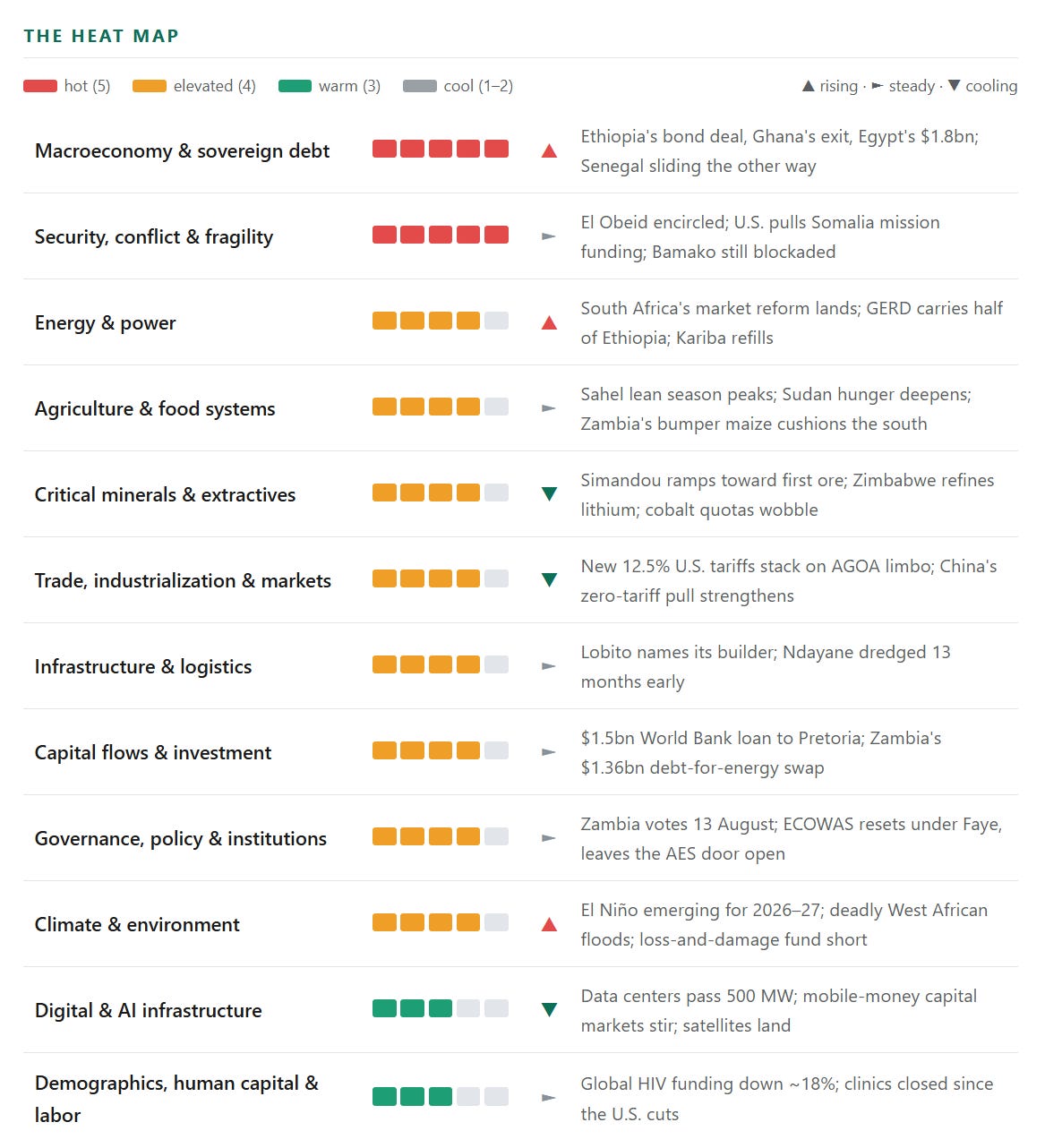
That is the split screen of this edition. The continent’s balance sheet is healing: Ghana finished its $3 billion International Monetary Fund program [5], Egypt unlocked another $1.8 billion [6][7], Nigeria’s reserves crossed $52 billion for the first time in seventeen years [8][9], and Zambia turned $1.36 billion of debt service into an energy fund [10]. At the same time, the external scaffolding is coming down: peacekeeping money withdrawn, trade preferences stuck in the United States Senate five months from expiry [11], new 12.5% tariffs on South Africa and Angola [12][13], global HIV funding down roughly a fifth in a year [14].
China moved the other way, with zero tariffs for 53 African countries since May and first-half trade at a record, per Chinese customs data [15][16]. The middle of Africa’s risk curve is recovering. The tails, from Sudan to the Sahel to Somalia, and now Senegal, are being asked to carry more weight with less help.
Deep dive — macro & debt: the default era winds down
Three exits and one loud entrance
Start in Addis Ababa. Ethiopia’s agreement in principle swaps the defaulted $1 billion bond for an $880 million note maturing in 2029: a 12% haircut, plus payment of roughly $99 million in missed coupons [1][2]. The International Monetary Fund board completed its fifth program review the next day and released $464 million [17]. If the exchange completes, the pandemic wave of African defaults (Zambia, Ghana, Ethiopia) is effectively worked out.
Ghana shows what the far side looks like. On 27 July the Fund completed the sixth and final review of its $3 billion program and Accra asked for a successor policy instrument with no money attached [5]: the sovereign equivalent of leaving the hospital but keeping the physiotherapist. Inflation that touched 54% in 2022 printed 5.3% in June [18]. Egypt cleared its seventh review and drew about $1.8 billion [6][7]. Nigeria is the quiet success: reserves above $52 billion [8][9], inflation easing to 15.91% [19], and a central bank holding at 26.5% rather than declaring victory [20].
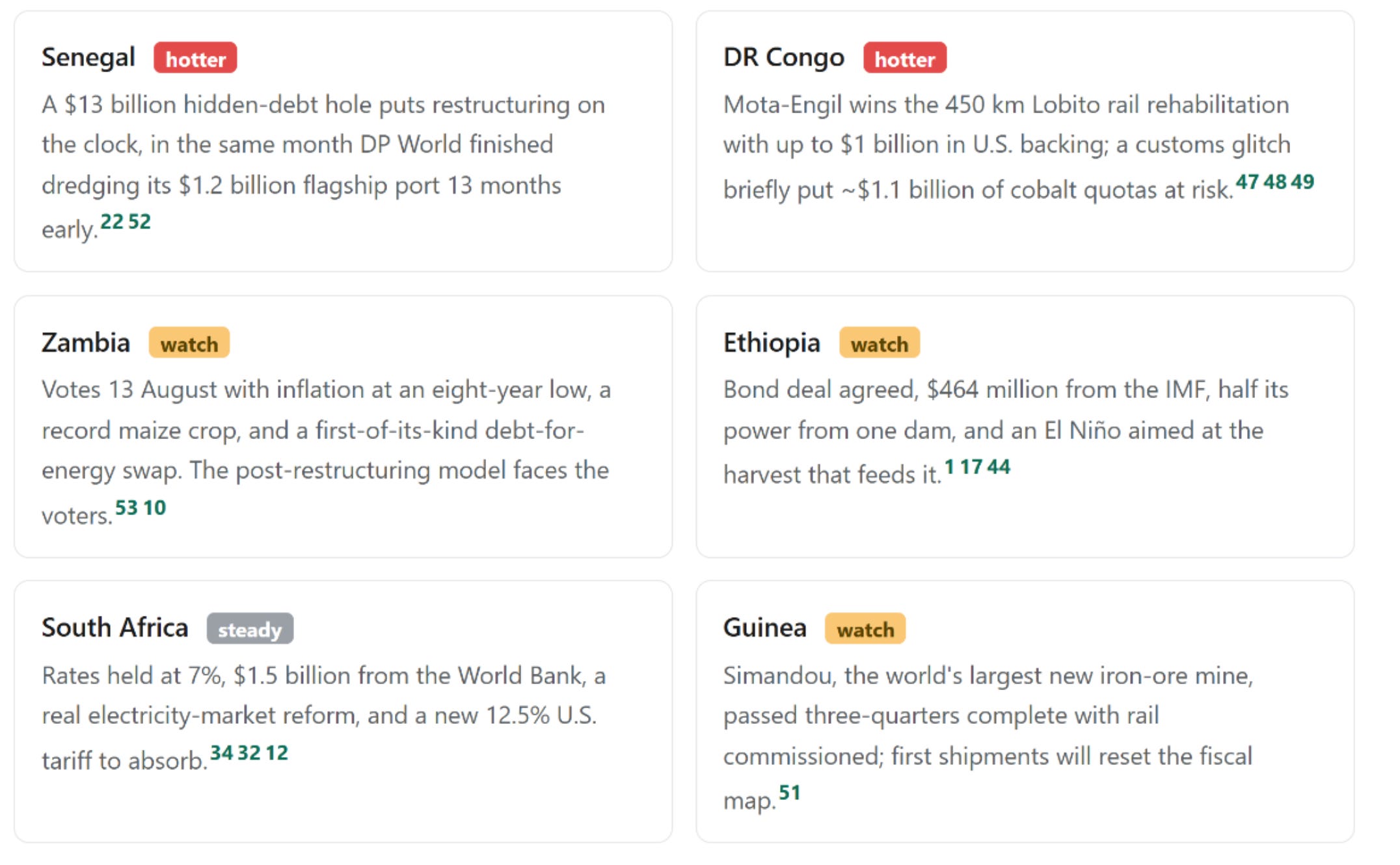
The loud entrance is Senegal. Audits have surfaced roughly $13 billion in previously hidden debt, about a quarter of gross domestic product, and its bonds traded in the 50s during June’s IMF visit, with most investors treating restructuring as a matter of timing [21][22]. Debt is the model’s master gate: distress in one member of the West African currency union raises the cost of money for its neighbors. And with the United States Federal Reserve holding rates again on 29 July [23][24], the external window frontier borrowers were counting on stays only half-open.
Deep dive — security: the bill arrives as the donors leave
A mission defunded, a city encircled
The most consequential letter of the period was short: the United States will end support for the logistics package that supplies the African Union Support and Stabilization Mission in Somalia (AUSSOM) when its mandate expires on 31 December [3][4]. Washington has put roughly $2 billion into African Union missions in Somalia since 2007. The AU called an emergency meeting two days later. No replacement funder has stepped forward, and al-Shabaab is resurgent.
In Sudan, the war’s center of gravity moved. The Rapid Support Forces have encircled El Obeid in North Kordofan, half a million residents plus more than 100,000 displaced people, with sustained drone strikes [25]. The World Food Programme now calls the city the new epicenter of the crisis: 19.5 million Sudanese acutely food insecure, 770,000 at risk of famine, food prices in the besieged city up about 300% [26]. A United Nations fact-finding panel concluded on 9 July that Rapid Support Forces mass killings and rapes amount to genocide [27].
Eastern Congo ran both tracks at once. The peace process kept meeting, and the UN sanctioned six rebel leaders, including coalition coordinator Corneille Nangaa [28]. On the ground, M23 commissioned more than 9,000 newly trained fighters in the same month [29]. Process up; facts on the ground worse. And Bamako entered roughly its tenth month under an economic siege, with regional security assessments describing Mali’s capital as still dependent on escorted fuel convoys [30][31].
Security is one of the model’s three chokepoints: shocks that cross it don’t fade, they spread. A defunded mission in Mogadishu prices risk into every frontier bond; a siege in Kordofan pushes displacement into Chad and Egypt. The domain holds at maximum heat.
Deep dive — energy: the constraint loosens in three places
Reform in Pretoria, a dam in Addis, rain over Kariba
For once, the energy story is mostly good news. South Africa’s cabinet approved the long-delayed Electricity Pricing Policy on 30 July, and President Ramaphosa endorsed the Eskom restructuring roadmap a day later, the framework for an independent grid operator and a competitive wholesale market [32][33]. Paired with a $1.5 billion World Bank loan for energy and freight-logistics reform signed the week before [34], it is the most coherent reform push the sector has had in years.
Ethiopia shows what new supply does. State utility figures put generation at 35,671 gigawatt-hours for the fiscal year just ended, up 21%, with the Grand Ethiopian Renaissance Dam supplying just over half [35]. One dam now carries half the power system of a country of 130 million people. Further south, Lake Kariba, the reservoir behind Zambia and Zimbabwe, held near 47% usable storage in late July, far above last year’s drought lows [36]. Add Zambia’s debt-for-energy swap [10] and Mission 300’s 50 million new connections [37], and the continent’s binding constraint is visibly loosening.
Egypt is the caution. Summer demand above 40 gigawatts has Cairo negotiating a multi-year deal for 15 to 18 liquefied natural gas cargoes a month [38][39], a dollar drain its IMF program has to absorb. Why energy earns a deep dive in a good month: power is a chokepoint. Every megawatt gates something else: the 500 megawatts of data-center capacity now running on the continent [40], Zimbabwe’s new $400 million lithium-sulphate plant [41][42], the smelters every beneficiation law assumes. Loosen the constraint and the effect compounds downstream.
Chain of the month
This one starts in the Pacific Ocean and ends, if it runs, in next year’s food riots. The model says: don’t damp it.
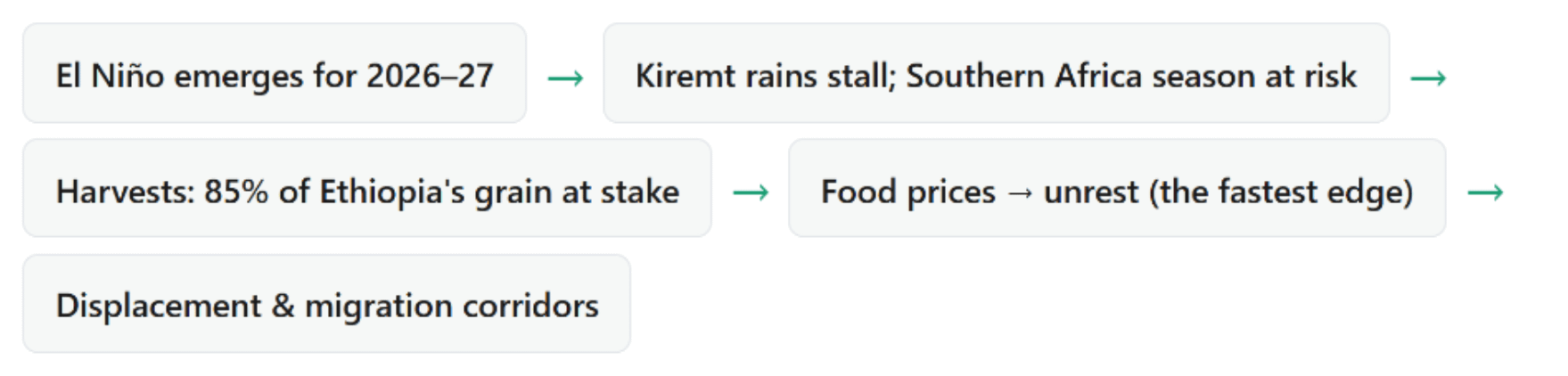
The Famine Early Warning Systems Network (FEWS NET) has an El Niño emerging for the 2026–27 season [43]: Ethiopia’s kiremt rains are already stalling, threatening the meher harvest that supplies over 85% of its grain [44], and Southern Africa is rated high-concern for a poor October-to-March season [43]. Food prices to unrest is the strongest, fastest edge in the transmission map, and it crosses the security chokepoint, so the effect spreads rather than fades. Nothing is in the price data yet; harvests are months away, and Zambia’s record maize crop of nearly 5 million tonnes cushions the region this year [46]. But the chain is armed. Watch the October rains.
Country movers
What to watch
Zambia’s election on 13 August: the first African incumbent to run on a completed post-default restructuring. Watch the margin, and whether it’s accepted. [53]
Who pays for AUSSOM. The United States exit lands 31 December; watch the African Union’s funding scramble and any Gulf or European offer. [3]
Senegal and the IMF: a new program or a restructuring announcement, and the bond-market reaction across the West African currency union. [21]
AGOA’s cliff. The trade preference expires 31 December with reauthorization stuck in the Senate; watch for a fall vote, and whether the new tariff stack makes it moot. [11]
The October rains: the first real El Niño verdict on Southern Africa’s planting season and Ethiopia’s meher harvest assessment. [43]
Cobalt quota enforcement: whether Kinshasa reallocates unused export quotas, and whether prices hold near $57,000 a tonne. [49][50]
Sources
[1] Ecofin Agency — “Ethiopia and Bondholders Reach New Preliminary Deal on $1 Billion Eurobond Restructuring,” 30 Jun 2026 (accessed 3 Aug 2026).
[2] The EastAfrican — “Ethiopia-bondholder debt relief deal wins IMF backing,” 2 Jul 2026 (accessed 3 Aug 2026).
[3] Garowe Online — “African Union holds emergency meeting over U.S. decision to end support for Somalia mission,” Jul 2026 (accessed 3 Aug 2026).
[4] Africa Confidential — “US funding exit threatens future of AUSSOM peacekeeping force,” Jul 2026 (accessed 3 Aug 2026).
[5] IMF — “IMF Executive Board Completes the Sixth Review of Ghana’s Arrangement Under the ECF” (PR 25/260), 27 Jul 2026 (accessed 3 Aug 2026).
[6] IMF — “IMF Staff Reaches Staff Level Agreement on Egypt’s Seventh Review Under the EFF and Second Review Under the RSF” (PR 26/231), 29 Jun 2026 (accessed 3 Aug 2026).
[7] Daily News Egypt — “IMF board approves $1.8bn disbursement for Egypt following seventh review,” 31 Jul 2026 (accessed 3 Aug 2026).
[8] Nairametrics — “External reserves cross $52 billion, surpass CBN’s 2026 forecast,” 22 Jul 2026 (accessed 3 Aug 2026).
[9] Arise TV — “Nigeria’s Foreign Reserves Hit $51.86 Billion, Highest In More Than 17 Years,” 16 Jul 2026 (accessed 3 Aug 2026).
[10] African Development Bank — “African Development Bank Group backs Zambia’s Global Landmark Debt-for-Development swap,” 25 Jun 2026 (accessed 3 Aug 2026).
[11] Ecofin Agency — “Five Months From Expiry, AGOA Is Stuck in the U.S. Senate,” 10 Jul 2026 (accessed 3 Aug 2026).
[12] Engineering News — “SA signals intent to prohibit goods produced by forced labour after new 12.5% US tariff,” 27 Jul 2026 (accessed 3 Aug 2026).
[13] BusinessTech Africa — “US Tariffs Revisited: South Africa and Angola Targeted,” 23 Jul 2026 (accessed 3 Aug 2026).
[14] UNAIDS — “Global HIV response falters as reemergence looms,” 27 Jul 2026 (accessed 3 Aug 2026).
[15] Government of China — “China implements historic zero tariffs for all African nations with diplomatic ties,” 1 May 2026 (accessed 3 Aug 2026).
[16] CGTN — “China-Africa trade hits record 1.41 trln yuan in H1 as imports from Africa surge,” 27 Jul 2026 (accessed 3 Aug 2026; Chinese state media reporting official customs data, stated as such in text).
[17] IMF — “IMF Executive Board Completes the Fifth Review under the ECF Arrangement for Ethiopia” (PR 26/235), 1 Jul 2026 (accessed 3 Aug 2026).
[18] Ghana Statistical Service — Consumer Price Index and inflation, June 2026 release (accessed 3 Aug 2026).
[19] Channels Television — “Nigeria’s Inflation Rate Drops To 15.91% In June,” 15 Jul 2026 (accessed 3 Aug 2026).
[20] Financial Afrik — “Nigeria: Central Bank maintains its key rate at 26.50% to curb inflation,” 22 Jul 2026 (accessed 3 Aug 2026).
[21] Reuters via CNBC Africa — “As IMF visits Senegal, more investors view default as inevitable,” 17 Jun 2026 (accessed 3 Aug 2026).
[22] Bloomberg — “A hidden-debt scandal derails Senegal’s infrastructure dream,” 13 Jul 2026 (accessed 3 Aug 2026).
[23] CNBC — “Divided Fed holds interest rates steady,” 29 Jul 2026 (accessed 3 Aug 2026).
[24] Fox Business — “July FOMC: Fed holds interest rates steady,” 29 Jul 2026 (accessed 3 Aug 2026).
[25] ACLED — “Africa Overview: July 2026,” 6 Jul 2026 (accessed 3 Aug 2026).
[26] World Food Programme — “WFP warns El Obeid is becoming the new epicentre of Sudan’s displacement and hunger crisis,” 17 Jul 2026 (accessed 3 Aug 2026).
[27] Al Jazeera — “UN probe finds mass killings, gang rapes by Sudan’s RSF amount to genocide,” 9 Jul 2026 (accessed 3 Aug 2026).
[28] United Nations — “Security Council 1533 Sanctions Committee Adds Six Individuals and Two Entities to Its Sanctions List” (SC/16416), 17 Jul 2026 (accessed 3 Aug 2026).
[29] Critical Threats Project (AEI) — “Congo War Security Review,” entries of 17–31 Jul 2026 (accessed 3 Aug 2026).
[30] Rio Times — “Mali’s Fuel Blockade Tightens the Siege on Bamako,” 15 Jun 2026 (accessed 3 Aug 2026).
[31] OpsCon Intelligence — “Mali: JNIM’s fuel blockade is strangling Bamako,” 16 Jun 2026 (accessed 3 Aug 2026; blockade status rests on secondary assessments, hedged as such in text).
[32] TimesLive — “Cabinet approves key policies on electricity pricing and market reform,” 30 Jul 2026 (accessed 3 Aug 2026).
[33] IOL — “Ramaphosa endorses Eskom reform plan to pave way for independent grid operator,” 31 Jul 2026 (accessed 3 Aug 2026).
[34] World Bank — “South Africa Infrastructure Modernization and Job Creation Development Policy Loan” (factsheet), 22 Jul 2026 (accessed 3 Aug 2026).
[35] New Business Ethiopia (reporting Ethiopian Electric Power figures) — “Ethiopia Generates 21 Percent More Electricity, Half Generated From GERD,” 1 Aug 2026 (accessed 3 Aug 2026).
[36] Zambezi River Authority — Lake Kariba hydrology data, 21 Jul 2026 (accessed 3 Aug 2026).
[37] World Bank — “Under Mission 300, A New Way of Doing Business Connects Over 50 Million People to Electricity Across Africa,” 16 Jun 2026 (accessed 3 Aug 2026).
[38] LNG Industry (citing Reuters) — “Egypt in talks with energy majors for multi-year LNG supply deal,” 22 Jul 2026 (accessed 3 Aug 2026).
[39] Bloomberg — “Egypt Buys August LNG Cargoes to Meet Summer Power Demand,” 27 Jul 2026 (accessed 3 Aug 2026).
[40] Nairametrics — “Africa’s data centre capacity exceeds 500 MW with 890 MW in pipeline,” 27 Jul 2026 (accessed 3 Aug 2026).
[41] Financial Afrik — “Zimbabwe: Lithium sulfate production plant commissioned in Arcadia for a $400 million investment,” 21 Jul 2026 (accessed 3 Aug 2026).
[42] Capmad — “Arcadia commissions Zimbabwe’s first lithium sulphate plant in a $400 million investment,” Jul 2026 (accessed 3 Aug 2026).
[43] FEWS NET — “El Niño 2026–2027” briefing and topic page, Jun–Jul 2026 (accessed 3 Aug 2026).
[44] FEWS NET — “Ethiopia Food Security Outlook: Peak lean season emerges as El Niño stalls kiremt rains,” 30 Jun 2026 (accessed 3 Aug 2026).
[45] FEWS NET — “West Africa Food Security Outlook, June 2026” (accessed 3 Aug 2026).
[46] Zambia Ministry of Agriculture — “Zambia projected to produce nearly 5 million metric tonnes of maize,” May 2026 (accessed 3 Aug 2026).
[47] Bloomberg — “Congo Taps Portugal’s Mota-Engil to Revive Copper Rail Link,” 13 Jul 2026 (accessed 3 Aug 2026).
[48] Mining.com — “Congo taps Portugal’s Mota-Engil to revive copper rail link,” 13 Jul 2026 (accessed 3 Aug 2026).
[49] Mining Weekly (Reuters) — “Congo cobalt exporters fear losing quotas due to administrative glitch, sources say,” 6 Jul 2026 (accessed 3 Aug 2026).
[50] Investing News Network — “DRC to Reclaim Unused Export Quotas from Cobalt Miners,” Jul 2026 (accessed 3 Aug 2026).
[51] Rio Tinto — “Rio Tinto releases second quarter 2026 production results,” 15 Jul 2026 (accessed 3 Aug 2026).
[52] DP World — “DP World completes dredging ahead of schedule at Senegal’s Port of Ndayane,” Jul 2026 (accessed 3 Aug 2026).
[53] Reuters via CNBC Africa — “Zambia election will put Hichilema’s economic record to the test,” 9 Jul 2026 (accessed 3 Aug 2026).
[54] ECOWAS — “Final Communiqué, 69th Ordinary Session of the Authority of Heads of State and Government,” 19 Jul 2026 (accessed 3 Aug 2026).
[55] Al Jazeera — “US funding cuts deal blow to global HIV treatment: Report” (amfAR survey, AIDS 2026), 21 Jul 2026 (accessed 3 Aug 2026).
Every material claim is verified to one primary source or two independent reputable sources. Items resting on secondary assessments (the Bamako blockade status; Chinese trade data) are stated as such in the text.
Africa Signal is a systems brief from The Critical Post. Method: twelve development domains scored for intensity and direction, with cross-domain effects traced through a causal model. Edition 02 covers 16 June – 3 August 2026. © 2026 The Critical Post.
***