


Edition 03 August 2026 · covering 17 – 31 August 2026 ~9 min read
Subscriber edition
The continental read
The most consequential speech for African borrowers this period was given in Wyoming. On 28 August, United States Federal Reserve Chairman Kevin Warsh told the Jackson Hole symposium that inflation, at 3.7% by the Fed’s preferred measure, is not falling fast enough, and pointedly declined to rule out raising rates [1][2]. Our last edition ended on the opposite hope: a weak July jobs report had markets pricing a friendlier Fed and a reopened issuance window. That window just narrowed again.
The continent’s own institutions had a better two weeks than the global backdrop. Zambia’s electoral commission declared President Hakainde Hichilema re-elected on 18 August [4][5], and six days later a government bond auction that had been undersubscribed before the vote closed 37% oversubscribed [6][7]. The Democratic Republic of Congo and the M23 rebels agreed a roadmap for peace talks in Doha [8][9]. Senegal, by Reuters’ account, moved closer to a new International Monetary Fund (IMF) program [19].
The physical floor is another story. Nigeria’s grid suffered its first collapse of 2026 on 23 August, generation falling to about 700 megawatts from over 4,000 earlier that day [13][14]. Four days later, MTN and Gulf capital announced 150 megawatts of artificial-intelligence data centers for Nigeria and South Africa [15][16]. In Sudan, more than 200,000 people were newly displaced across Kordofan in under a month [11]. The politics steadied this period. The machine underneath, and the war beside it, did not.
The heat map
hot (5)elevated (4)warm (3)cool (1–2)▲ rising · ► steady · ▼ cooling
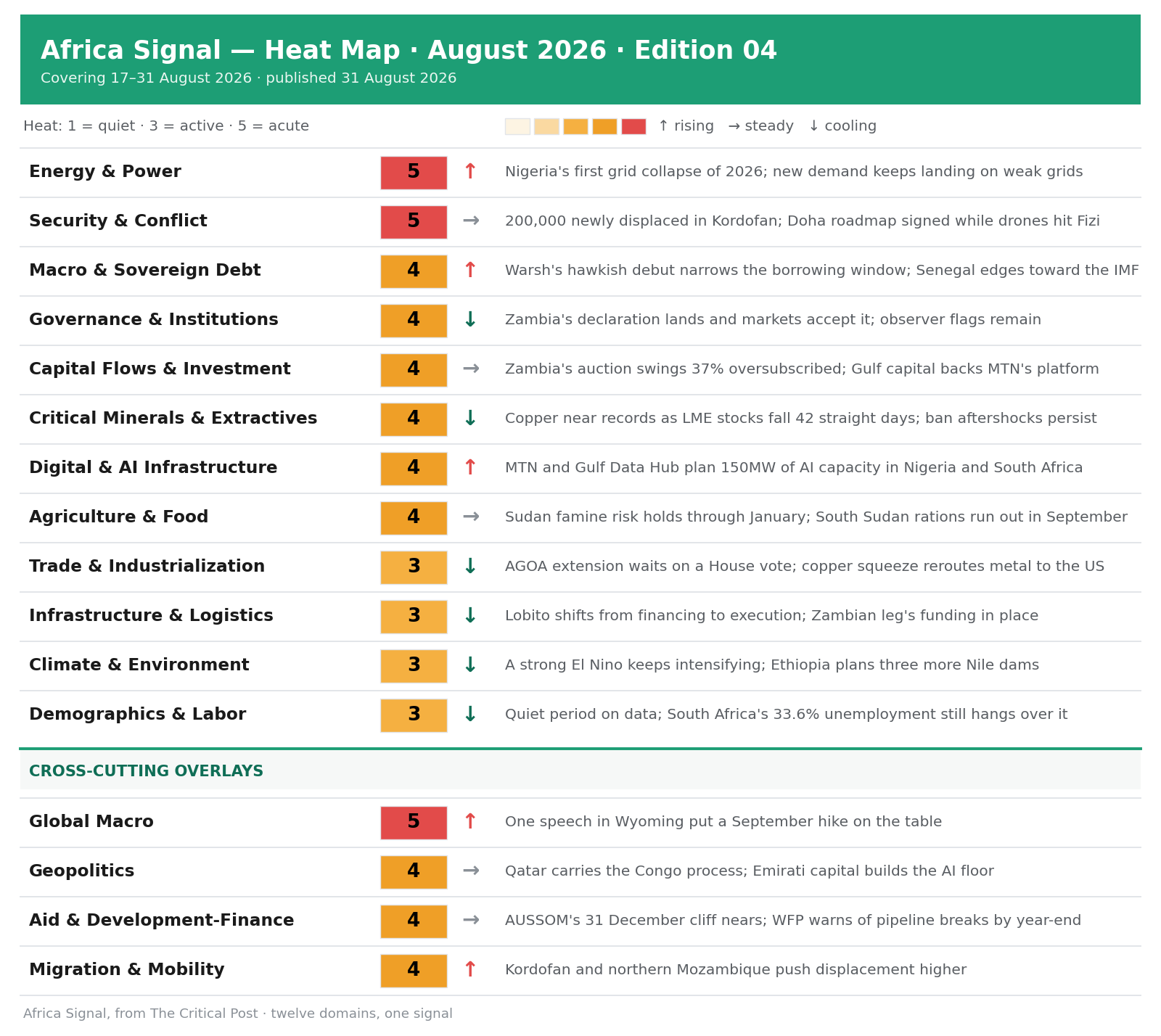
Deep dive — global macro: one speech in Wyoming
The window that didn’t reopen
Kevin Warsh’s first Jackson Hole address as Fed chairman ran directly against what markets wanted to hear. Inflation by the personal consumption expenditures measure stands at 3.7%, and about half the goods and services in the basket are still rising at annualized rates above 3% [1]. His summary line: “I stand here today committed to a discipline, not to a decision.” Analysts read the discipline as hawkish; a rate increase at the 15–16 September meeting is now treated as a live possibility rather than a tail risk [2][3].
For African sovereigns this is the master financial gate swinging shut, the macro chokepoint in this model. Dollar rates set the price of every refinancing on the continent’s calendar, and a Fed debating hikes rather than cuts keeps the Eurobond window narrow into 2027. No African spread data yet captures the shift; the mechanism points one way, and we flag that as a projection rather than a reported fact.
The offset is that the continent’s marginal buyer is changing. Zambia’s post-election auction drew its demand from local and regional investors [6][7]. The capital behind the period’s biggest digital deal is Emirati [15]. And the concessional track still moves: an IMF mission visited Dakar the week of 18 August, with Reuters reporting progress toward a new program to replace the one derailed by Senegal’s hidden-debt scandal [19]. None of that replaces the depth of the dollar market. It does mean a hawkish Fed no longer freezes everything at once.
The practical read for the next two weeks is simple. Any government that was waiting for a cheaper window to refinance will keep waiting, and any issuance calendar penciled in for the autumn is now written in pencil. The 15–16 September meeting is the gate. A hold with dovish language reopens the conversation; a hike, or a hold delivered in Warsh’s Jackson Hole register, pushes the window into next year and raises the value of every alternative channel below.
Deep dive — governance: the count that markets believed
Thirty-seven percent oversubscribed
Zambia’s electoral commission declared Hakainde Hichilema re-elected on 18 August, with roughly 2.97 million votes against 1.86 million for Brian Mundubile [4][5]. The count had been suspended for hours amid attacks on election officials and the theft of marked ballots, and European Union observers flagged campaign violence, intimidation and a biased media environment [4]. Mundubile’s alliance says it has concerns about the process. The declaration nonetheless landed, and the country moved on.
The market’s verdict came six days later. A government bond sale that had gone undersubscribed before the vote drew bids 37% above the amount on offer on 24 August [6][7]. This model’s strongest short-lag edge runs from governance to capital: investors price rule of law before they price copper. It is rare to watch that edge fire this cleanly, one declaration, one week, one swing from no-demand to excess demand.
Two cautions before this becomes a success story. First, acceptance is not the same as legitimacy: the observer findings stand, and the opposition’s window to petition has not closed. Second, the money is betting on continuity of a program that still has to deliver, a million-tonne copper target Zambia is only halfway to at mid-year, and a restructured debt stock that stays sustainable only if growth arrives. The election removed a risk. It did not add a single tonne of copper.
The delivery agenda is at least fully funded on one front. The financing package behind Zambia’s leg of the Lobito rail corridor is now in place, the African Development Bank loan approved in early August and the wider program confirmed this period [30]. With copper trading near record levels [17][18], the second Hichilema term inherits the best external conditions a Zambian government has faced in a decade. That is precisely why the bar for excuses just went up.
Deep dive — security: a roadmap signed under drones
Doha on paper, Fizi on the ground
On 23 August in Doha, the Congolese government and the M23 rebels agreed a roadmap meant to sequence the stalled peace process: prisoner exchanges, a ceasefire verification mechanism, and eventually the restoration of state authority in the east [8][9]. It is the most concrete step since the framework was signed, and Qatar’s mediation is now the load-bearing structure of the whole process.
The ground disagrees with the paper. The Critical Threats Project, which tracks the war in detail, recorded a drone strike on 19 August against a hotel in Fizi hosting senior Congolese coalition officers, attributed to M23 and Rwanda, plus M23 counteroffensives in Kalehe and Masisi and fighting in Walungu and Mwenga for the first time since May [10]. A roadmap signed while medium-altitude drones hunt commanders is a roadmap on probation.
The wider arc bends the same way. The International Organization for Migration (IOM) counted more than 200,000 people newly displaced across Sudan’s Kordofan region in under a month, driven by fighting around besieged El Obeid and by floods [11][12], with famine risk holding through January [24]. Northern Mozambique’s insurgency is displacing more people than at any point in years [20][21]. And Somalia’s African Union mission still faces its 31 December funding cliff with no rescue in sight [22]. Security is a chokepoint in this model: shocks that cross it widen instead of fading. This period the chokepoint produced one genuine opening, in Doha, and it will need to survive the drones.
Chain of the month
This one starts at a podium in Wyoming and ends in the capital-raising plans of a dozen African finance ministries.
A hawkish first speech from the new Fed chairman → dollar rates stay high into 2027 (the global-macro overlay fires) → the Eurobond window narrows (the macro chokepoint) → borrowers lean on local markets, Gulf capital & the IMF → the continent’s creditor mix keeps shifting
The entry shock is a speech, not a policy change, but the global-macro overlay transmits to sovereign balance sheets at strength five, and the macro domain is a chokepoint: the effect passes through undamped. A Fed debating hikes keeps every refinancing expensive and every issuance calendar tentative. The second-order move is the interesting one. This period showed each alternative channel working in miniature: Zambia raising domestic money on post-election confidence [6], Emirati capital funding data centers MTN could not fund alone [15], Senegal working its way back toward the IMF [19]. If the dollar window stays shut through 2027, the lasting effect is not a funding stop. It is a creditor mix that keeps tilting local, Gulf and concessional, and the pricing power that follows.
Country movers
Zambia — watch. Hichilema declared with roughly 61% of the vote; the count’s suspension and observer flags linger; a bond auction swings 37% oversubscribed within a week. [4][6][7]
DR Congo — watch. Agreed a Doha roadmap while a drone strike and M23 advances tested the ceasefire; copper’s record run keeps the stakes of its export policy rising. [8][10][17]
Nigeria — watch. First grid collapse of 2026 dropped generation to about 700 megawatts; the same week brought a 150-megawatt artificial-intelligence data-center plan with Gulf backing. [13][15][16]
Sudan — hotter. More than 200,000 newly displaced across Kordofan in under a month as fighting and floods compound; famine risk holds through January. [11][12][24]
Ethiopia — watch. The Shererina truce holds but forces stay massed; Amnesty warns of renewed risk to Tigray civilians; planning proceeds on three more Nile dams of roughly 5,700 megawatts. [25][26][27]
Senegal — steady. An IMF mission visited Dakar with reported progress toward a new program, the step that would reopen concessional finance after the hidden-debt scandal. [19]
What to watch
The Federal Reserve on 15–16 September: after Warsh’s speech a hike is a live option; either way, African issuance calendars stay frozen until the decision lands. [1][2]
The AGOA House vote: the Senate’s extension of the African Growth and Opportunity Act through 2028 still needs House concurrence, riding a spending bill that funds the United States government to 11 December. [28][29]
The Doha roadmap’s first tests: whether prisoner exchanges and the ceasefire mechanism actually begin, and whether strikes like Fizi’s stop. [8][10]
Zambia’s aftermath: the petition window, and whether the auction demand extends across the local curve and into the kwacha. [6]
September’s food cliff: rations for roughly 240,000 refugees in South Sudan run out without new funding, while Sudan’s famine-risk areas head into the January review. [23][24]
Ethiopia’s meher assessment: the September–October harvest evaluation after the failed kiremt rains, with a strong El Niño intensifying into the 2026–27 season. [31][32]
Sources
[1] US Federal Reserve Board — “Keynote remarks by Chairman Warsh at the 2026 Jackson Hole Economic Policy Symposium,” 28 Aug 2026. federalreserve.gov (accessed 31 Aug 2026).
[2] PBS News — “Warsh raises stakes for Fed’s next meeting, and other takeaways from Jackson Hole conference,” 29 Aug 2026. pbs.org (accessed 31 Aug 2026).
[3] The Washington Post — “Fed chair Warsh, concerned about inflation, says bank may have ‘work to do’,” 28 Aug 2026. washingtonpost.com (accessed 31 Aug 2026).
[4] Al Jazeera — “Hichilema re-elected as Zambia president amid opposition concerns over vote,” 18 Aug 2026. aljazeera.com (accessed 31 Aug 2026).
[5] Associated Press (via The Hill) — “Zambia President Hakainde Hichilema is declared the winner of a second term,” 18 Aug 2026. thehill.com (accessed 31 Aug 2026).
[6] Bloomberg — “Zambia’s Bond Sale Draws Robust Demand After Hichilema Wins Vote,” 24 Aug 2026. bloomberg.com (accessed 31 Aug 2026).
[7] Business Day (Nigeria) — “Zambia bond auction swings from undersubscribed to 37% oversubscribed after election,” Aug 2026. businessday.ng (accessed 31 Aug 2026).
[8] Al Jazeera — “DR Congo, M23 rebels agree on roadmap for peace talks,” 23 Aug 2026. aljazeera.com (accessed 31 Aug 2026).
[9] Africanews (with AFP) — “DRC, M23 agree peace roadmap as Doha talks seek to regain momentum,” 24 Aug 2026. africanews.com (accessed 31 Aug 2026).
[10] Critical Threats Project (AEI) — “Congo War Security Review, August 21, 2026,” 21 Aug 2026. criticalthreats.org (accessed 31 Aug 2026).
[11] International Organization for Migration — “Sudan: 200,000 Newly Displaced as Fighting and Floods Intensify,” 19 Aug 2026. iom.int (accessed 31 Aug 2026).
[12] Al Jazeera — “Over 200,000 people newly displaced in Sudan’s Kordofan as fighting rages,” 20 Aug 2026. aljazeera.com (accessed 31 Aug 2026).
[13] THISDAY — “Discos Embark on Load Shedding as Power Grid Suffers Partial Collapse, Generation Plunges to 1,132MW,” 23 Aug 2026. thisdaylive.com (accessed 31 Aug 2026).
[14] The Guardian (Nigeria) — “National grid suffers first collapse of 2026, generation falls to zero,” 24 Aug 2026. guardian.ng (accessed 31 Aug 2026).
[15] Bloomberg — “UAE Tycoon Al Ashram, MTN Agree to Build Africa AI Data Centers,” 27 Aug 2026. bloomberg.com (accessed 31 Aug 2026).
[16] Capacity — “MTN targets 150MW of AI data centre capacity in Nigeria and South Africa with Tarek Al Ashram’s UAE-based investment platform,” 27 Aug 2026. capacityglobal.com (accessed 31 Aug 2026).
[17] Bloomberg — “Copper Market Squeeze Intensifies as More Metal Is Shipped to US,” 17 Aug 2026. bloomberg.com (accessed 31 Aug 2026).
[18] Mining.com — “Copper price holds near record as London warehouse bidding war looms,” 14 Aug 2026. mining.com (accessed 31 Aug 2026).
[19] Reuters (via TimesLIVE) — “IMF visit Senegal this week reflects progress towards new programme,” 18 Aug 2026. timeslive.co.za (accessed 31 Aug 2026).
[20] Al Jazeera — “Why northern Mozambique’s surging violence is worsening displacement crisis,” 26 Aug 2026. aljazeera.com (accessed 31 Aug 2026).
[21] ACLED — “Mozambique Conflict Monitor Update: August 2026,” 5 Aug 2026. acleddata.com (accessed 31 Aug 2026).
[22] Mada Masr — “As US funding cut for AU mission looms, Somalia faces reckoning it isn’t ready for,” 19 Aug 2026. madamasr.com (accessed 31 Aug 2026).
[23] WFP/UNHCR — “Joint News Release: Refugees in South Sudan Face Extreme Hunger as Funds Run Out,” 14 Aug 2026. wfp.org (accessed 31 Aug 2026).
[24] FEWS NET — “Conflict and poor rainfall to drive Emergency and risk of Famine through January” (Sudan Key Message Update), late Jul 2026. fews.net (accessed 31 Aug 2026).
[25] Vanguard (AFP) — “Clashes end between Ethiopia and Tigray rebels,” 2 Aug 2026. vanguardngr.com (accessed 31 Aug 2026).
[26] Amnesty International — “Ethiopia: Tigray residents at renewed risk of human rights violations as violence returns to the region,” Aug 2026. amnesty.org (accessed 31 Aug 2026).
[27] Al Jazeera — “After GERD, can Egypt shape Ethiopia’s next Nile dams?,” 21 Aug 2026. aljazeera.com (accessed 31 Aug 2026).
[28] Ecofin Agency — “Africa’s duty-free access to the U.S. now rides on a spending bill,” 13 Aug 2026. ecofinagency.com (accessed 31 Aug 2026).
[29] GovTrack (US Senate record) — “H.R. 6500: AGOA Extension Act — Senate Vote #228,” 8 Aug 2026. govtrack.us (accessed 31 Aug 2026).
[30] Railway Gazette International — “Financing backs Zambia’s participation in the Lobito Corridor programme,” 17 Aug 2026. railwaygazette.com (accessed 31 Aug 2026).
[31] WMO — “Strong El Niño expected to intensify,” 31 Jul 2026. wmo.int (accessed 31 Aug 2026).
[32] FEWS NET — “Seasonal Forecast Review,” August 2026. fews.net (accessed 31 Aug 2026).
Every material claim is verified to one primary source or two independent reputable sources. Single-source items are attributed in the text: the Fizi drone strike and front-line detail rest on Critical Threats Project tracking, and Senegal’s IMF progress on Reuters reporting. The effect of Warsh’s speech on African spreads is a model projection, flagged as such, not a reported fact.
Africa Signal is a systems brief from The Critical Post. Method: twelve development domains scored for intensity and direction, with cross-domain effects traced through a causal model. Edition 04 covers 17 – 31 August 2026. © 2026 The Critical Post.
***