

The continental read
The coin flip landed on a hike. On 16 September the Federal Reserve raised its benchmark rate a quarter point to a range of 3.75 to 4 percent, its first increase since 2023, and the vote was unanimous[1][2]. Eight days earlier, Brent crude had crossed $100 a barrel as strikes between the United States and Iran escalated around the Strait of Hormuz[3][4].
Those are the two prices that discipline every African budget: the cost of dollars and the cost of oil. This period, both went up. Last edition’s reopened doors now swing against the wind. Nigeria’s record N2.15 trillion refinery listing was approved on 4 September[12][13], FTSE Russell’s index re-entry lands on the 21st[15], and Ghana wants domestic investors to fund its cocoa harvest starting this week[24]. Every one of those trades just got repriced.
And the weather system behind last edition’s warnings now has a name. On 14 September, US National Oceanic and Atmospheric Administration (NOAA) data showed the Pacific warming past the two-degree threshold: a super El Niño, potentially among the strongest on record, running into early 2027[21]. A war is moving the money. The ocean is moving the food. The continent sits downstream of both.
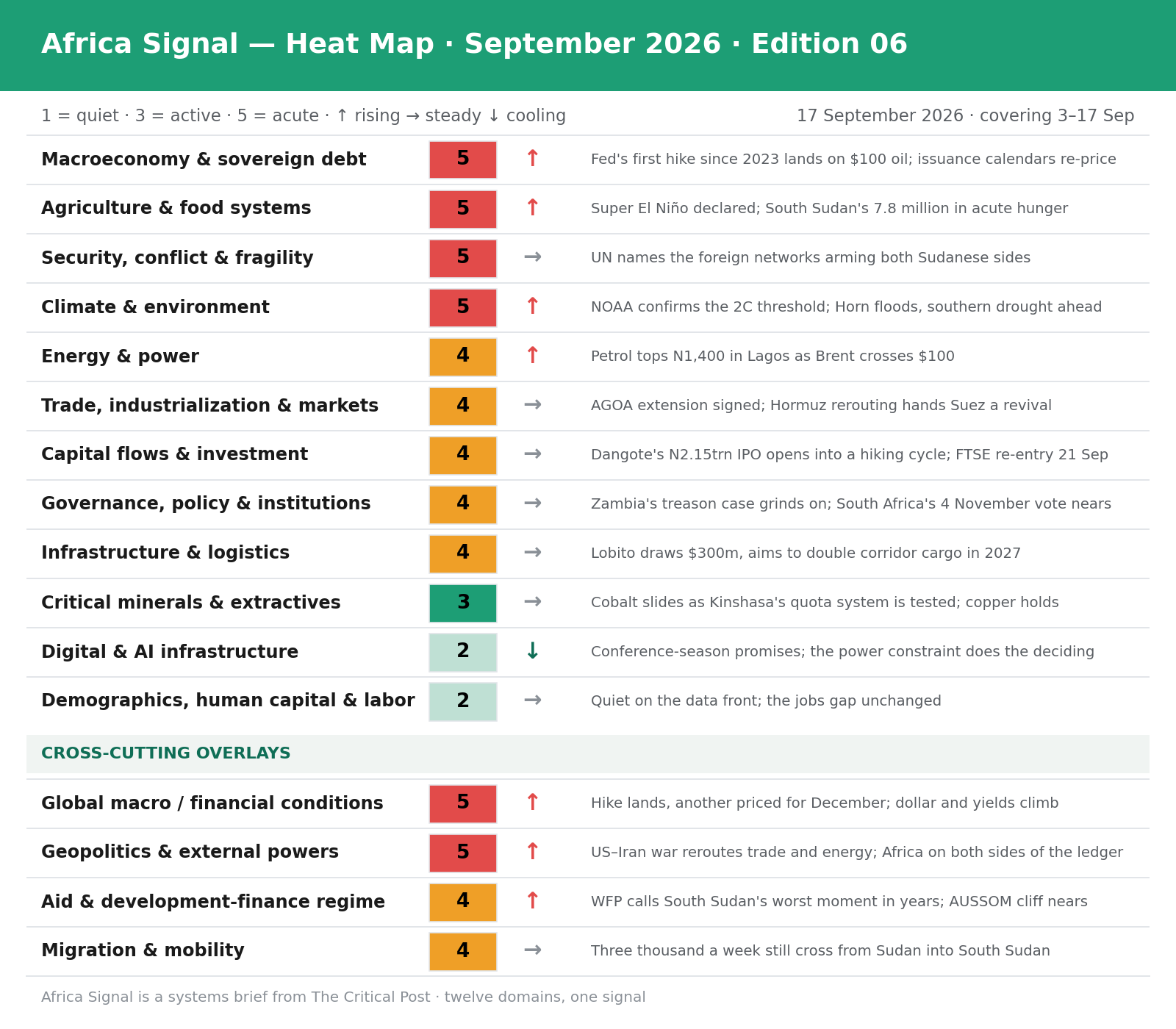
The heat map
Deep dive — macro: the squeeze arrives twice
Dearer dollars meet dearer oil
The Federal Reserve’s 25-basis-point rise to 3.75–4 percent came with no dissents and no comfort: the committee’s own projections point to a year-end rate between 4.1 and 4.4 percent, and markets now price another quarter-point in December[1][2]. For African borrowers, the number matters less than the direction. A hiking cycle re-prices every refinancing calendar on the continent at once.
In this model, the macro domain is the master gate: dollar shocks enter there and pass through nearly undamped. The mechanics run in a familiar order. Yields rise, frontier issuance windows narrow, and the hard-won rehabilitation stories of the past two editions, Senegal’s supervised way back[33], Nigeria’s index re-entry[15], suddenly matter more, because concessional and index-driven money is what still moves when market money stops.
The oil price is the second jaw of the squeeze, and it splits the continent in two. Brent above $100 hands Nigeria, Angola, Algeria and Libya a paper windfall[3][17]. It hands everyone else a bigger import bill in a dearer dollar: fuel, fertilizer, freight, all at once.
South Africa showed what the crossfire looks like first. The economy shrank 0.2 percent in the second quarter, ending what Bloomberg had flagged as its longest growth run in a decade, with the war’s trade disruption named in the data[5][6]. That contraction predates the hike. The third quarter gets both.
The honest counterpoint is that the real economy didn’t stop to watch. The African Growth and Opportunity Act (AGOA) extension was signed into law on 2 September, restoring the duty-free horizon exporters had waited on[7][8]. The Lobito railway drew $300 million from its financing package and says it will double corridor cargo next year[27][28]. Even Kinshasa’s cobalt quota system got its first real market test, with Bloomberg reporting prices sliding rather than spiking[26]. Rate cycles set the financing weather. They don’t lay the track.
The honest flag: no African eurobond spread data crossed the wire in this period’s scan, so the frozen-window read is the model’s projection from the mechanism, not yet a reported fact. The October Federal Reserve meeting on the 27th and 28th is the next gate.
Deep dive — climate: the ocean crosses two degrees
A super El Niño, and two different Africas
NOAA’s 14 September data confirmed what last edition could only call “strengthening”: the equatorial Pacific has warmed more than 2C above normal, the informal threshold for a super El Niño, with peak intensity expected by early 2027[21]. The European Commission’s Joint Research Centre had already tied this event to crop failures in East Africa and named Southern Africa’s coming season as the next at risk[22].
The continental effect is not one drought. It’s a split. The Intergovernmental Authority on Development’s climate center puts a 90 percent probability on wetter-than-usual October-to-December rains across southern Ethiopia, Somalia and northeastern Kenya, regions that draw up to 70 percent of their annual rain from that one season: a flood forecast, in the Horn[21]. The South African Weather Service expects the opposite, below-normal rain and above-normal heat, exactly as Southern Africa’s maize belt plants its 2026-27 crop[21][22].
The World Food Programme (WFP) now estimates the event could push 49 million more people into acute hunger by the end of 2027, with Eastern and Southern Africa taking the largest share[21]. In South Sudan it isn’t a forecast. Some 7.8 million people, over half the country, already face acute food insecurity, another million could lose assistance by October as funding collapses, and 3,000 people a week still arrive from Sudan[19][20].
West Africa’s version of this story is priced in francs and cedis. Last edition’s chain ended at the farm gate, and the farm gate has now answered: Côte d’Ivoire opened its season holding the price at 1,200 CFA francs a kilogram even with world cocoa above £4,800 a ton[25], while Ghana proposes a 6 percent rise that would leave its farmers earning roughly 76 percent more than their Ivorian neighbours, an open invitation to smugglers[23][24]. Ghana still has to find the 16.3 billion cedis to pay for it[24].
The model’s fastest edge runs from climate to agriculture, and its hardest chokepoint sits one step further on, where food prices meet the street. The place to watch that chokepoint first is Southern Africa’s planting window over the next eight weeks: rainfall there decides whether the 2027 story is a flood year in the Horn or a hunger year everywhere south of the Zambezi.
Deep dive — security: a war with foreign logistics
The UN names Sudan’s supply chains
On 3 September, the United Nations Fact-Finding Mission on Sudan said plainly what reporting had circled for a year: both sides of the war are being armed and staffed through transnational networks. The mission documented roughly 2,000 former Colombian military contractors operating combat drones and advanced weapons alongside the Rapid Support Forces (RSF), supplied through routes running via Chad, southeastern Libya and Somalia, with private entities from Colombia and the United Arab Emirates in the chain[18].
The mission’s case studies carry the human arithmetic. An RSF drone strike on Kalogi, in South Kordofan, killed 114 people, around 60 of them children. An army strike on Ad-Da’ein in East Darfur killed at least 70 and destroyed a major hospital[18]. El Obeid’s infrastructure has been degraded by repeated drone attacks since mid-year[18].
The analytical point matters beyond Sudan. Wars burn out when they exhaust local resources. A war with foreign logistics doesn’t exhaust; it resupplies. That is why this model treats security as an amplifier rather than a normal domain, and why Sudan’s heat stays at the ceiling even in a period when neither side took a major city.
The spillover is the migration overlay’s steadiest number: those 3,000 weekly arrivals into a South Sudan that can no longer feed the refugees it has[19]. Watch whether any Security Council member moves against the named supply routes. Documentation without enforcement is how this war has been fed since 2023.
Chain of the month
This one starts in the Strait of Hormuz and ends at a Lagos filling station.
US–Iran strikes close in on Hormuz → Brent crosses $100; container lines reroute → Suez traffic and toll revenue revive in Egypt → Import bills and pump prices jump continent-wide → The fuel-price unrest channel goes on watch.
The entry shock is the geopolitics overlay, and overlays amplify rather than damp. This chain then crosses two of the model’s three chokepoints, the macro gate and the energy constraint, so the effects don’t halve as they travel. The strangest link is the second one: shipping lines pulling out of Hormuz have pushed traffic back toward the Suez Canal, whose toll revenue climbed last quarter and whose authority now forecasts 20 percent more transits, a war dividend for the same Egypt that spent two years losing canal income to the Red Sea crisis[9][10][11]. The last link is the one to respect. Petrol in Lagos passed N1,400 a litre this period even as the state’s oil revenue swelled[16][17]. Budgets feel windfalls slowly; streets feel pump prices immediately. History says watch the streets.
Country movers
Nigeria (watch) — The SEC approves Dangote’s N2.15 trillion refinery IPO at N525 a share, FTSE re-entry lands 21 September, and petrol tops N1,400 as the state’s oil take swells.[12][14][13][16]
Egypt (hotter) — The Hormuz crisis reroutes container traffic back through Suez: canal revenue climbing and transits forecast to rise 20 percent.[9][10]
Ghana (watch) — Cocobod proposes a 6 percent cocoa price rise and asks pension funds and banks for 16.3 billion cedis before the season opens; the arithmetic doesn’t yet close.[23][24]
South Africa (watch) — A 0.2 percent second-quarter contraction ends the decade’s longest growth run just as campaigning starts for the 4 November municipal vote.[5][6]
South Sudan (hotter) — WFP calls this the most dangerous humanitarian moment in years: 7.8 million in acute hunger, a million more may lose aid by October.[19][20]
Zambia (watch) — The treason case against the election runner-up grinds on with no trial date set; the detained challenge their custody from Mukobeko maximum security prison.[29][30]
What to watch
Nigeria’s double test from 21 September: the FTSE Russell re-entry takes effect and the Dangote book builds. The first clean read of frontier appetite inside a hiking cycle.[12][15]
The Federal Reserve’s 27–28 October meeting: another quarter-point is partly priced; the December projection decides whether this is a correction or a cycle.[1][2]
The IMF Executive Board on Senegal: board approval and the first disbursement, now worth more with market windows narrowing.[33]
Ghana’s cocoa raise: whether the finance minister signs the 6 percent price and whether the 16.3 billion cedi securities find buyers as purchases begin.[23][24]
The rains, both kinds: the Horn’s flood-risk October-to-December season and Southern Africa’s planting rainfall, the two ends of the super El Niño.[21][22]
Somalia’s 31 December funding cliff for the African Union mission; one outlet reports a US offer of a twelve-month drawdown for the UN support office, unconfirmed.[31][32]
Sources
[1] Advisor Perspectives — “Fed’s Interest Rate Decision: September 16, 2026,” 16 Sep 2026. advisorperspectives.com (accessed 17 Sep 2026).
[2] CNBC — “Fed rate decision September 2026: Rates rise to 3.75%-4%,” 16 Sep 2026. cnbc.com (accessed 17 Sep 2026).
[3] CNBC — “Brent crude tops $100 as U.S.-Iran tit-for-tat strikes stoke oil supply worries,” 9 Sep 2026. cnbc.com (accessed 17 Sep 2026).
[4] CNBC — “Oil rises to $99 on report Iran launched second undisclosed attack on U.S. Navy ships,” 8 Sep 2026. cnbc.com (accessed 17 Sep 2026).
[5] Reuters — “South African economy contracts in second quarter, reflecting Iran war impact,” Sep 2026. investing.com (accessed 17 Sep 2026).
[6] Bloomberg — “South Africa’s Economy Seen Ending Longest Growth Run in Decade,” 7 Sep 2026. bloomberg.com (accessed 17 Sep 2026).
[7] The White House — “Congressional Bill H.R. 6500 Signed into Law,” 2 Sep 2026. whitehouse.gov (accessed 17 Sep 2026).
[8] Semafor Africa — “US-Africa trade pact extended,” 2 Sep 2026. semafor.com (accessed 17 Sep 2026).
[9] Bloomberg — “Suez Canal Revival Gathers Pace as Hormuz Crisis Reroutes Ships,” 8 Sep 2026. bloomberg.com (accessed 17 Sep 2026).
[10] Al Manassa — “Suez Canal forecasts 20% rise in ship traffic despite Iran conflict,” Sep 2026. almanassa.com (accessed 17 Sep 2026).
[11] Lloyd’s List — “Iran attacks prompt Red Sea rethink as box shipping exits Strait of Hormuz,” Sep 2026. lloydslist.com (accessed 17 Sep 2026).
[12] TheCable — “Dangote refinery secures SEC approval for IPO, sets price at N525/share,” 4 Sep 2026. thecable.ng (accessed 17 Sep 2026).
[13] THISDAY — “SEC Approves Dangote Refinery IPO at N525 Per Share,” 5 Sep 2026. thisdaylive.com (accessed 17 Sep 2026).
[14] Vanguard — “Dangote Refinery unveils N2.15trn IPO at N525 per share,” Sep 2026. vanguardngr.com (accessed 17 Sep 2026).
[15] Nairametrics — “FTSE Russell lists Dangote Cement, First HoldCo, MTN, Zenith, others in Frontier Index Series,” 3 Sep 2026. nairametrics.com (accessed 17 Sep 2026).
[16] Nairametrics — “Petrol rises above N1,400/litre as crude oil climbs past $100 per barrel,” 13 Sep 2026. nairametrics.com (accessed 17 Sep 2026).
[17] Vanguard — “Oil above $100, Nigeria faces revenue windfall, fuel price risks,” Sep 2026. vanguardngr.com (accessed 17 Sep 2026).
[18] OHCHR — “Sudan: External support networks are fuelling conflict and civilian harm, UN Fact-Finding Mission warns,” 3 Sep 2026. ohchr.org (accessed 17 Sep 2026).
[19] UN News — “’Super El Niño’ deepens hunger crisis in South Sudan – WFP,” 15 Sep 2026. news.un.org (accessed 17 Sep 2026).
[20] World Food Programme — “As Needs Surge and Funding Collapses, South Sudan Faces Its Most Dangerous Humanitarian Moment in Years,” 15 Sep 2026. wfp.org (accessed 17 Sep 2026).
[21] Al Jazeera — “El Niño reaches super status: Where will it bring rain, drought and heat?” (NOAA, IGAD and South African Weather Service data), 15 Sep 2026. aljazeera.com (accessed 17 Sep 2026).
[22] European Commission Joint Research Centre — “El Niño drives crop failure in Central America and East Africa and threatens the next season in Southern Africa, East Africa, Western South America, and Southeast Asia,” 3 Sep 2026. joint-research-centre.ec.europa.eu (accessed 17 Sep 2026).
[23] Bloomberg — “Ghana Plans 6% Cocoa Price Hike, Risking More Ivorian Smuggling,” 9 Sep 2026. bloomberg.com (accessed 17 Sep 2026).
[24] Ecofin Agency — “Ghana wants local investors to finance a cocoa price it has not yet explained,” 11 Sep 2026. ecofinagency.com (accessed 17 Sep 2026).
[25] CNBC Africa (Reuters) — “Ivory Coast sets cocoa farmgate price at 1,200 CFA francs per kg for 2026/27 main crop, official says,” 1 Sep 2026. cnbcafrica.com (accessed 17 Sep 2026).
[26] Bloomberg — “Cobalt Prices Slide as Congo’s Export Quotas Test Market Controls,” 4 Sep 2026. bloomberg.com (accessed 17 Sep 2026).
[27] Bloomberg — “Lobito Corridor to Double Minerals Cargo After $300 Million Draw,” 11 Sep 2026. bloomberg.com (accessed 17 Sep 2026).
[28] MINING.COM — “Lobito corridor to double minerals cargo after $300 million draw,” 11 Sep 2026. mining.com (accessed 17 Sep 2026).
[29] Lusaka Times — “Mundubile, Zulu Remain In Mukobeko As Treason Case Proceeds,” 4 Sep 2026. lusakatimes.com (accessed 17 Sep 2026).
[30] Lusaka Times — “Treason Trial Date Still Unset As Custody Petition Reaches Court,” 13 Sep 2026. lusakatimes.com (accessed 17 Sep 2026).
[31] The EastAfrican — “US funding exit casts doubt on AU peace mission in Somalia,” Aug 2026. theeastafrican.co.ke (accessed 17 Sep 2026).
[32] The Somali Digest — “US Reportedly Offers a Twelve-Month UNSOS Drawdown After December,” Sep 2026. thesomalidigest.com (accessed 17 Sep 2026).
[33] International Monetary Fund — “IMF Reaches Staff-Level Agreement on an Extended Credit Facility Arrangement with Senegal” (Press Release 26/282), 1 Sep 2026. imf.org (accessed 17 Sep 2026).
Every material claim is verified to one primary source or two independent reputable sources. Single-source items are attributed in the text: the reported twelve-month UNSOS drawdown offer rests on one outlet and is flagged as unconfirmed. The AGOA extension’s signature rests on the White House record of H.R. 6500’s signing alongside congressional passage reporting. The frozen-issuance effect of the Fed hike is a model projection from the mechanism, flagged as such, not yet a reported fact. Ghana’s cocoa financing figures rest on Ecofin Agency’s reporting of Cocobod’s plan, and Zambia’s case-status details rest on Lusaka Times courtroom reporting.
Africa Signal is a systems brief from The Critical Post. Method: twelve development domains scored for intensity and direction, with cross-domain effects traced through a causal model. Edition 06 covers 3 – 17 September 2026. © 2026 The Critical Post.
***