

Edition 01 June 2026 · covering ~16 May–18 June 2026 ~9 min read Subscriber edition
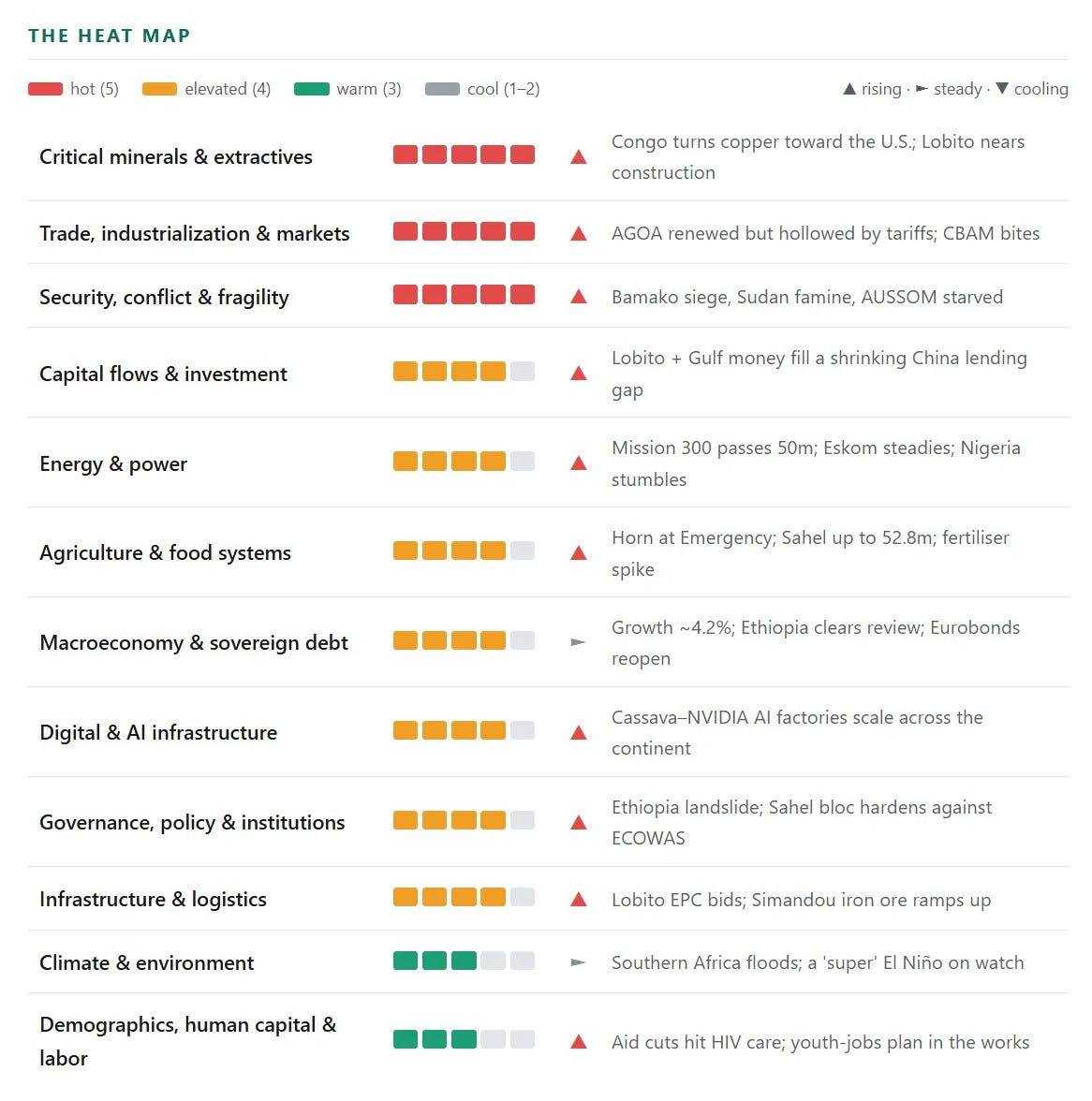
How to read this. We track the African continent as one system across twelve domains — the big moving parts of development, from money and minerals to food and security. Each gets a heat score from 1 (quiet) to 5 (very active) for the period, plus a trend arrow (▲ rising · ► steady · ▼ cooling). The edition leads with what moved most, then traces how a shock in one domain travels into others. Every claim links to its source; the full list is at the end.
The continental read
Last month’s pattern was a retreat and a reach — Washington pulling back from Africa while reaching in hard for its minerals. This month both halves hardened into something you can put a date on.
The reach became law. On 8 June the U.S. House of Representatives passed the Critical Mineral Dominance Act, which lets the government take equity stakes in mines, co-finance them, and claim first call on what allied projects produce — the legal machinery behind a year of African deal-making (Mining.com, 2026). Congo’s cobalt sits at the center: exporters have until 30 June to ship their allotted tonnes or forfeit them to a state reserve (Mining Technology, 2026), and a U.S.-backed venture is circling a 40% stake in Glencore’s Congolese copper and cobalt (Mining.com, 2026).
The retreat became a map redrawn. In Mali, a Tuareg-and-jihadist alliance has taken the entire north — Kidal, Tessalit, Aguelhok — in the largest offensive since 2012, and Russia’s Africa Corps has fallen back to ring the capital rather than hold the desert (CNN, 2026).
Underneath runs a third story the headlines miss: the bill for last year’s aid cuts is coming due. Congo is fighting an Ebola outbreak with no vaccine — 837 cases, 196 dead — even as it is being courted for its copper (World Health Organization, 2026). The continent is being priced, fought over, and quietly destabilized at the same time.
The heat map
Deep dive — critical minerals: the push becomes a law
Washington writes its mineral strategy into statute
For a year the U.S. drive for African minerals ran on deals and memos. This month it got a rulebook. On 8 June the House passed the Critical Mineral Dominance Act — bipartisan, by voice vote — authorizing the government to take equity, co-finance projects, and secure first claim on the output of allied mineral ventures abroad (Mining.com, 2026). It still needs the Senate, but it turns a scramble of one-off agreements into a standing policy. The backdrop: the U.S. imports all of its supply of at least eleven critical minerals.
Congo is the test case. Under an export-quota system that has kept cobalt prices high, exporters must ship their first-half allocation by 30 June or lose it to a national reserve (Mining Technology, 2026). At the same time, a U.S.-backed mining house — drawing on the U.S. development-finance arm and Gulf capital — is in early talks for a 40% stake in Glencore’s Congolese copper and cobalt, a potential consolidation of the copperbelt (Mining.com, 2026). The minerals-for-security framework Washington and Kinshasa signed late last year is still being turned into actual investment (Mining Technology, 2026).
Others are playing the same hand. Kenya is courting a U.S. deal to process rare earths and graphite at home, and Zimbabwe is accelerating a ban on exporting raw lithium concentrate to force battery-grade refining onshore (AllAfrica, 2026). The contest is no longer over who digs. It is over who refines — and now one side has written that ambition into law. (Followed in depth in our sister brief, AI Signal.)
Deep dive — security: Mali’s north falls, and Russia trades ground for the capital
A rebel alliance takes the north; the mercenaries fall back
Since late April, an alliance of Tuareg separatists and an al-Qaeda affiliate has overrun northern Mali — capturing Kidal, the Tessalit garrison, and Aguelhok, and pressing on Gao — in the widest offensive since the 2012 rebellion (Al Jazeera, 2026). Russia’s Africa Corps, the junta’s main security partner, withdrew from the north — jeered out of Kidal — and has consolidated around Bamako to protect the regime rather than fight for the desert (CNN, 2026). It is now striking from the air the towns it could not hold on the ground (Africa Defense Forum, 2026).
The pattern repeats wherever outside support thins or shifts. In Sudan, the paramilitary Rapid Support Forces are massing for a ground assault on El Obeid, the gateway to the Kordofan region, after days of drone strikes on its fuel depots and army base (Sudan Tribune, 2026). In eastern Congo, army-versus-M23 fighting grinds on near Goma despite a U.S.-brokered peace track, including a June drone strike at Kibati (Critical Threats, 2026). And on Lake Chad, Boko Haram killed 23 Chadian soldiers in a single island raid (Al Jazeera, 2026).
The thread is uncomfortable. Russia’s mercenary model is buckling at exactly the moment the U.S. is signing mineral contracts over the same ground. The supply chains and the security that is supposed to protect them are pulling apart — and the gap is where the armed groups move.
Deep dive — health & people: the aid cuts come back as a body count
A vaccine-less Ebola outbreak meets a hollowed-out system
The most under-covered emergency of the month is in northeastern Congo, where an Ebola outbreak — the Bundibugyo strain, for which there is no licensed vaccine or treatment — has reached 837 confirmed cases and 196 deaths, concentrated in Ituri province (World Health Organization, 2026). An international coalition fast-tracked funding for three candidate vaccines on 1 June, but none is ready (UN News, 2026).
It lands on a system already cut to the bone. The first public update on the U.S. global HIV program in sixteen months showed roughly a 30% funding drop and falling testing, with models projecting hundreds of thousands of additional infections (Healthbeat, 2026). Cholera deaths across Africa nearly doubled in 2025, to about 7,500 (Center for Global Development, 2026), and the UN children’s agency reports a 72% gap in nutrition funding (UNICEF, 2026).
This is the cost that never showed up on the savings ledger. New research ties last year’s U.S. aid withdrawal to a measurable rise in conflict events across the continent (Center for Global Development, 2026). Cut the clinics and the peacekeepers, and the bill arrives later — as disease, hunger, and violence. That is the chain below.
Chain of the month
How a budget decision in Washington becomes a displacement crisis on the Mediterranean — the kind of cross-domain link the model is built to trace.

Each step is sourced above and below. Internal displacement in sub-Saharan Africa hit 17.3 million in 2025, the year conflict overtook disasters as the world’s leading driver (IOM / IDMC, 2026); the central Sahel alone is projected to reach 5.6 million displaced by year-end (UNHCR, 2026). The signal: the aid cut didn’t erase the cost, it relocated it downstream — into conflict, disease, and a deadlier Mediterranean crossing. The savings are American; the bill is shared.x`
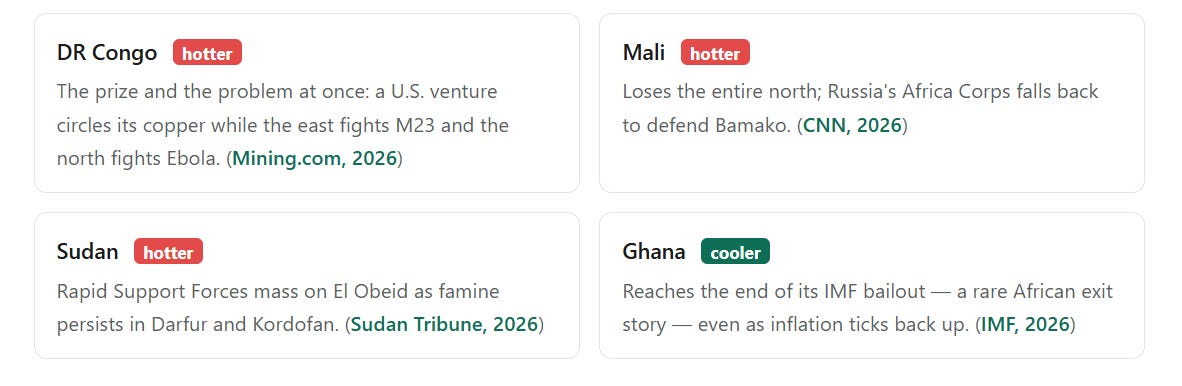
Country movers
What to watch next month
Whether the Lobito railway names its construction contractor on schedule — the real test of the Western minerals push. (Ecofin Agency, 2026)
Ethiopia’s $350m Eurobond payment due mid-July — the close, or not, of Africa’s last unfinished default. (IMF, 2026)
The U.S. tariff surcharge clock and AGOA’s end-2026 cliff — both running out this summer. (Carnegie, 2026)
The Sahel lean season peaking June–August against a fertiliser price spike and the Bamako blockade. (RPCA, 2026)
Early signals on a possible “super” El Niño that would threaten Southern Africa’s 2026–27 harvest. (WHO, 2026)