

Edition 04 · 16 July 2026 · covering 2–15 July 2026 · ~9 min read · Subscriber edition
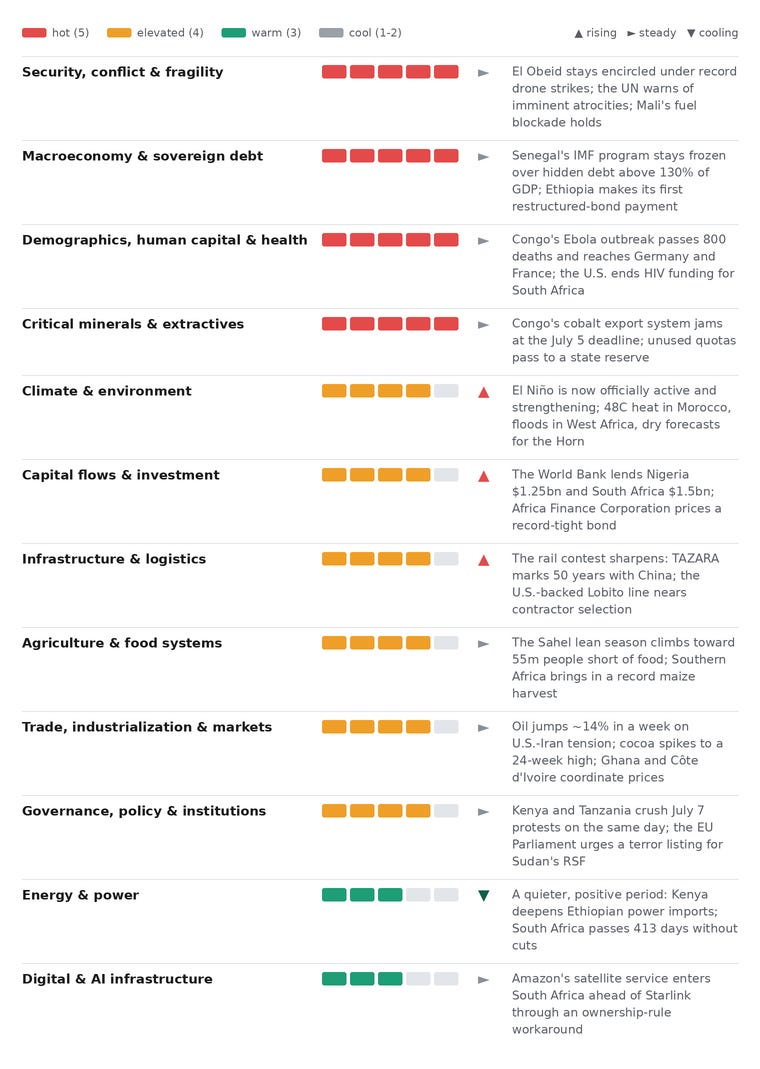
How to read this. We track the African continent as one system across twelve domains, the big moving parts of development, from money and minerals to food and security. Each gets a heat score from 1 (quiet) to 5 (very active) for the period, plus a trend arrow (▲ rising · ► steady · ▼ cooling) against the last edition. The edition leads with what moved most, then traces how a shock in one domain travels into others. Every claim links to its source; the full list is at the end.
The continental read
Last edition, the story was money returning to Africa. This edition shows the first crack in it, and it is not where you would look for one.
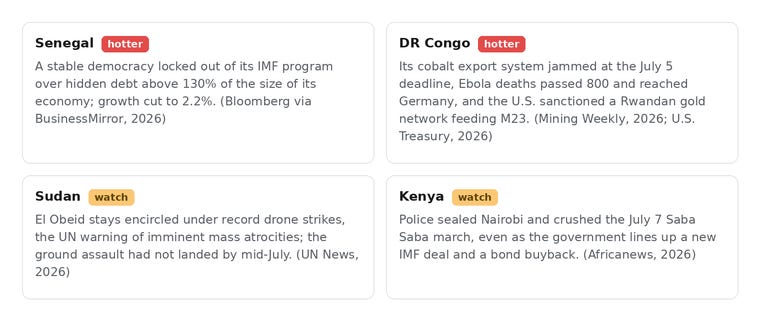
Senegal is a stable democracy, not a war economy. Yet its International Monetary Fund program is still frozen, after auditors put the country’s hidden debt in the billions and lifted total debt above 130% of the size of its economy, in what the Fund calls its largest case of misreported debt ever (CNBC Africa, 2026). The machinery still works elsewhere: the Fund released about $464 million to Ethiopia, a country just out of default (IMF, 2026). The market is starting to sort African borrowers less by whether they defaulted and more by whether their books can be trusted.
Beneath the money, the human floor keeps dropping, and this period it began to cross borders. Congo’s Ebola outbreak roughly doubled again, past 800 deaths, and for the first time left the continent: a United States aid worker was flown to Germany for treatment on July 13 (World Health Organization, 2026). In Sudan, the city of El Obeid is still encircled under record drone strikes, with the United Nations warning of imminent mass atrocities (UN News, 2026).
And a new driver has switched on under all of it. Forecasters now confirm El Niño, the Pacific warming pattern that reorders African rainfall, is active and strengthening (NOAA Climate Prediction Center, 2026). It is already flooding cocoa farms in the west and drying out the Horn. Where money is returning, transparency is the new test. Where the floor is failing, the shocks no longer stay put.
The heat map
Deep dive: sovereign debt
Senegal’s frozen program is the market’s new fault line
Senegal’s IMF program remains suspended, and after a June visit the Fund said only that further decisive action is needed to resolve the misreporting (CNBC Africa, 2026). The channel this travels through is trust. When an audit lifts a country’s reported debt from about 74% of the size of its economy to above 130%, lenders reprice not just that country but the assumption that audited numbers are clean (VoxDev, 2026). Bond prices move within weeks; the lesson other borrowers draw from it plays out over months.
The direct loss is Senegal’s own. The Fund cut its 2026 growth forecast to 2.2%, from 3.0%, and the infrastructure plans that the borrowing was meant to fund are on hold (Bloomberg via BusinessMirror, 2026). The wider exposure is every government still marketing a new bond into the low-premium window this newsletter described last edition, and the Fund’s own standing as the body that certifies a country’s numbers.
The second-order effect is the contrast with Ethiopia, and it is the reason the story matters. Ethiopia defaulted, restructured, and this period drew a fresh $464 million from the Fund while it prepared the first payment on its new bond (IMF, 2026; The Africa Report, 2026). Senegal never defaulted, and is locked out. Solvency is no longer the whole test; the credibility of the books is becoming the price of entry. Base case: the freeze holds through the summer while Senegal negotiates a corrective path, and its borrowing costs stay high but contained. The alternative, at perhaps one chance in three, is a broader repricing if a second country’s numbers are questioned. What would confirm the base case: the Fund sets a timetable to resume lending, or Kenya lands its planned bond buyback into a still-open market (Bloomberg, 2026). What would break it: another core government discloses debt it had not reported.
Deep dive: critical minerals
Congo’s cobalt machine jams, and the state becomes the market
On July 5 the deadline to use the first half of Congo’s cobalt export quotas fell due, but from July 1 exporters could not file the customs papers to ship, because the regulator had not authorized processing, putting up to 20,000 tonnes and about $1.1 billion of shipments at risk (Mining Weekly, 2026). What looks like a paperwork failure is really a transfer of control. Any quota a miner cannot use is not returned; it is forfeited to the regulator’s strategic reserve, a state buffer stock of roughly 10% of the national export ceiling that the government can steer toward projects it deems in the national interest (Reuters via Kitco, 2026).
The exposed parties are the big exporters, Glencore and CMOC among them, who may lose allocations they had counted on and have asked the prime minister to step in (Kitco, 2026). The direct winner is the Congolese state, which is accumulating a larger and larger share of the world’s cobalt and the power to decide when it moves. The cap is working as designed: cobalt has held near $57,000 a tonne, up roughly 160% since Congo’s first export block in early 2025 (Trading Economics, 2026).
The second-order effect is a change in what Congo is. In the same weeks, United States firms stepped up their bids to map the country’s geology from the air (Semafor, 2026), and the finance ministry confirmed plans for a Kinshasa stock exchange, trading in both the local franc and the dollar, to list the country’s mineral wealth by 2027 (Bloomberg, 2026). The country that supplies about three-quarters of the world’s cobalt is building the machinery to price it, not just dig it. For buyers, the supply risk is migrating from the mine to the ministry. Base case: the regulator extends the deadline or quietly clears the backlog, exports resume, but more volume sits in state hands. The alternative, at perhaps one chance in three, is a hard forfeiture that spikes the price and pushes carmakers to design cobalt out faster. What would confirm the base case: a deadline extension or the reserve released for sale. What would break it: customs stays shut and the third-quarter shipments miss.
Deep dive: health
Ebola crosses the water as the response loses its funding
Congo’s Ebola outbreak, caused by the Bundibugyo strain, roughly doubled again, to about 2,124 cases and 828 deaths by July 15, from 1,561 cases and 506 deaths in the World Health Organization report dated July 5, and for the first time it left the continent, with a United States aid worker flown to Germany on July 13 and an earlier case recorded in France (World Health Organization, 2026; NPR, 2026). The mechanism that turns a bad outbreak into an international one is the same one that has been quietly weakened. There is no licensed vaccine for this strain, so control depends on finding and isolating each contact, which takes staff, and staff is what last year’s aid withdrawal removed. A missed contact becomes a new cluster in two to three weeks; an infected traveler becomes a case abroad in days.
The heaviest exposure is still in Ituri province, now about 1,904 cases across 27 of 36 health zones, and in North and South Kivu, where the M23 war blocks health teams from reaching the sick (World Health Organization, 2026). The newly exposed are Congo’s neighbors and, in a small but politically loud way, the health systems of Europe.
The second-order effect is the collision with money. The same government whose citizen was flown home for treatment is ending its HIV program funding for South Africa and letting 120 disease-control awards that serve 8.7 million patients expire in September (CNN, 2026; Semafor, 2026). The border-crossing outbreak and the funding cut are the same story told from two ends: pull back the money that keeps African health systems staffed, and the diseases those systems used to contain begin arriving at the donor’s own door. Base case: the outbreak keeps growing in eastern Congo but the cases abroad stay isolated imports; Uganda has begun its 42-day countdown to declaring its own outbreak over, which supports that reading (World Health Organization, 2026). The worse scenario, at perhaps one chance in four: spread into a major city such as Bunia or Goma, or sustained transmission across a border. What would confirm the worse reading: the World Health Organization adds new health zones. What would break it: the case count levels off as trial vaccines reach the field.
Charter Subscriber — 50% Off. Lock in 50% off your subscription for your first three months when you join by September 30, 2026. Claim the Charter rate
Chain of the month
How a warming in the Pacific Ocean is quietly setting the price of a chocolate bar, and steadying a West African farmer’s income along the way. This is the kind of cross-domain link the model is built to trace.

Forecasters confirmed this period that El Niño is active and strengthening, a pattern that reorders rainfall across Africa (NOAA Climate Prediction Center, 2026). In West Africa its first mark was too much water, not too little: early-July flooding across Ghana, Benin, Togo and Nigeria killed people and disrupted the cocoa mid-crop (OkayAfrica, 2026). With some 2026/27 Ivorian output forecasts cut toward 1.7 to 1.8 million tonnes, cocoa jumped about 14% in a single session to a 24-week high (Foodcom, 2026). Into that squeeze, the two countries that grow most of the world’s cocoa are moving to coordinate their farm-gate prices and crop calendars from the new season (Rio Times, 2026). One ocean signal is being passed, farm by farm and contract by contract, from a rain gauge in the Gulf of Guinea to the shelf price of chocolate, and the producers are trying to keep more of the gain for themselves along the way.
Country movers
What to watch next
El Obeid: whether the expected Rapid Support Forces ground assault lands. The UN calls the atrocity risk imminent; this would be the period’s biggest single event. (UN News, 2026)
Senegal: whether the IMF sets a timetable to resume lending, or the freeze drags and pushes borrowing costs higher across the region. (CNBC Africa, 2026)
Ethiopia: whether reserves cover the first payment on the restructured bond and the deal completes cleanly. (The Africa Report, 2026)
July 24: the United States decides whether its blanket 10% tariff lapses or is extended, with the AGOA trade preference set to expire December 31, 2026. (Ecofin Agency, 2026)
Ebola: whether the World Health Organization adds health zones beyond Ituri and the Kivus, or the case count levels off as trial vaccines deploy. (World Health Organization, 2026)
Cobalt: whether the regulator extends the July deadline or lets the forfeitures stand, handing more of the world’s supply to the Congolese state. (Kitco, 2026)
Sources
[3] VoxDev: “Navigating Senegal’s unexpected debt crisis,” 2026. voxdev.org (accessed 16 Jul 2026).
[10] Trading Economics: cobalt price data, accessed 16 Jul 2026. tradingeconomics.com.
Every material claim is verified to one primary source or two independent reputable sources. Items resting on a single secondary source are stated as such in the text.
***