

Edition 01 · 1 November 2026 · covering October 2026 · ~4 min read · Free edition followed by paid subscriber extended PDF download.

How to read this. We track eight forces, the pressures that move artificial intelligence (AI) politics, rather than who said what this week. Each gets a heat score from 1 (quiet) to 5 (defining the debate) and a trend arrow (▲ rising · ► steady · ▼ cooling), read against the start of 2026. Two dividing lines cut across every force: restraint versus acceleration, and establishment politics (the two-party system) versus insurgent politics (movements, rank-and-file groups and voters challenging it).
The top-line read
In an early-October survey, 44% of registered voters told the Pew Research Center that artificial intelligence is very important to their vote. The economy scored 84% (Pew Research Center, 2026). By that measure, AI is a middling issue.
One piece of it is not. 61% of voters dislike political leaders who back building data centers near them, and only 8% like it. The dislike reaches Republicans, 44% to 14%, with 42% indifferent (Pew Research Center, 2026). Pressure gathers where daily life is touched and then climbs into party politics. This month we saw it climb.
Nate Silver, the election forecaster, says the November 3 results will show whether an AI backlash appears in state-by-state returns, and that AI “could be the biggest issue of 2028” (Newsweek, 2026).
The heat map
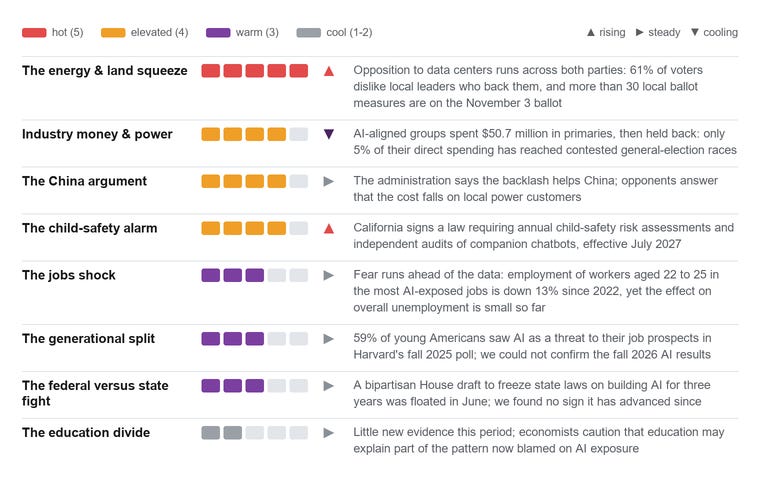
Where it moved most
The data center pause has crossed from the edge to the center
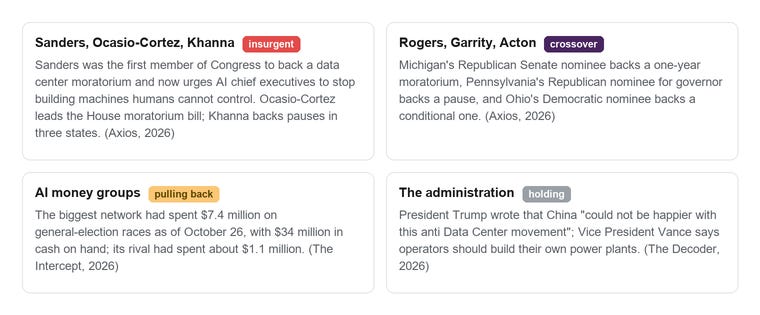
In late 2025, Senator Bernie Sanders was the first member of Congress to back a data center moratorium, and most Democrats rejected it. By August, Michigan’s Republican Senate nominee backed a one-year moratorium, Ohio’s Democratic candidate for governor backed a conditional one, and Pennsylvania’s Republican nominee for governor backed a pause (Axios, 2026). The idea moved from insurgent to establishment in under a year. The federal executive is moving the other way: President Trump wrote that China “could not be happier with this anti Data Center movement” (The Decoder, 2026). The split inside the establishment is the thing to watch after November 3.
AI money bought a lesson, not a Congress
Two networks of super political action committees, groups that spend unlimited money on elections, put $50.7 million into primaries. The candidate they targeted, Alex Bores, lost, but he says the spending “served to elevate the issue of AI.” In the general election the biggest network had spent $7.4 million as of October 26, and only 5% of all direct spending has reached contested races (The Intercept, 2026). The industry appears to have learned that its money draws attention it does not want.
The jobs fear runs ahead of the jobs data
Employment for workers aged 22 to 25 in the most AI-exposed jobs is down 13% since 2022, but the Federal Reserve Bank of Dallas finds the effect on overall unemployment small so far, mostly through fewer young people being hired, not through layoffs (Federal Reserve Bank of Dallas, 2026). In Harvard’s fall 2025 poll, 59% of young people saw AI as a threat to their job prospects (Fortune, 2025). Politics responds to the fear, not the data, so this force can grow without new evidence.
Move of the month
How anger at a power bill reaches the 2028 campaign.

Power bills draw local anger. The anger reaches more than 30 local ballot questions on November 3, with counts from 34 to 39 depending on the tracker (S&P Global, 2026; Newsweek, 2026). Candidates of both parties move toward a pause, and the federal executive answers with the China argument.
Shifts in the system
What to watch next
November 3: whether Republicans underperform where big data center projects are proposed. (Newsweek, 2026)
2028 silence: nearly twenty potential Democratic candidates were asked about Sanders’s call for a pause, and only one answered directly. (Axios, 2026)
Federal and state: a House draft would freeze state laws on building AI for three years; we found no sign it moved after June. (Broadband Breakfast, 2026)
Child safety: California’s new chatbot law takes effect July 1, 2027, and other states may copy it. (Common Sense Media, 2026)
Read the full edition
The subscriber PDF goes further: full reasoning behind each deep dive with scenario likelihoods and the signs that would confirm or break them, a table of all eight forces on both dividing lines, a hypothesis check, what the commentators are arguing, standing metrics, a decision guide for four kinds of reader, what we could not confirm, and all sources. Paid subscribers ($5 a month for all newsletters) can download below.