

Edition 06 August 1, 2026 · covering July 15–31 ~9 min read Subscriber edition
The read
Three headlines landed within 72 hours in late July. Nvidia was reported to be considering a backstop of $250 billion in financing for an OpenAI data-center project in Ohio (Axios, July 27). The cost of insuring CoreWeave’s debt against default spiked to levels that imply roughly even odds of failure within five years (Bloomberg, July 29). And the Federal Reserve held rates steady with three committee members dissenting in favor of a hike (Federal Reserve, July 29).
Put those together and this period’s story is simple: The AI build-out has stopped being a cash story and become a credit story. The money now arrives as debt, vendor guarantees, securitizations and sovereign funds, and for the first time the markets that price that debt are pushing back.
The strange part: the fundamentals have never looked better. TSMC posted a record quarter and raised its capex plans (CNBC, July 16), the four biggest cloud builders now plan roughly $700 billion of combined 2026 capital spending, and data-center vacancy sits at record lows. The machine is running hotter than ever. What changed is who pays for it, and at what price.
The heat map

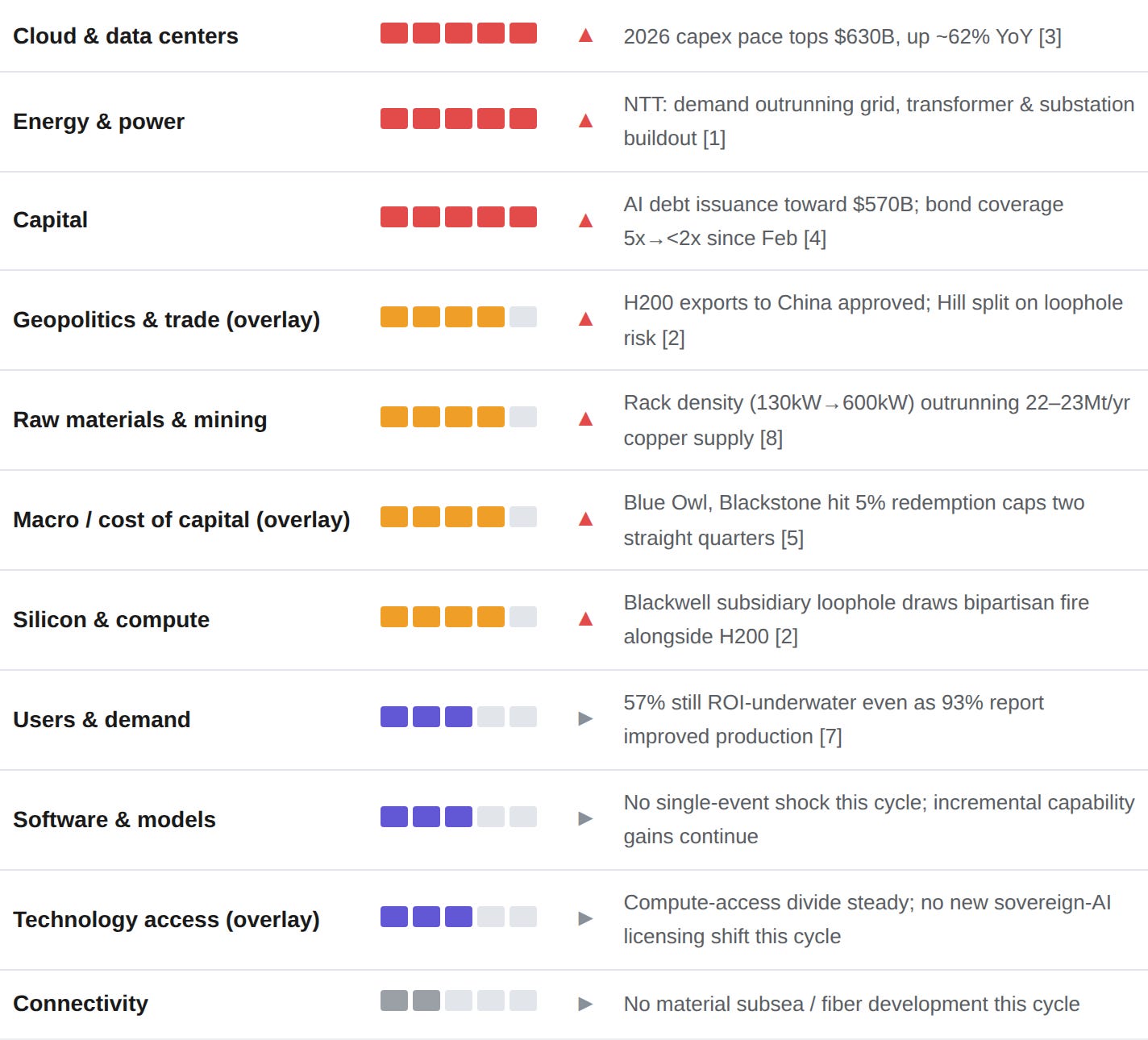
Layers and overlays come straight from the AI-ecosystem model. Heat = current news intensity; trend = direction vs. structural baseline.
Deep dive — Capital
The build-out meets the bond market
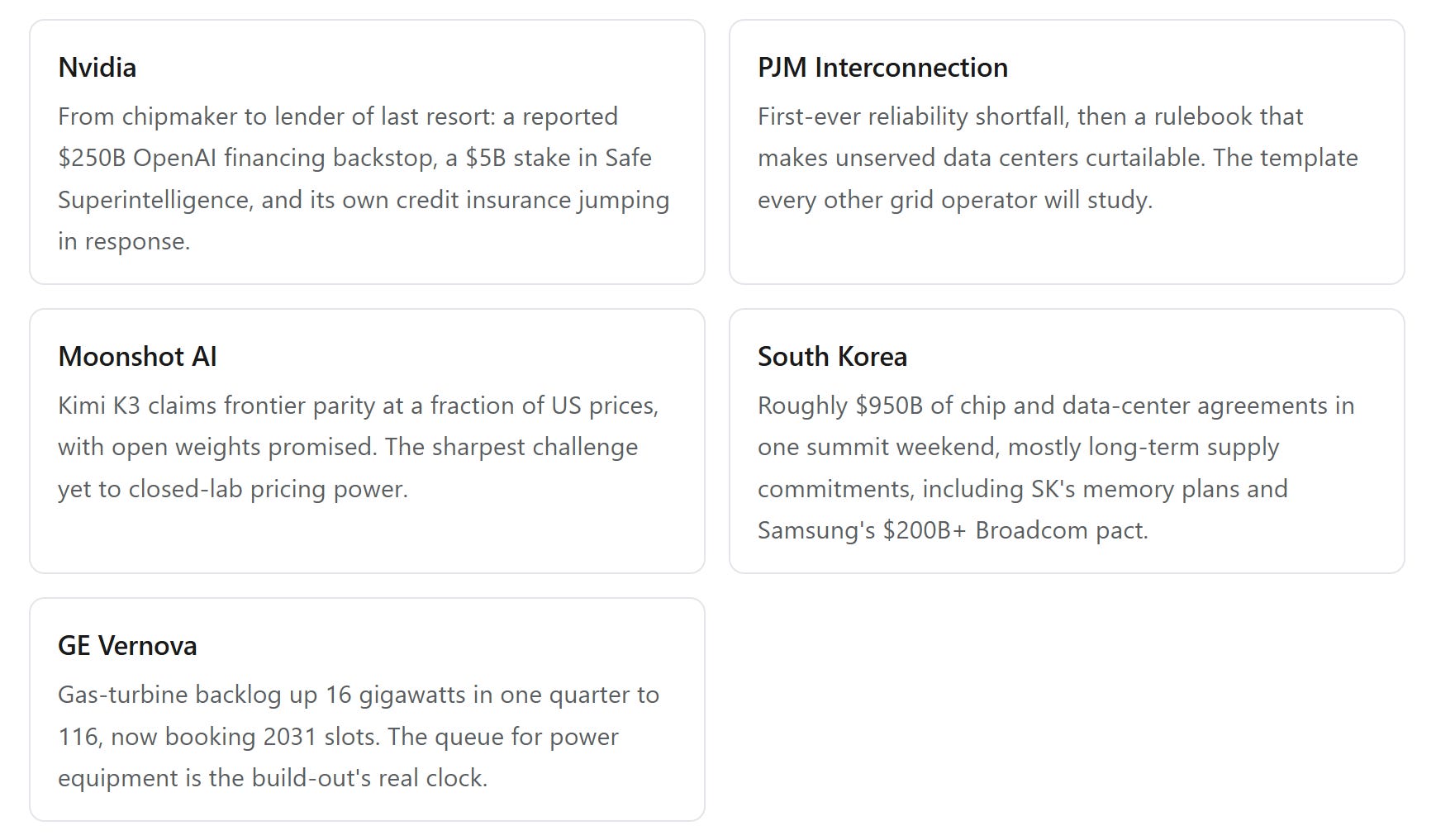
On July 27, Axios reported that Nvidia is exploring a backstop of $250 billion in financing for an OpenAI data-center project in southern Ohio, on top of financing OpenAI’s purchase of $350 billion of Nvidia chips (Axios, 2026). Bloomberg counts more than $540 billion of such circular deals announced this year alone, before the potential OpenAI commitments, in which Nvidia funds the customers who buy its chips (Bloomberg, 2026). The same day, Nvidia put a reported $5 billion into Safe Superintelligence, a lab with no product and no revenue (Bloomberg, 2026).
Markets noticed: Nvidia shares fell about 4.5% on the news and the cost of insuring its debt jumped. Credit-default swaps (insurance against a borrower failing) on CoreWeave spiked past 855 basis points, implying near coin-flip default odds over five years, and Oracle’s reached a multi-year high (Bloomberg, 2026). Even strong earnings couldn’t calm the mood: Meta’s revenue grew 28%, but its free cash flow fell 91% (Meta, 2026), and the hyperscalers faced open capex scrutiny all week (CNBC, 2026).
Here’s the model read: The silicon-to-software financing loop is a designated amplifier: when sentiment turns negative, shocks in it don’t damp, they spread to every counterparty. The debt window is still open (Aligned closed a $1.18 billion data-center securitization on July 28, upsized 30% (Aligned, 2026)). But a hawkish Fed puts a floor under the cost of every dollar of it. Watch financing terms, not headlines: they move first.
Deep dive — Energy
The largest US grid just said no
On July 14, PJM Interconnection, the grid operator serving 13 states from Chicago to Washington, ran its annual capacity auction and, for the first time in its history, fell short of its reliability requirement, by 6,831 megawatts. It bought 138,318 megawatts at $325 per megawatt-day, near the price cap for a third straight year, at a total cost of $16.4 billion (PJM, 2026). The market monitor says data centers drove $6.3 billion of that bill (Utility Dive, 2026).
Two weeks later the response arrived. PJM’s board approved a first-of-its-kind package: a backstop auction this fall at a raised $555 per megawatt-day cap with 15-year commitments, and a rule that new large loads without their own power supply must curtail during emergencies (PJM board letter, 2026). Power, the model’s binding chokepoint, now has a rulebook, and the rulebook says data centers stand at the back of the line.
So the build-out is routing around the grid. GE Vernova’s gas-turbine backlog jumped from 100 to 116 gigawatts in a single quarter, and it’s now taking reservations for 2031 delivery (GE Vernova, 2026). Meta quit a global clean-energy pledge as it backs roughly ten gas plants for its Louisiana campus (Reuters, 2026). Upstream, data centers will absorb an estimated 500 kilotonnes of copper this year, roughly all of global demand growth (Kpler, 2026). That copper seam is where our sister brief Africa Signal picks up the story.
Deep dive — Software & models
China opens its weights while America closes
On July 16, Moonshot AI released Kimi K3, a roughly 2.7-trillion-parameter model it claims matches the best US closed systems, priced at $15 per million output tokens against $50 for the top American flagship (Fortune, 2026). Then, around July 27, Moonshot released the model’s weights for download, making it the largest open-weight model ever (Bloomberg, 2026). Analysts hadn’t expected Chinese parity until 2027.
The American labs shipped too, but in the opposite direction. OpenAI released its GPT-5.6 family (OpenAI, 2026), Anthropic released Claude Opus 5, pitched as approaching its flagship’s capability at half the price (Anthropic, 2026), and Meta shipped a proprietary coding model, confirming its retreat from open releases. The open/closed map has inverted: US labs are closing while China opens, and Chinese models now take a large share of routed traffic at a fraction of the price.
The economics underneath are brutal: Token prices are falling roughly tenfold per year while volumes explode; Google alone processes more than 3.2 quadrillion tokens a month (Google, 2026). DeepSeek even announced peak-hour pricing for its new model, doubling rates in busy hours, a sign cheap inference is now capacity-bound, per TechNode (TechNode, 2026). Demand is real: The Information reports ChatGPT is nearing a billion weekly users (PYMNTS, 2026). But the pricing power that justifies closed-lab valuations is eroding, and that feeds straight back into the capital story above.
Charter Subscriber — 50% Off. Lock in 50% off your subscription for your first three months when you join by September 30, 2026. Claim the Charter rate
Chain of the month
How one shock travels across the ecosystem — the non-obvious link most coverage misses.

Start at the macro overlay: A Fed that holds with three votes for a hike tells every lender that rates stay higher for longer. That repriced the riskiest AI credit within days: default insurance on CoreWeave and Oracle blew out just as the bill for the build-out migrates from corporate cash to debt and securitization. From there the shock enters the model’s circular-financing amplifier, the loop where Nvidia finances the labs and clouds that buy its chips. Amplifiers don’t damp: a doubt about one borrower becomes a doubt about every counterparty in the loop, which is why Nvidia’s own credit insurance jumped on a report about OpenAI’s financing.
Net read: power remains the physical gate on the build-out, but this period the binding constraint moved one layer up, to the price of money. Watch the September Fed meeting the way you’d watch a grid auction.
Movers
What to watch next
PJM’s backstop auction (Sept 30–Oct 21). Trigger: clearing at or near the raised $555/MW-day cap would confirm power scarcity is repricing the whole eastern build-out.
The September Fed meeting. Trigger: if July’s three hike dissents become a hike, every data-center financing model gets re-run at a higher discount rate.
CoreWeave’s next earnings and credit spreads. Trigger: further widening in default insurance, or a pulled financing, would mark the first real casualty of the credit turn.
Who builds on Kimi K3’s open weights. Trigger: major Western deployments, or a Washington response, since an open frontier-class Chinese model undercuts the logic of chip export controls.
China’s delayed export-control package. The postponed October 2025 mineral controls come due late this year; the International Energy Agency puts $6.5 trillion a year of production outside China at risk if they’re implemented in full. Trigger: an implementation notice from China’s Ministry of Commerce.
Texas grid operator ERCOT’s “Batch Zero” notifications (August). Trigger: how much of the 438-gigawatt data-center connection queue survives first contact with process.
Sources
[1] Axios — “Nvidia’s OpenAI backstop,” 27 Jul 2026. (accessed 1 Aug 2026).
[2] Bloomberg via Yahoo Finance — “Nvidia’s $750 billion deals revive circular-financing fears,” 28 Jul 2026. (accessed 1 Aug 2026).
[3] Safe Superintelligence — company update, 27 Jul 2026. https://ssi.inc/updates (accessed 1 Aug 2026); Bloomberg — “Nvidia makes substantial investment in Sutskever’s AI startup,” 27 Jul 2026.
[4] Bloomberg via Yahoo Finance — AI credit-default-swap levels (CoreWeave >855bp, Oracle 215bp), 29 Jul 2026. (accessed 1 Aug 2026); 24/7 Wall St., 29 Jul 2026.
[5] Federal Reserve — FOMC statement, 29 Jul 2026. (accessed 1 Aug 2026).
[6] Meta — “Meta Reports Second Quarter 2026 Results,” 29 Jul 2026. (accessed 1 Aug 2026).
[7] Aligned Data Centers — “$1.18 Billion Securitization Financing,” 28 Jul 2026. (accessed 1 Aug 2026).
[8] PJM Interconnection — “Capacity Auction Procures 138,318 MW,” 14 Jul 2026. (accessed 1 Aug 2026).
[9] Utility Dive — “Data centers drove $6.3B of PJM capacity auction cost, market monitor says,” 20 Jul 2026. (accessed 1 Aug 2026).
[10] PJM Board — decisional letter on reliability backstop procurement, 27 Jul 2026. (accessed 1 Aug 2026).
[11] Utility Dive — “PJM board approves backstop capacity auction, data-center curtailment,” 28 Jul 2026. (accessed 1 Aug 2026).
[12] GE Vernova — Q2 2026 earnings press release, 22 Jul 2026. (accessed 1 Aug 2026).
[13] Reuters via Yahoo Finance — “Meta quits clean energy pledge,” 25 Jul 2026. (accessed 1 Aug 2026); Forbes, 27 Jul 2026.
[14] Kpler — “Copper: the perfect squeeze,” 17 Jul 2026. (accessed 1 Aug 2026).
[15] S&P Global Commodity Insights — “China bans rare earth exports to 14 European companies,” 24 Jul 2026. (accessed 1 Aug 2026); South China Morning Post. https://www.scmp.com/economy/global-economy/article/3361732/china-adds-eu-entities-export-control-list
Every material claim verified to one primary source or two independent reputable sources; claims that rest on single-outlet reporting are attributed as such in the text.
Charter Subscriber — 50% Off. New here? Become a Charter Subscriber and get 50% off for your first three months — offer ends September 30, 2026. Subscribe at half price
AI Signal is a twice-monthly systems brief from The Critical Post, sister to Africa Signal. Method: the AI-ecosystem model — eight layers plus regulatory, geopolitical, macro and technology-access overlays — scored for intensity and direction, with shocks traced through directed transmission edges. © 2026 The Critical Post.
***