

Edition 11 October 28, 2026 · covering October 16–28~10 min read. A downloadable PDF of this newsletter is available to paid subscribers at the bottom of this post.
How to read this
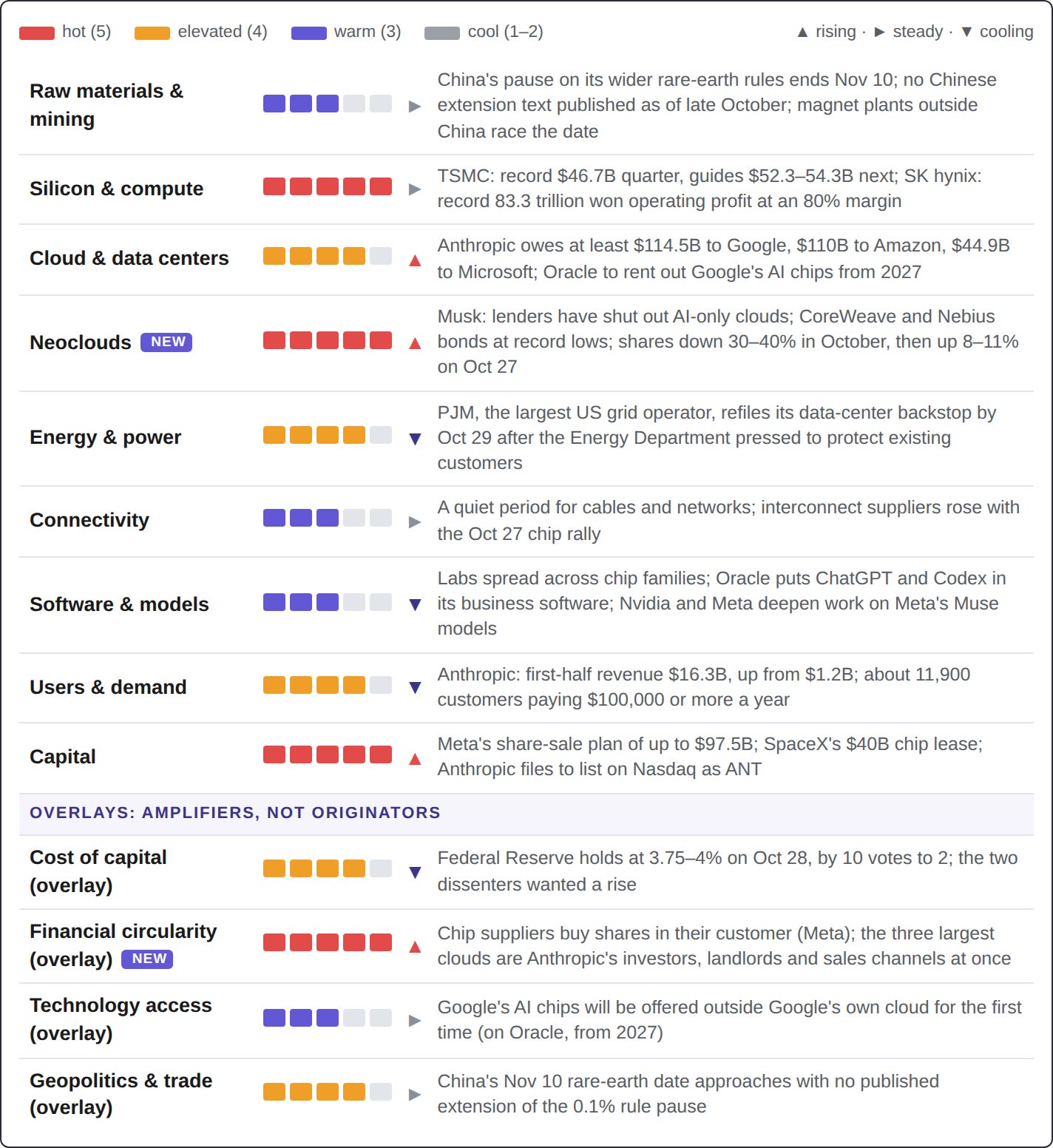
Heat (1 to 5) of the heat map measures how intense the news was in each layer this period: 5 is hot, 1 is quiet. It measures news intensity, not long-term importance. Arrows compare with the last edition: ▲ rising, ► steady, ▼ cooling. Neoclouds are companies that rent out high-end AI chips and little else. They borrow most of what they spend, and they borrow against their customers’ multi-year contracts.
Financial circularity is when money a company sends out comes back to it, through other companies in the ecosystem, as its own revenue, as a customer contract, or as security for loans. A loop is not a fault in itself. It becomes a risk when the same few companies are on both sides of the money. Overlays are forces that strengthen or weaken shocks in the layers. They rarely start a shock on their own.
New in this edition: neoclouds
From this edition, AI Signal tracks neoclouds as a ninth layer of the model. A neocloud rents out high-end AI chips, mostly Nvidia’s, to the very large buyers of computing power, such as Microsoft, Meta, OpenAI and Anthropic. The listed leaders are CoreWeave and Nebius. A private group includes Crusoe, Nscale, Lambda, Fluidstack and Together AI. A third group are former bitcoin miners that now host AI chips, such as IREN, Hut 8, Core Scientific and TeraWulf.
The large cloud companies pay for their build-out mostly from their own cash. Neoclouds borrow, and use customer contracts as security. That makes them the place where the financial risk of AI spending gathers. It is also why the model now tracks financial circularity as a fourth overlay.
The read
On October 26, three filings landed on the same day. Anthropic made its listing document public: it owes at least $269 billion in minimum payments to Google, Amazon and Microsoft, payable whether or not it uses the capacity (Anthropic Form S-1, Oct 26) (Motley Fool, Oct 26). SpaceX told the Securities and Exchange Commission it had a binding commitment for a lease of AI chips worth about $40 billion, through an entity managed by Apollo (SpaceX Form 8-K, Oct 26). And Meta launched the largest share sale in its history, now up to $97.5 billion, with Nvidia putting in $3 billion and AMD $1 billion, two of the companies whose chips the money will buy (Yahoo Finance, Oct 28) (Reuters via Yahoo Finance, Oct 27).
The day before, Elon Musk wrote that debt markets had almost entirely closed to companies without substantial revenue outside AI data centers, and that more than 200 neoclouds faced “guppy-level death and consolidation” (CNBC, Oct 26) (Quartz, Oct 26). CoreWeave and Nebius had already lost more than 30 percent of their value in October, and IREN about 40 percent.
These are one story. Money still flows into AI at record scale, but it now flows through a small circle of companies that are each other’s customers, suppliers, lenders and shareholders. Inside the circle, capital is plentiful. At the edge, where the neoclouds sit, it is drying up. That is this edition’s main thread: the AI build-out showed its wiring.
The heat map
The circularity read
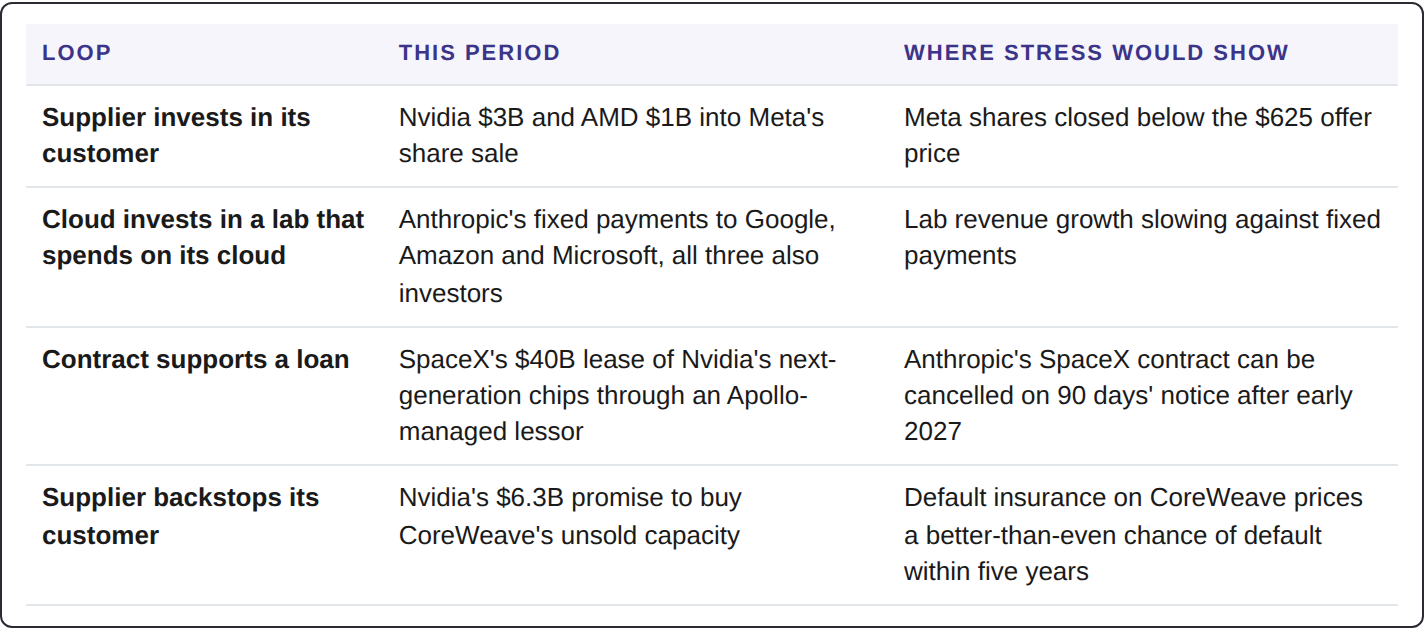
Four money loops moved this period, and each was disclosed in a filing or a company statement.
Suppliers invested in a customer: Nvidia committed $3 billion and AMD $1 billion to Meta’s share sale, money that returns to them as chip orders (Reuters via Yahoo Finance, Oct 27) (Aiera, Oct 28).
Clouds sat on every side of one customer: Amazon, Google and Microsoft are Anthropic’s investors, its suppliers of computing power and its sales channels, and the filing lists those overlapping roles as a risk (Anthropic Form S-1, Oct 26).
A contract supported a loan: SpaceX’s lease rests on its rocket and satellite revenue and on compute contracts in which Anthropic is the largest customer (SpaceX Form 8-K, Oct 26) (CNBC, Oct 26).
A backstop came under watch: Nvidia’s 2025 promise to buy any capacity CoreWeave cannot sell runs to April 2032 and has not been called (RCR Wireless, 2025). Stress would show first in neocloud bond prices and in what lenders charge for loans secured on AI chips.
Deep dive: Capital and financial circularity
The circle, in the filings
Meta has paid for most of its growth from advertising cash. This year that is not enough. It plans capital spending of $135 billion to $145 billion in 2026, and on October 26 and 27 it launched a share-sale plan of up to $97.5 billion: $25 billion of common stock at $625 a share, $12.5 billion of preferred stock, and up to $60 billion sold gradually from 2027 (Yahoo Finance, Oct 27) (MLQ, Oct 27). Orders for the common stock reached about five times the shares on offer.
Two of the buyers are also sellers. Nvidia will invest $3 billion and AMD $1 billion. Both sell Meta the chips the money pays for, and Nvidia announced a wider deployment of its Vera Rubin systems at Meta in the same statement (Reuters via Yahoo Finance, Oct 27) (Yahoo Finance, Oct 28). LoRosha’s Investment Desk, a daily newsletter that reads the Asian market close, described this as supplier money flowing back into the buyer to secure chip purchases. Its reading: when buyers raise capital and suppliers join in, the market’s doubt about whether those buyers can pay falls, and supplier shares rise (LoRosha, Oct 28).
Anthropic’s filing shows the same pattern at a larger scale. It owes at least $114.5 billion to Google through July 2033 and at least $110 billion to Amazon through April 2036, regardless of use, plus at least $44.9 billion to Microsoft from November 2026 (Anthropic Form S-1, Oct 26) (Motley Fool, Oct 26). All three are also investors in Anthropic and sell its models to their own customers. The filing names this web as a risk: some suppliers have investment ties with the company and are also its customers. Fortune’s reading of the same document: the payments are fixed, while many customers can stop paying at any time (Fortune, Oct 26).
A loop becomes a risk when the same few companies sit on both sides of the money. This period showed how small that set is: Nvidia, the three largest clouds, Meta, and the two leading labs. A cut in spending at any one of them would travel around the loop.
Deep dive: Neoclouds
Inside the circle, and at its edge
On Sunday, October 25, Elon Musk wrote that debt markets had almost entirely closed to companies whose revenue depends on AI data centers, and that most of the more than 200 neoclouds would fail or be absorbed (Quartz, Oct 26) (CNBC, Oct 26). The post landed on a market that was already selling. Bonds of CoreWeave due 2033 and of Nebius due 2034 had hit record lows (Reuters via U.S. News, Oct 26). The price of insuring CoreWeave’s debt against default had reached a record, implying a more than 60 percent chance of default within five years (Fortune, Oct 26).
Earlier in October, the research firm Gartner said that 80 percent of neoclouds could stop operating independently by 2032 (Reuters via U.S. News, Oct 26). Musk is not a neutral observer. SpaceX also rents out AI computing power, and Anthropic is the largest customer of its AI unit (CNBC, Oct 26). In LoRosha’s account, Musk said SpaceX could borrow for chips because it also earns money from satellite internet and rocket launches (LoRosha, Oct 27).
The market then drew a line through the sector. On October 27, Nebius rose more than 11 percent, and CoreWeave and IREN about 8 percent each (TradingView, Oct 27) (GuruFocus, Oct 27). Nebius had already set itself apart. It funds itself mainly with shares, convertible bonds and customer prepayments, and its revenue chief said it does not carry the kind of debt CoreWeave carries (CNBC, Oct 26) (Rolling Out, Oct 26). LoRosha’s reading of the two sessions is that neoclouds tied by contract to the large paying customers gained the most, while those outside such contracts remain exposed to Musk’s warning (LoRosha, Oct 27).
Anthropic’s filing adds a fact that points the other way: the lab has compute agreements with two private neoclouds, Nscale and Lambda, alongside the large clouds (CNBC, Oct 26) (Fortune, Oct 26). For neoclouds that hold such contracts, the circle is a source of support. For the rest, it is closed. In the model this layer is an amplifier: a credit shock that reaches it passes on at full strength, to chip orders upstream and to AI lending in general.
Deep dive: Silicon and compute
The suppliers are paid in cash
While the middle of the system argued about credit, the suppliers nobody can replace reported their results. TSMC, which makes most of the world’s advanced AI chips, had third-quarter revenue of $46.72 billion, up 41 percent from a year earlier in dollars, at a 66.4 percent gross margin (TSMC Form 6-K, Oct 15). It expects $52.3 billion to $54.3 billion in the fourth quarter, and chips for data centers and other high-performance computing made up 68 percent of its revenue (TSMC call transcript, Oct 15) (Benzinga, Oct 15).
On October 28, SK hynix reported its best quarter ever: revenue of 104.6 trillion won, operating profit of 83.3 trillion won and an operating margin of 80 percent. It expects its newest high-bandwidth memory, the stacked memory placed next to AI chips, to overtake the previous generation in both shipments and revenue this quarter. It plans to return about 100 trillion won to shareholders, and its shares rose about 11 percent in Seoul (CNBC, Oct 28) (SK hynix call transcript, Oct 28).
LoRosha’s notes on the Korean session show why Anthropic’s filing mattered there. In its reading, the filing names Samsung, SK hynix and Micron as Anthropic’s main memory suppliers and counts that dependence as a risk. South Korea’s main stock index rose 3.09 percent on October 27, led by the two Korean memory makers (LoRosha, Oct 27). The filing’s own summary of risks confirms the general point: limits on the critical inputs to computing could restrict the computing power Anthropic can secure (Anthropic Form S-1, Oct 26).
This is the other half of the circularity story. Money that circles among the buyers ends up, as cash, with the chokepoint suppliers: the chip foundry and the memory makers. They carry little of the financing risk. The risk sits in the middle, with the companies that borrow to buy their output. A strong supplier result does not solve the buyer’s financing problem, as the QuantData newsletter pointed out this week (QuantData, Oct 28).
Chain of the month
This edition, the chain follows money, not goods: who pays whom, and what comes back.
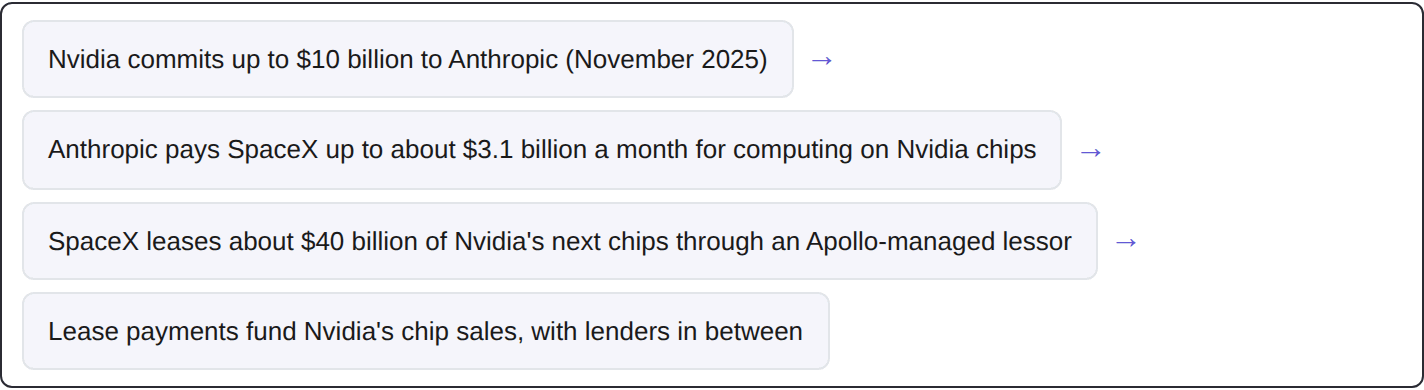
Follow one loop through the system. In November 2025, Nvidia committed to invest up to $10 billion in Anthropic, and Anthropic agreed to use Nvidia systems (Reuters via Khaleej Times, Nov 2025) (Built In, Nov 2025). Anthropic’s filing now shows that it buys computing power on Nvidia chips from SpaceX’s AI unit: about $3.1 billion a month once all capacity is delivered, and up to $120.5 billion through 2029 (CNBC, Oct 26) (Motley Fool, Oct 26). On the same day, SpaceX disclosed a binding commitment for a finance lease: an Apollo-managed entity will buy Nvidia’s next-generation chips and lease them to SpaceX, with about $40 billion of principal payments and deliveries from the first half of 2027 (SpaceX Form 8-K, Oct 26). Each link is on the record. Together they bring part of Nvidia’s investment back to Nvidia as chip revenue.
Two terms decide how firm the loop is. Anthropic’s SpaceX contract can be cancelled on 90 days’ notice once early 2027 has passed (Equibles, Oct 27) (Motley Fool, Oct 26). The lease runs for years. If Anthropic moves its computing elsewhere, SpaceX still owes the lease payments. Its satellite and rocket revenue is the cushion, which is the same point Musk made about the neoclouds. The upstream end of this chain is still copper, gallium and rare-earth magnets, which our sister brief, the Critical Minerals & REE Signal, covers at the source.
Movers
Meta Launched a share-sale plan of up to $97.5 billion, with demand at five times the shares offered. Two chip suppliers are among the buyers. Advertising cash alone no longer covers its AI spending.
Nvidia A shareholder in its own customers: $3 billion into Meta, up to $10 billion committed to Anthropic in 2025, and a $6.3 billion backstop for CoreWeave. It sits at the center of every loop in this edition.
SpaceX A binding commitment for a lease of about $40 billion of Nvidia’s next chips, and Anthropic’s largest supplier of computing on Nvidia chips. Its warning to neoclouds also described its own advantage: revenue outside AI.
CoreWeave Down more than 30 percent in October, with default insurance priced at a better-than-even chance of default within five years, then up about 8 percent on October 27. The stress gauge for the neocloud layer.
SK hynix SK hynix is one of the three companies that make the high-bandwidth memory placed next to AI chips. They had a record quarter, with ₩ 83.3 trillion ( South Korean won, or about $63 billion) of operating profit at an 80 percent margin. It plans to return about 100 trillion won to shareholders. Every AI chip buyer needs its memory, so it is paid in cash on delivery, while the buyers carry the borrowing risk.
Oracle Will offer Google’s AI chips in its cloud from 2027, the first cloud outside Google to do so, alongside more Nvidia systems. Its cloud is becoming a marketplace for every kind of AI chip.
What to watch next
Big Tech results this week. Trigger: Alphabet and Microsoft report after the US close on October 28, and Amazon the next day. Any change to 2027 capital spending plans travels around every loop in this edition.
Anthropic’s price range. Trigger: an amended filing with a price range and the start of marketing to investors. The pricing will show how investors value $269 billion of fixed payments.
Neocloud results and bond prices. Trigger: CoreWeave and Nebius third-quarter reports in November, CoreWeave’s bond prices, and any use of Nvidia’s capacity backstop.
PJM’s backstop refiling. Trigger: the filing due October 29 at federal regulators, and how it divides the cost of new power supply between data centers and existing customers.
China’s November 10 date. Trigger: a Ministry of Commerce notice that extends, changes or ends the pause on its wider rare-earth rules, including the 0.1 percent rule.
The December Federal Reserve meeting. Trigger: whether the two votes for a rate rise become a majority. A higher rate hits the borrowing layer, the neoclouds, hardest.
Sources
[1] Anthropic, PBC: Form S-1 registration statement, U.S. Securities and Exchange Commission, filed 26 Oct 2026. link
[2] CNBC: “Anthropic IPO live updates: AI lab’s S-1 filing,” 26 Oct 2026. link
[3] Motley Fool: “5 Key Numbers From Anthropic’s S-1 Filing,” 26 Oct 2026. link; “Anthropic’s Billions in Microsoft Commitments Add to Its Mounting Compute Bill,” 26 Oct 2026. link
[4] Fortune: “Anthropic’s S-1 makes clear it’s on the hook for billions in compute. Its customers can walk at any time,” 26 Oct 2026. link
[5] Equibles: “Anthropic’s S-1 Explains the Unnamed Deals in Google, Broadcom and SpaceX Filings,” Oct 2026. link
[6] Space Exploration Technologies Corp.: Form 8-K (master finance lease commitment with an Apollo-managed lessor), Oct 2026. link; BigGo Finance, 27 Oct 2026. link
[7] Yahoo Finance: “Meta’s $25 Billion Stock Sale Drew Five Times the Demand,” 28 Oct 2026. link; “Meta’s nearly $100 billion stock sale is a turning point for how Big Tech pays for AI,” 27 Oct 2026. link
[8] Reuters via Yahoo Finance: “Nvidia to commit $3 bln to Meta share offering as part of bigger AI partnership,” 27 Oct 2026. link; MLQ, 27 Oct 2026. link; Aiera, 28 Oct 2026. link
[9] CNBC: “Elon Musk says more than 200 neoclouds face ‘guppy-level death’,” 26 Oct 2026. link; Quartz, 26 Oct 2026. link
[10] Reuters via U.S. News: “Musk’s Warning Hits Neocloud Stocks as Debt Concerns Mount” (Gartner estimate; bond record lows), 26 Oct 2026. link
[11] Fortune: “Elon Musk warns more than 200 AI cloud companies face ‘guppy-level death’ as the AI boom runs into a debt crisis,” 26 Oct 2026. link
[12] TradingView (GuruFocus): “Nebius Leads Major Rebound in Neocloud Stocks,” 27 Oct 2026. link; GuruFocus, 27 Oct 2026. link; Rolling Out, 26 Oct 2026. link
[13] RCR Wireless: “Nvidia commits $6.3B for CoreWeave’s unused cloud capacity,” 16 Sep 2025. link; Converge Digest, Sep 2025. link
[14] Reuters via Khaleej Times: “Microsoft, Nvidia to invest in Anthropic as Claude maker commits $30 billion to Azure,” Nov 2025. link; Built In, 18 Nov 2025. link
[15] Oracle and Google: “Oracle Brings Google TPUs to Oracle Cloud Infrastructure,” press release, 27 Oct 2026. link; StreetInsider, 27 Oct 2026. link; The Next Web, 28 Oct 2026. link
[16] TSMC: third-quarter 2026 results, Form 6-K, 15 Oct 2026. link; earnings call transcripts (The Singju Post; Benzinga via Webull), 15 Oct 2026. link link
[17] CNBC: “SK Hynix shares jump 11% after record quarterly profit,” 28 Oct 2026. link; Motley Fool: SK hynix third-quarter 2026 earnings call transcript, 28 Oct 2026. link
[18] Federal Reserve: “Federal Reserve issues FOMC statement,” 28 Oct 2026. link; CNN live coverage, 28 Oct 2026. link; Associated Press via PBS, 28 Oct 2026. link
[19] Utility Dive: “DOE presses PJM on ratepayer protections from large load costs” (refiling by Oct 29), Oct 2026. link; AI Data Center Insights: “The Changelog, Edition 14,” Oct 2026. link
[20] European Parliament Think Tank: “China’s rare-earth export restrictions” (suspension to 10 Nov 2026). link; Rare Earth Investing: export-control status, Oct 2026. link
[21] LoRosha’s Investment Desk (Substack): “KOSPI Jumps 3.09%: Anthropic’s S-1 Names Samsung Electronics and SK hynix as Memory Supply Risk,” 27 Oct 2026; analysis of the 26 Oct session (neocloud funding and disclosures), 27 Oct 2026; “Meta’s $97.5B Offering Draws 5x Demand, Nvidia’s $3B Participation Reverses Supplier Capital to Buyer,” 28 Oct 2026. link
[22] QuantData (Substack): “Investors are returning to the AI trade. The funding test remains,” 28 Oct 2026. link
Every material claim is verified to one primary source or two independent reputable sources. Single-outlet items, including LoRosha’s market readings, are attributed as such in the text.
AI Signal is a twice-monthly systems brief from The Critical Post, sister to Africa Signal and the Critical Minerals & REE Signal. Method: the AI-ecosystem model, nine layers including neoclouds, plus four overlays (cost of capital, financial circularity, technology access, and geopolitics and trade), scored for intensity and direction, with shocks and money loops traced through directed links. This edition covers October 16–28, 2026. © 2026 The Critical Post.