


Edition 04 · July 2026 · covering 25 June – 9 July 2026 · ~9 min read · Subscriber edition
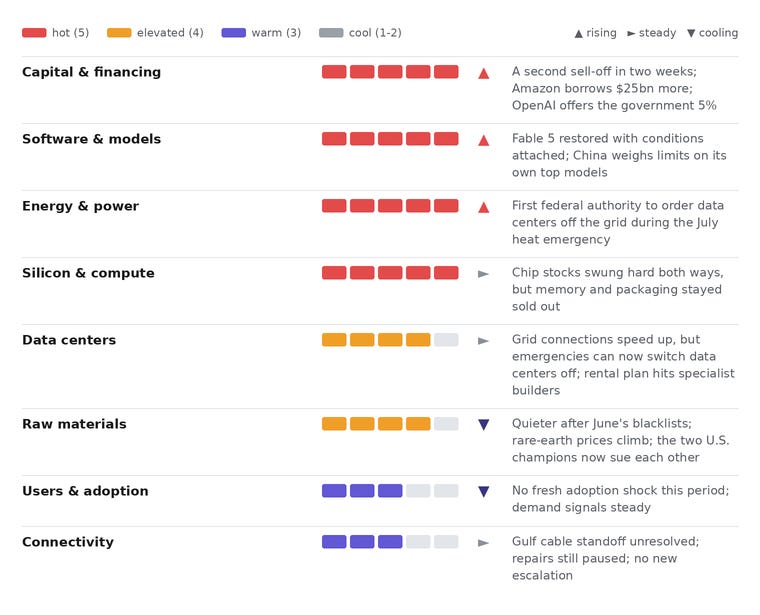
How to read this. AI Signal reads the AI build-out as one system, in eight layers: from the raw minerals and chips at the bottom, through data centers, power and models, up to users and the capital paying for it all. Each layer gets a heat score from 1 (quiet) to 5 (very active) and a trend arrow (▲ rising · ► steady · ▼ cooling). We lead with what moved and trace how a shock in one layer travels into the others. Every claim links to its source.
The build-out read
Last edition the story was a gap: violent markets on top, a booming physical build-out underneath. This period the rulebook itself moved, in three places at once.
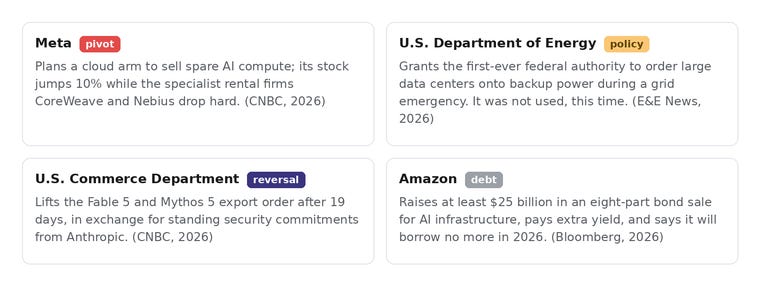
First, the model shutdown ended. On 30 June the U.S. government lifted the export order that had switched off Anthropic’s two most capable AI models worldwide, and Fable 5 came back on 1 July (CNBC, 2026). One week later, Reuters reported that China’s government is discussing the same kind of restriction for its own top models (Time, 2026). Second, during the 2 July heat emergency, the U.S. Department of Energy gave the country’s largest grid operator the authority, for the first time, to order big data centers off the grid and onto their own backup generators (E&E News, 2026).
Third, news broke that Meta plans to sell its spare AI computing power to outside customers, and in one day that changed what every dollar of AI construction spending means to the market (Bloomberg, 2026). Chip stocks fell hard worldwide the next morning, then recovered within two days (Yahoo Finance, 2026). The physical build-out did not slow through any of this. The rules around it moved in every layer.
The heat map
Deep dive — software & models: the off switch came back on, and now both sides may have one
What a 19-day shutdown leaves behind
On 30 June the U.S. government lifted the June export order against Anthropic’s two most capable AI models, and Fable 5 returned to users worldwide on 1 July (Al Jazeera, 2026). The interesting part is not the restoration. It is the price of the restoration. Anthropic agreed to standing conditions: it will proactively detect and address security risks in its models, work with the government on standards for future models, and report malicious activity (CNBC, 2026). That is a permanent supervisory relationship between a government and a frontier AI company, created by settlement rather than by law. The effect is immediate and it applies to every future model, not just these two.
Who is exposed? Every buyer outside the United States now knows a U.S.-hosted model can vanish for 19 days with no warning. That memory outlasts the fix, and it feeds the government-run “sovereign AI” programs that were already accelerating after June. The clearest beneficiaries are those programs, and the open-license models that companies treated as insurance during the shutdown.
Here is the second-order effect: the insurance itself is now at risk. On 7 July Reuters reported that China’s commerce ministry met Alibaba, ByteDance and the startup Z.ai to discuss restricting overseas access to China’s most advanced models, including open-license ones and models not yet released (Reuters via Yahoo Finance, 2026). Nothing is decided. But if both governments treat frontier models as controlled goods, the escape routes narrow from both ends. Base case: China limits only its top-end models and keeps mid-tier open models flowing. The stricter scenario, a broad restriction that covers open-license releases, is less likely but would push every country’s sovereign-AI spending up another step. A formal Chinese rule, or a quietly cancelled open-model release, would confirm the stricter reading. A major new open-license release from a top Chinese lab would break it.
Deep dive — energy: in a grid emergency, data centers are now switched off first
Faster to connect, first to be disconnected
During the 2–3 July heat emergency, the U.S. Department of Energy for the first time authorized the country’s largest grid operator, which serves about 67 million people across the eastern states, to order data centers of 50 megawatts or more onto their own backup generators (E&E News, 2026). The authority was never used. Paying large users to cut back held the peak at 162 gigawatts, the second-highest ever recorded and just below the 2006 record (Utility Dive, 2026). But the precedent now exists, and it works fast: in the next emergency, big AI campuses are formally the first users the grid can disconnect.
Follow what that does to the economics. A campus that can be ordered off the grid needs its own power plant on site to keep its contracts. So the rule quietly converts backup generation from an option into a requirement, and pushes new demand into the same generator and gas-turbine supply chain that is already backlogged toward the end of the decade. Data-center operators carry the new risk. Generator and turbine suppliers, and utilities that avoided rolling outages, gain. Households gained twice: the lights stayed on, and the emergency strengthened the argument, already adopted by 23 states, that data centers should pay their own grid costs.
The price signal underneath was blunt: wholesale electricity in the data-center corridor of the mid-Atlantic traded above $2,500 per megawatt-hour during the peak, against roughly $40 in normal conditions (Yahoo Finance, 2026). Base case: curtailment authority becomes standard summer practice and is rarely used. The scenario to watch, a real forced curtailment this summer, has meaningful odds in a hot year and would visibly split the market into grid-dependent and self-powered campuses. A repeat emergency order in the next heat wave confirms the reading; a quiet summer breaks it.
Deep dive — capital: Meta’s rental plan changes what AI spending means
When spending stops meaning demand
Bloomberg reported on 1 July that Meta is building a cloud business, internally called Meta Compute, to sell its spare AI computing power to outside customers (Bloomberg, 2026). For two years, investors have read the giant AI construction budgets as proof of demand: a company only builds what it needs. If the builders start renting out what they built, the same spending can also mean surplus. That re-reading repriced the whole stack in a day. Meta’s own shares rose about 10%, because renting out spare capacity is new revenue. The specialist compute-rental firms fell hard, CoreWeave by 10.8% and Nebius by 12.4%, because their biggest tenants may become their competitors (CNBC, 2026). The next morning the selling went global: South Korea’s main stock index fell almost 8% before closing lower, and its two memory-chip giants lost about $290 billion of combined value in the session (CNBC, 2026). Two days later most of it came back (Yahoo Finance, 2026).
The second-order effect sits in the debt market, not the stock market. The borrowing that funds the build-out is priced on the assumption that computing capacity stays scarce. On 7 July, in the middle of this argument, Amazon launched a bond sale of at least $25 billion to fund a construction budget of roughly $200 billion this year, and had to offer extra yield to fill the order book (CNBC, 2026; Fortune, 2026). High-yield bonds backing AI projects have already reached $31.9 billion this year through 8 July (Yahoo Finance, 2026). If a rental market makes compute cheaper, the weakest borrowers in that stack feel it first.
Base case: Meta launches the service narrowly, sells raw computing power to selected customers, and the market settles, as it did after June’s sell-off. The bigger scenario, several giants reselling capacity and a true open market for compute forming, looks unlikely this year but would push compute prices down and financing costs up together. Meta confirming the plan at its late-July earnings, or a second giant announcing resale, confirms the reading. Meta shelving the plan breaks it.
Charter Subscriber — 50% Off. Lock in 50% off your subscription for your first three months when you join by September 30, 2026.Claim the Charter rate →
Chain of the period
How one leaked business plan in a cloud division traveled through stock markets and into the price of borrowed money.

Each step is sourced above. Note what did not move: the memory chips are still sold out, the packaging lines are still booked, and the power queues are still long. The shock traveled entirely through the financial layer, from a business-model question to a stock repricing to a borrowing cost. That is the new transmission channel this model keeps flagging: the physical build-out runs on multi-year contracts, but the money that pays for it now reprices in an afternoon, and every repricing raises the cost of the next borrowed dollar.
Movers
What to watch next
The six regional grid operators’ capacity reports to the federal energy regulator, due around mid-July, and their rate justifications due in August. They will show how much room the grid really has. (FERC, 2026)
Whether China turns its talks with Alibaba, ByteDance and Z.ai into a formal rule restricting overseas access to Chinese models. Reuters reports nothing is decided. (Time, 2026)
The cloud giants’ late-July earnings: construction-spending guides, and whether anyone besides Meta talks about reselling compute. (Bloomberg, 2026)
Whether the U.S. government accepts OpenAI’s offer of a 5% stake, floated for all the leading AI companies, worth roughly $42.6 billion at OpenAI’s latest valuation. (CNBC, 2026)
The 10 November deadline when China’s paused rare-earth and graphite export rules are set to return, sitting under every magnet and battery in the stack. (Clark Hill, 2026)
Whether undersea-cable repairs in the Gulf resume. The world’s largest repair company has kept its pause in place, and a new cable fault there could become semi-permanent. (Scientific American, 2026)
Sources
[2] Anthropic — “Redeploying Claude Fable 5,” Jul 2026. anthropic.com (accessed 9 Jul 2026).
Figures verified to the linked sources as of 9 July 2026.
***