

The read
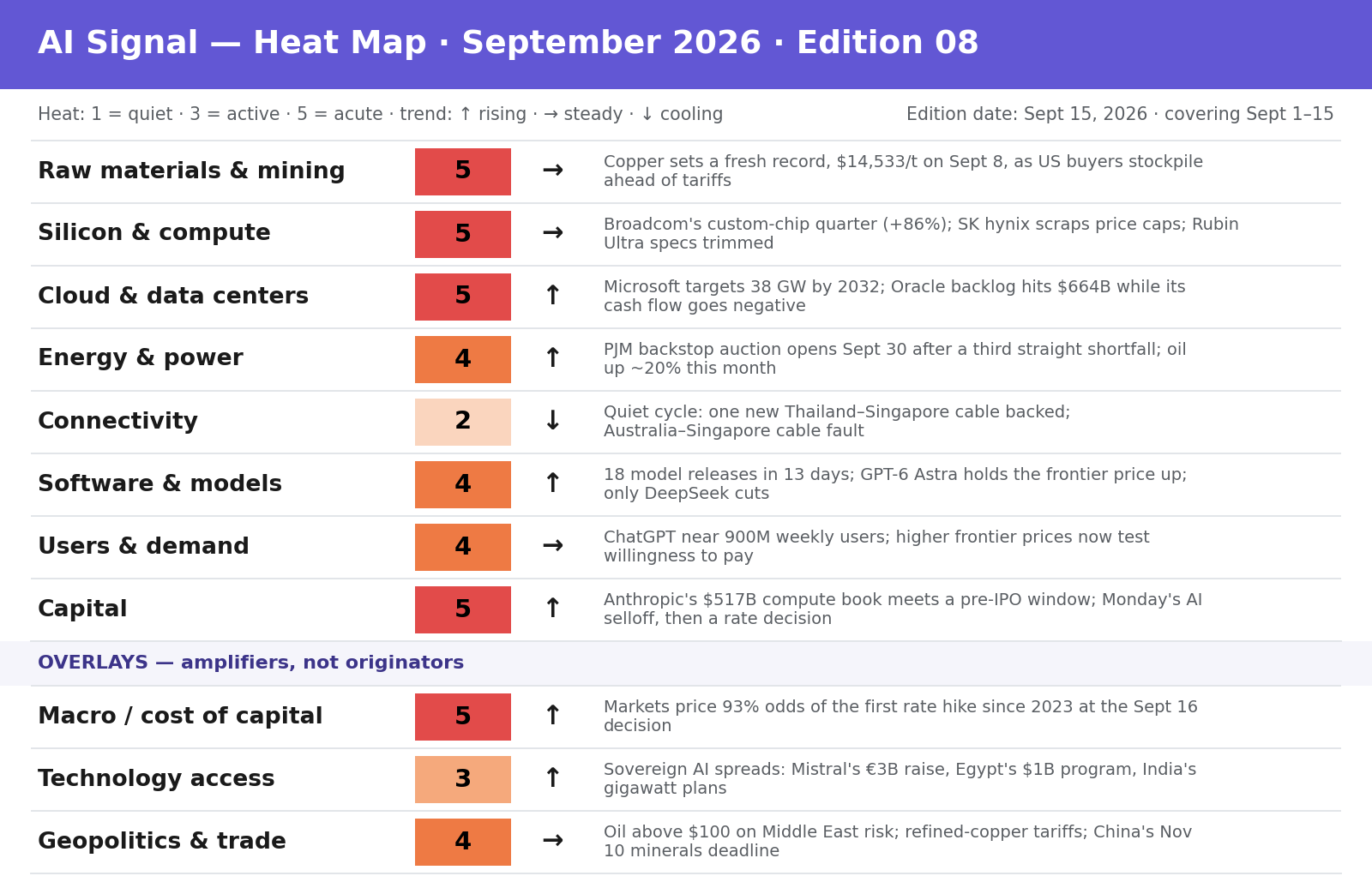
This edition goes to press on the eve of a rate decision. Futures markets give a 93 percent chance that the Federal Open Market Committee lifts its policy rate a quarter point on Wednesday, September 16, to a range of 3.75 to 4.00 percent, the first increase since July 2023 (Kiplinger, Sep 15). The market flinched first: on Monday, chipmakers fell 5 to 6 percent and AI infrastructure names dropped 5 to 8 percent.
The strange part is what the builders did while the financiers sweated. Microsoft plans to more than triple its data-center fleet, from about 12 gigawatts today to 38 gigawatts by 2032 (Bloomberg, Sep 10). Anthropic disclosed $517 billion of compute contracts signed in eleven months, just ahead of a confidential filing for an initial public offering (Yahoo Finance, Sep 13). Oracle reported a $664 billion order backlog and spent more on capacity in one quarter than its operations brought in (CNBC, Sep 10).
The tell sits in the price list. On September 3, OpenAI launched its new flagship at $10 per million input tokens and $50 per million output, holding the frontier price up while nearly every rival cut around the edges (Yahoo Finance, Sep 2026). After two years of falling token prices, the cost of metal, memory and money has started to show up in what users pay. That is this edition’s through-line: the bill for the build-out is moving downstream.
The heat map
Deep dive — Capital
Half a trillion, confidentially
Anthropic has signed roughly $517 billion of compute commitments in eleven months, spread across about a decade of delivery. The figure surfaced as the company confidentially filed to go public. It breaks down to more than $300 billion with Amazon and Alphabet for around 11 gigawatts of capacity, upward of $30 billion of Microsoft Azure capacity, up to $45 billion with SpaceX’s Colossus, a 2-gigawatt accelerator deal with AMD, and a string of contracts with smaller “neocloud” providers (Yahoo Finance / 24-7 Wall St, Sep 13). Eleven months ago the disclosed number was $180 billion.
Oracle showed what the other side of such contracts looks like. Its remaining performance obligations, the money customers have contracted to spend, rose $26 billion in the quarter to $664 billion, and cloud infrastructure revenue grew 121 percent to $7.4 billion (CNBC, Sep 10). Serving that book cost $28.5 billion of capital in a quarter that produced $23.1 billion of operating cash. Free cash flow came to negative $5.4 billion, and this year’s plan is $90 to 95 billion of gross capital spending, with $20 to 25 billion pushed into “alternative financing” off Oracle’s own books (TIKR, Sep 14).
The queue behind them is forming fast: Nscale seeking about $3.5 billion pre-listing, Mistral raising €3 billion, Blue Owl planning a publicly traded data-center trust (DataX Connect, Sep 11). All of it reaches for the equity window at the exact moment the Federal Reserve prepares to make money dearer. In the model, capital is a short-lag edge: financing terms hit the build-out within quarters, and the macro overlay amplifies whatever happens. The circular-financing loop between chip vendors, labs and clouds stays armed, and in a bad scenario it widens damage rather than damping it. Monday’s markdowns were the market rehearsing that scenario, one day before the Fed decides.
Deep dive — Cloud & data centers
Microsoft names the number
Microsoft’s internal plan, reported by Bloomberg on September 10, is to grow from roughly 12 gigawatts of owned and leased data-center capacity today to more than 38 gigawatts by 2032, an addition of about 26 gigawatts (Bloomberg, Sep 10) (Aroged, Sep 14). For scale, 26 gigawatts is on the order of two dozen large nuclear reactors’ output, contracted by one company. Microsoft completed 88 data centers in its last fiscal year, and its reported capital spending has climbed from $55.7 billion in 2024 toward roughly $175 billion expected next year.
The rest of the period kept pace. Google committed €13 billion over two years to Finland, its biggest European push yet (Google, Sep 9). Tata Consultancy Services set out plans for a one-gigawatt campus in southern India (Bloomberg, Sep 5). Oracle brought 850 megawatts online in a single quarter and says its accelerator fleet runs at 97.9 percent utilization. And the cycle’s first hard regulatory stop arrived: Thailand suspended 49 planned data-center projects until a legal framework for power and water is in place (DataX Connect, Sep 11).
Trace it through the map. Announced gigawatts become chip orders within quarters, which is how Broadcom just guided to a $34.8 billion quarter. The friction lives at the energy link: PJM Interconnection, the largest US grid operator, has missed its reliability target three years running and opens an emergency backstop auction on September 30 (OilPrice, 2026). The model’s hardest link, power to data centers, still gates everything: announcements are not megawatts, and interconnection queues, not capital, will decide which of these plans exist by 2030.
Deep dive — Software & models
The frontier price stops falling
Eighteen models shipped from eight labs in the first thirteen days of September, by one tracker’s count (Capital & Compute, Sep 2026; single-outlet tally, flagged as such). The interesting one is the price tag. OpenAI’s GPT-6 Astra arrived September 3 at $10 per million input tokens and $50 per million output, with long-context work billed at double and a “fast” tier reaching $40/$150 (Yahoo Finance, Sep 2026). Anthropic held its base rates and instead cut cache-read pricing 75 percent. Google and Meta priced their new releases as utility models, well below the frontier. Of the eighteen releases, exactly one, DeepSeek’s V4.1 Flash, cut headline prices.
For two years the reliable story in this layer was deflation: capability up, token prices down. That story paused this period at the top of the market, and the reason runs through the silicon layer’s tightest gate. Dynamic random-access memory (DRAM) supply is expected to stay short into 2027; high-bandwidth memory (HBM), the stacked chips bolted to every AI accelerator, should grow bit shipments 50 to 60 percent next year and still fall short of demand (TrendForce, Aug 4). SK hynix has reportedly struck price ceilings out of its long-term contracts, and Samsung is pressing for increases of up to 20 percent this quarter (BigGo / ZDNet Korea, Sep 2026; reported).
Nvidia has begun evaluating lower memory configurations for its Rubin Ultra generation, 8-high stacks instead of the original 12-high design (TrendForce, Aug 4). That is the first time this cycle a flagship roadmap has bent to an input constraint rather than a design choice. Model demand created the shortage; the shortage now feeds back as cost pressure on the labs. The open question is demand: whether enterprises renew at the new frontier prices or step down a tier. Renewal season, not benchmarks, is the next capability test.
Chain of the month
How one shock travels across the ecosystem — the non-obvious link most coverage misses.
Memory scarcity deepens; contract price caps scrapped → silicon chokepoint (HBM & DRAM): no damping → Nvidia trims Rubin Ultra memory specs; system costs floor → frontier token prices rise (GPT-6 Astra at $10/$50)
Start in the memory fabs. SK hynix removing price ceilings from long-term contracts, with Samsung pushing 20 percent quarterly increases, is a supply shock at the silicon layer’s tightest serial gate. High-bandwidth memory is a chokepoint in the model, so the shock passes downstream at full strength instead of damping.
First stop: Nvidia re-speccing its 2027 flagship around scarcer memory, which puts a floor under system and cloud costs. Second stop: the labs, whose margins were already carrying the training bill. Eleven days into September, the leading lab priced its new flagship above the utility field instead of below its predecessor, and only one of eighteen September releases cut prices.
The input squeeze has reached the checkout page. The upstream half of the story is metal rather than memory: copper set another record on September 8, and that chain runs through the mines our sister brief Africa Signal covers at the source.
Movers
Microsoft — A 38-gigawatt capacity target by 2032, up from about 12 today. The plan would make one company the world’s largest private buyer of power, chips and concrete, and it surfaced the week money got dearer.
Anthropic — $517 billion of compute locked in eleven months, then a confidential filing to go public. The compute book has become the balance sheet.
OpenAI — GPT-6 Astra at $10/$50 per million tokens on September 3. The first frontier launch of the cycle that held prices up instead of cutting them.
Oracle — A $664 billion contracted backlog, negative $5.4 billion free cash flow, and a $90-to-95-billion capex year. The order book now runs ahead of the cash machine.
SK hynix — Reportedly struck price ceilings from long-term memory contracts, with DRAM gross margins already above 90 percent. The quiet setter of everyone else’s margins.
What to watch next
The Fed decision, September 16, 2 pm Eastern. Trigger: the quarter-point hike lands as priced, or Warsh signals more behind it. Either way, data-center financing models re-run at a higher discount rate the same afternoon.
PJM’s backstop capacity auction, September 30 to October 21. Trigger: clearing at or near the raised $555 per megawatt-day cap would confirm power scarcity is repricing the eastern US build-out.
Fourth-quarter memory contract talks. Trigger: whether resets land nearer TrendForce’s 13 to 18 percent estimate or Samsung’s 20 percent ask, and whether more chip roadmaps get re-specced the way Rubin Ultra was.
The AI listings queue. Trigger: Anthropic’s filing going public, Nscale’s $3.5 billion raise pricing, and Blue Owl’s data-center trust. The first pure-play AI listing into rising rates prices the whole sector.
China’s mineral-controls deadline, November 10. Trigger: implementation notices from the Ministry of Commerce, and whether H200 uptake stays stuck near 13 percent of the reported quota.
US refined-copper tariff details. Trigger: scope and rates for next year. Each expansion pulls more metal into US warehouses and tightens everyone else’s power and cooling bill.
Sources
Every material claim verified to one primary source or two independent reputable sources; claims that rest on single-outlet reporting or tracker tallies are attributed as such in the text.
[1] Kiplinger — “September Fed Meeting: Live Updates and Commentary,” 15 Sep 2026. link; CNBC, 28 Aug 2026. link
[2] Bloomberg — “Microsoft AI Focused Data Center Plan to Add 26 Gigawatts of Compute,” 10 Sep 2026. link; Aroged, 14 Sep 2026. link
[3] 24/7 Wall St via Yahoo Finance — “Anthropic Locks Down $517 Billion in Compute Ahead of IPO,” 13 Sep 2026. link; Forkast, Sep 2026. link
[4] CNBC — “Oracle (ORCL) Q1 earnings report 2027,” 10 Sep 2026. link; TIKR, 14 Sep 2026. link
[5] Yahoo Finance — “GPT-6 Astra Pricing Confirms OpenAI’s Premium Track: $10/$50 While Rivals Cut,” Sep 2026. link
[6] Capital & Compute — “New AI Models Released in September 2026,” Sep 2026 (release tracker; flagged where used). link
[7] South China Morning Post — “Copper rally sets record price on LME,” 8 Sep 2026. link; Bloomberg, 7 Sep 2026. link
[8] Quartz — “Broadcom Q3 FY2026 earnings: Record revenue on AI chip demand,” 2 Sep 2026. link; 24/7 Wall St. link
[9] TrendForce — “DRAM Supply to Remain Tight in 2027, Prompting NVIDIA to Lower HBM Configurations for Rubin Ultra,” 4 Aug 2026. link
[10] BigGo Finance (citing ZDNet Korea, Bernstein, TrendForce) — “SK Hynix Reportedly Scraps Long-Term Contract Price Caps,” Sep 2026. link (single-outlet reporting, attributed as such)
[11] OilPrice — “PJM Auction Comes Up 6.8 Gigawatts Short As Data Centers Devour Power,” 2026. link; Utility Dive. link
[12] DataX Connect — “Weekly Data Centre News, 11th September 2026.” link
[13] Bloomberg — “TCS Plans One-Gigawatt Capacity Data Center in Southern India,” 5 Sep 2026. link; Google — €13B Finland investment release, 9 Sep 2026. link
[14] Demand Sage — “ChatGPT Statistics, September 2026” (aggregator estimate, flagged where used). link
[15] SubTel Forum — submarine cable news, 1–15 Sep 2026. link
[16] TechTimes — “Nvidia H200 Chips Enter China at 13% of Quota,” 20 Aug 2026. link
AI Signal is a twice-monthly systems brief. Method: the AI-ecosystem model — eight layers plus regulatory, geopolitical, macro and technology-access overlays — scored for intensity and direction, with shocks traced through directed transmission edges. This edition covers September 1–15, 2026. © 2026 The Critical Post.
***