


Covering August 2026 · ~9 min read · Subscriber edition
The read
On August 6, Reuters revealed an official order from the Democratic Republic of Congo, the world’s second-largest copper producer, banning exports of copper and cobalt concentrates (Reuters, Aug 6). Eight days later, cash copper touched a record near $14,500 a tonne and the premium for metal now over metal in three months hit a five-year high (Bloomberg, Aug 14). And on August 28, the Federal Reserve’s new chairman, Kevin Warsh, told the Jackson Hole symposium that inflation remains above target and that “the responsibility for 65 months of sustained, elevated inflation sits squarely with the central bank” (Federal Reserve, Aug 28).
Those three headlines are one story. The bill for the AI build-out is now arriving in three currencies at once: metal, memory and money. All three got more expensive in August.
The strange part, again, is that demand has never looked stronger. Nvidia booked a $96 billion quarter and guided to $108 billion (Nvidia, Aug 26), TSMC’s July sales grew 45% from a year earlier (TSMC, Aug 10), and CoreWeave’s order backlog reached roughly $129 billion (CoreWeave, Aug 11). Nobody doubts the machine wants to grow. The question this period is what its inputs cost, and who can still afford them.
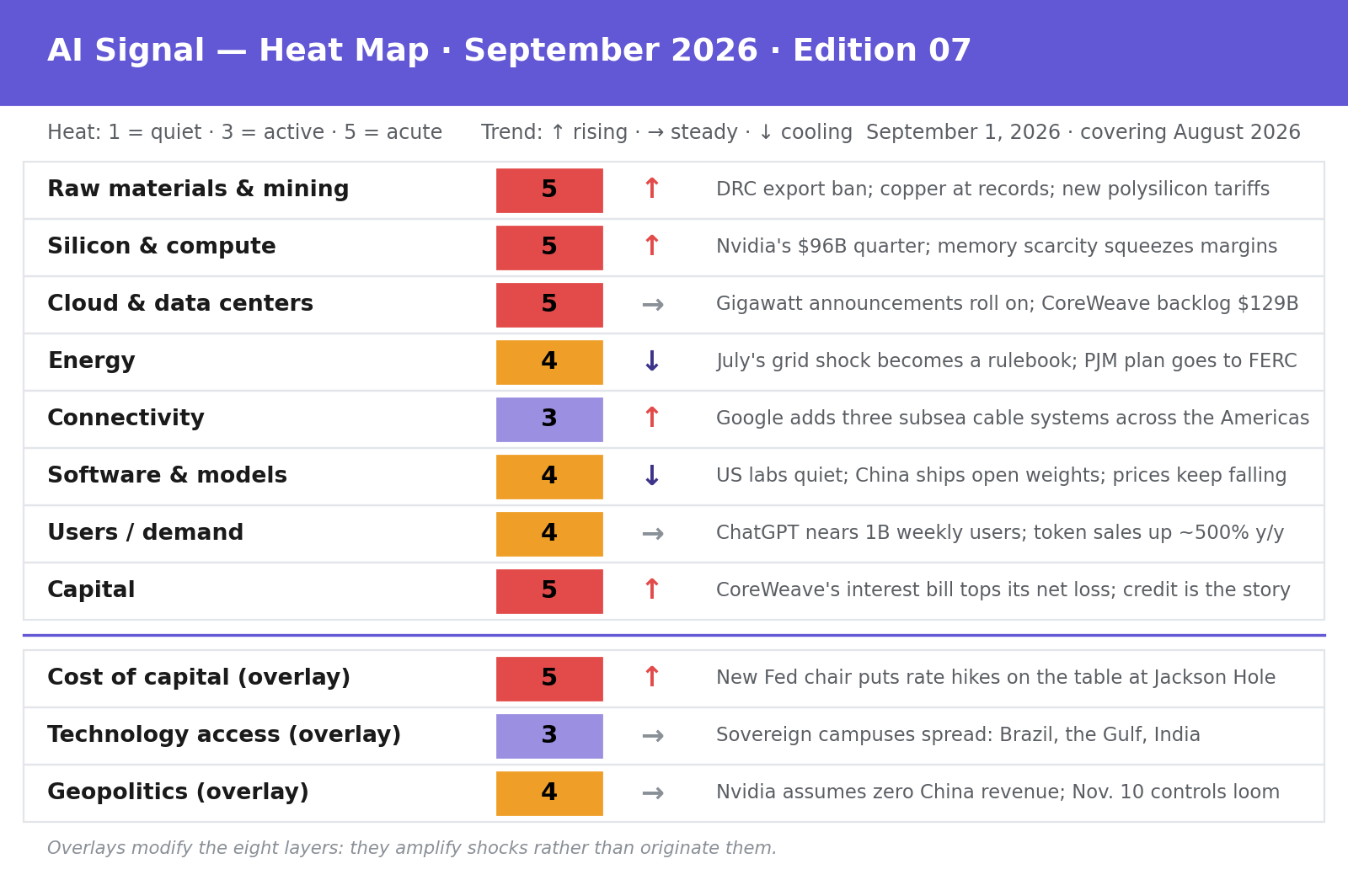
The heat map
Deep dive — Capital & the cost of it
A hawk walks into Jackson Hole
Kevin Warsh used his first Jackson Hole keynote as Federal Reserve chairman to say the quiet part: inflation has run above the 2 percent target for 65 months, and he thinks the Fed owns it. He offered no forward guidance, by design, but noted that “credit and loan markets are showing few signs of policy restraint” (Federal Reserve, 2026). Reporters heard the message clearly: rate increases are in play if inflation doesn’t fall (Axios, 2026). Stocks fell that afternoon (CNBC, 2026).
Why it matters here: the build-out now runs on borrowed money, and August produced the clearest exhibit yet. CoreWeave’s second quarter was a monster on the demand side, with revenue up 112% to $2.6 billion and backlog around $129 billion. But its interest expense was $640 million, more than its $626 million net loss, on $31.4 billion of recourse debt (CoreWeave, 2026). The stock jumped 14% on the print (CNBC, 2026), then gave much of it back the following week as rates climbed and debt-financing worries returned (Motley Fool, 2026).
The model treats the cost of capital as an overlay: it doesn’t start shocks, it amplifies them. A Fed chair openly weighing hikes reprices every leveraged layer at once, and the circular-financing loop stays armed. Nvidia’s own forward supply commitments more than doubled in a single quarter, to $279 billion (Yahoo Finance, 2026). In a downturn that loop widens the damage. Watch financing terms, not headlines; they move first.
Deep dive — Raw materials & mining
The metal bill comes due
The order, signed at the end of June and revealed by Reuters on August 6, bans exports of copper and cobalt concentrates, the semi-processed ore that feeds smelters abroad (Reuters, 2026). The measure affects roughly a fifth of the country’s copper output (Mining.com, 2026), though the mines minister can grant waivers, and Ivanhoe was quick to note that its own operations hold exemptions (Ivanhoe Mines, 2026). The aim is to force refining onshore. The immediate effect is scarcity everywhere else.
The market’s response was violent. Cash copper set records near $14,500 a tonne, the cash-to-three-month spread widened to $434, a five-year high, and London Metal Exchange stocks fell for 42 straight sessions, the longest slide since 2014 (Mining.com, 2026) (Bloomberg, 2026). Remember why this brief cares: data centers alone are expected to absorb about 500 kilotonnes of copper this year, roughly all of global demand growth (Kpler, 2026).
Washington added its own squeeze. An August 6 proclamation under Section 232 of the Trade Expansion Act puts a 15% tariff and minimum import prices on polysilicon and its derivatives, the raw feedstock of both solar panels and silicon wafers, effective December 4 (White & Case, 2026). In the model, refining is the master chokepoint: shocks that cross it don’t damp, they amplify. This one crossed it twice in a single day’s news, in Kinshasa and in Washington. Our sister brief Africa Signal picks the story up at the mine gate.
Deep dive — Silicon & compute
Even Nvidia pays the memory toll
Nvidia’s quarter was, by any historical standard, absurd: $96.2 billion in revenue, up 106% from a year ago, with data-center revenue of $89 billion and guidance of $108 billion for the current quarter, assuming zero revenue from China (Nvidia, 2026). The stock fell anyway. The reason was the margin line: gross margin is guided to bottom around 71 to 72 percent, down from 75, and chief executive Jensen Huang named the culprit, saying “memory scarcity today is being driven in large part by the AI buildout itself” (Yahoo Finance, 2026).
The memory market backs him up. Samsung and SK hynix both warn that the shortage of high-bandwidth memory (the stacked chips bolted to every AI accelerator) and now conventional DRAM could run into 2027 and beyond, with customers reserving supply years ahead (Tom’s Hardware, 2026). Samsung has reportedly committed about 70% of its memory capacity through 2031 under long-term agreements with buyers led by Microsoft, Nvidia and Google, and SK hynix has approved a $38 billion investment program stretching to the same horizon (Yahoo Finance, 2026).
The silicon layer’s chokepoints are serial: foundry, advanced packaging, high-bandwidth memory. Output is capped by the tightest of the three, and this period the tightest is memory. TSMC’s 45% July growth says the foundry gate is wide open (TSMC, 2026). So the squeeze lands downstream: on system prices, on cloud capital budgets, and, as Nvidia just showed, on the margins of the build-out’s biggest winner. When the toll collector starts paying tolls, the chokepoint is real.
Chain of the month
How one shock travels across the ecosystem — the non-obvious link most coverage misses.
DRC concentrate export ban revealed (Aug 6) → refining chokepoint: no damping → copper at records, five-year backwardation → data-center power and cooling costs rise into a hawkish Fed
Start at the mine. Congo’s ban routes a fifth of its copper output away from world markets, and because the shock passes through refining, the model’s master chokepoint, it lands downstream at full strength: record cash prices and the steepest scramble for near-term metal since 2021. Copper is the build-out’s circulatory system, in the power distribution, busbars and cooling of every new hall, and data centers are absorbing roughly all of this year’s demand growth. So the squeeze arrives at the cloud layer just as PJM Interconnection, the largest US grid operator, formalizes rules telling big new loads to bring their own generation or accept curtailment, and just as a new Fed chairman prices the debt that funds all of it a little higher. Three inputs, one message: the cost of entry to the build-out is rising in metal, megawatts and basis points at the same time. Projects with marginal economics get culled first.
Movers
Kevin Warsh — A first Jackson Hole speech as Fed chairman with no forward guidance, a claim of 65 months of failure, and a plain hint that the next move could be up. The build-out’s financiers heard it.
Democratic Republic of Congo — One official order rerouted the world copper market in a week. The refining-localization play is straight from the Indonesian nickel textbook.
Nvidia — A $96 billion quarter, a $108 billion guide, zero China assumed, and margins bending under memory costs. Also now carrying $279 billion of forward supply commitments.
Samsung & SK hynix — Capacity reportedly locked to 2031, shortage warnings stretching toward 2030, spot prices several times contract levels. Memory is the seller’s market of the cycle.
PJM Interconnection — Its data-center package (a 50-megawatt load registry, bring-your-own-capacity, curtailment from mid-2027) is now before federal regulators. Every other grid will study it.
What to watch next
The September Federal Open Market Committee meeting. Trigger: a hike, or hike-leaning language. Either one re-runs every data-center financing model at a higher discount rate.
FERC’s answer to PJM, and the fall backstop auction (Sept 30–Oct 21). Trigger: clearing at or near the raised $555 per megawatt-day cap would confirm power scarcity is repricing the eastern build-out.
Enforcement of Congo’s export ban. Trigger: exemptions or quota deals for individual miners, and whether London Metal Exchange stocks keep falling. A negotiated carve-out cools the squeeze fast.
Fourth-quarter memory contract talks. Trigger: the size of high-bandwidth-memory and DRAM price resets, and whether Nvidia’s margin trough lands at the guided 71 to 72 percent or below it.
China’s mineral-controls deadline, reported for November 10. Trigger: implementation notices from the Ministry of Commerce, and whether Beijing ultimately licenses or blocks Nvidia’s H200 sales, which Nvidia now assumes are zero.
The next data-center debt prints. Trigger: securitization spreads versus July’s Aligned deal. One pulled financing would mark the credit turn this brief has been tracking since Edition 06.
Sources
Every material claim verified to one primary source or two independent reputable sources; claims that rest on single-outlet reporting are attributed as such in the text.
[1] Reuters (via U.S. News) — “Congo Bans Exports of Copper, Cobalt Concentrates, Official Order Says,” 6 Aug 2026. link; Mining Weekly, 6 Aug 2026. link
[2] Ivanhoe Mines — clarification news release, Aug 2026. link
[3] Mining.com — “Copper price holds near record as London warehouse bidding war looms,” Aug 2026. link
[4] Bloomberg — “Copper Crunch Worsens as Key Spread Heads for Highest Since 2021,” 14 Aug 2026. link
[5] White & Case — polysilicon Section 232 proclamation of 6 Aug 2026. link; Wiley Rein. link
[6] Federal Reserve — Chairman Kevin Warsh, “In Our Time,” Jackson Hole keynote, 28 Aug 2026. link
[7] Axios, 28 Aug 2026. link; PBS NewsHour, 28 Aug 2026. link
[8] CNBC — market reaction, 28 Aug 2026. link
[9] Nvidia — Q2 FY2027 results, 26 Aug 2026. link
[10] Yahoo Finance — Nvidia earnings coverage, 27 Aug 2026. link
[11] TSMC — July 2026 revenue report, 10 Aug 2026. link; CNBC. link
[12] Tom’s Hardware — Samsung/SK hynix memory shortage warnings, Aug 2026. link
[13] Yahoo Finance — Samsung long-term memory agreements, 31 Aug 2026. link
[14] CoreWeave — Q2 2026 results (SEC filing), 11 Aug 2026. link
[15] CNBC — CoreWeave stock pops 14%, 11 Aug 2026. link
[16] The Motley Fool — market wrap, 18 Aug 2026. link
[17] Canary Media / Ohio Capital Journal — PJM’s data-center plan, 10 Aug 2026. link; Data Center Knowledge. link
[18] US Department of Energy — Paducah AI-energy campus partnership. link; Data Center Knowledge. link
[19] Data Center Knowledge — “New Data Center Developments: August 2026.” link
[20] Bloomberg — Google’s three Americas subsea cables, 11 Aug 2026. link; Data Center Dynamics. link
[21] The Information via PYMNTS — ChatGPT nears 1 billion weekly users, Jul 2026. link
[22] Kpler — “Copper: the perfect squeeze,” 17 Jul 2026. link
[23] Capital & Compute — August 2026 model-release tracker (used for the count and open-weight pattern of August releases, flagged as such). link
[24] PJM Board — decisional letter on reliability backstop procurement, 27 Jul 2026. link
AI Signal is a twice-monthly systems brief from The Critical Post, sister to Africa Signal. Method: the AI-ecosystem model — eight layers plus regulatory, geopolitical, macro and technology-access overlays — scored for intensity and direction, with shocks traced through directed transmission edges. This edition covers the full month of August 2026 (no mid-August edition was published). © 2026 The Critical Post.
***