

Edition 03 · June 2026 · covering 11–24 June 2026 · ~9 min read · Subscriber edition
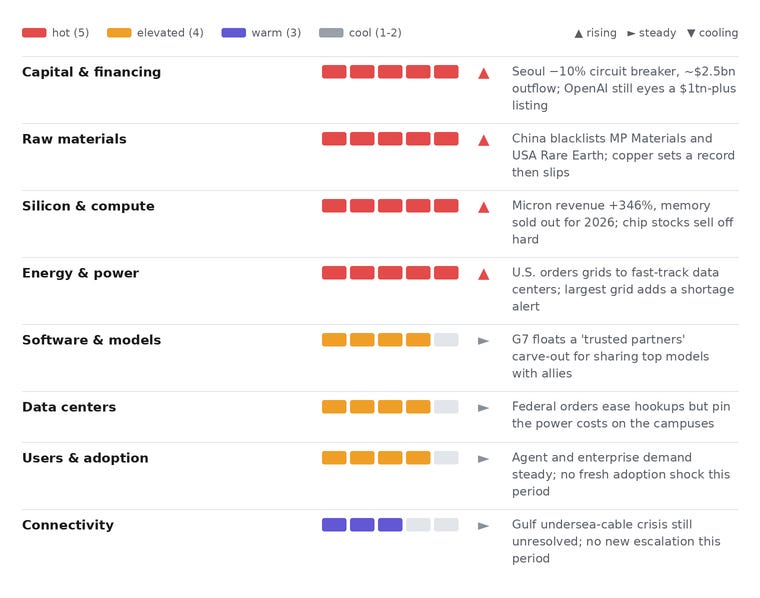
How to read this. AI Signal reads the AI build-out as one system, in eight layers — from the raw minerals and chips at the bottom, through data centers, power and models, up to users and the capital paying for it all. Each layer gets a heat score from 1 (quiet) to 5 (very active) and a trend arrow (▲ rising · ► steady · ▼ cooling). We lead with what moved and trace how a shock in one layer travels into the others. Every claim links to its source.
The build-out read
Last edition the build-out hit the money wall. This edition the two forces driving it — Washington’s policy and Wall Street’s money — pulled in opposite directions, hard.
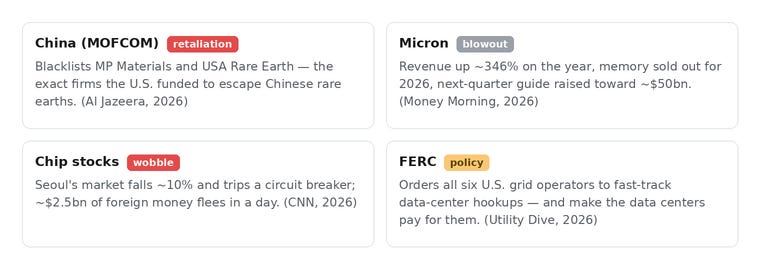
On 22 June, China blacklisted the two American companies the U.S. government has spent hundreds of millions of dollars building up to break its dependence on Chinese rare earths — the mining firm MP Materials and the magnet maker USA Rare Earth — in retaliation for a Pentagon list of Chinese military-linked firms (Al Jazeera, 2026). The next morning the market’s nerve snapped: South Korea’s main stock index fell almost 10% and tripped a circuit breaker, with roughly $2.5 billion of foreign money fleeing in a single session and the chip-heavy indexes following it down worldwide (CNN, 2026).
And yet the machine underneath kept roaring. On 24 June the memory-chip maker Micron reported revenue up about 346% from a year earlier, said the specialized chips that feed the processors are sold out for the year, and guided next quarter even higher (TheStreet, 2026). The same week, federal energy regulators ordered the country’s grid operators to put data centers in a fast lane to the power grid (FERC, 2026). The story of this period is that gap: the real economy of chips and power is accelerating, while the politics around it — and the price of the stocks on top of it — got a lot more violent.
Charter Subscriber — 50% Off. Lock in 50% off your subscription for your
first three months for the five newsletters when you join by September 30, 2026.
The heat map
Deep dive — raw materials: China hits America’s rare-earth champions
Beijing aims at the exact firms built to replace it
Rare earths are a small family of metals that turn into the powerful permanent magnets inside motors, fans, hard drives, generators and the cooling gear in every data center. China refines the overwhelming majority of them, which is why any move Beijing makes here travels up through the whole hardware stack. On 22 June it made one: its commerce ministry added ten U.S. firms to an export-control list, among them MP Materials, the company that runs America’s only large rare-earth mine, and USA Rare Earth, a magnet maker (CNBC, 2026).
The pointed part is the targeting. These are the two firms Washington has poured public money into precisely to escape its dependence on China, and Beijing went after the exact companies meant to replace it (Bloomberg, 2026). In the near term the bite is mostly symbolic — both companies say they have already cut off Chinese equipment and supplies, so there is little left to cut. The signal is what matters.
And the signal points at a date. The harshest version of China’s rare-earth rules is only suspended, not lifted, and that pause runs out on 10 November 2026 (Mining.com, 2026). The decision-relevant read for anyone buying motors, drives, or cooling equipment: the lever that sits under the entire build-out is still loaded, and Beijing just reminded everyone it is willing to pull it. The detail on the minerals themselves runs in this period’s Critical Minerals & Rare Earth Signal.
Deep dive — capital: the market’s nerve snaps, the fundamentals don’t
A circuit-breaker selloff lands the day before a blowout
For two years the worry was abstract: is AI a bubble? On 23 June it got concrete. South Korea’s market — home to the world’s biggest memory-chip makers — fell almost 10% in a day, one of its worst sessions on record, forcing a 20-minute trading halt as about $2.5 billion of foreign money rushed out (TechTimes, 2026). The selling spread: the U.S. tech index dropped about 2% and a basket of big chip stocks fell roughly 8% on the day (CNN, 2026).
Here is the catch that makes this more interesting than a simple crash. The trigger was not weak AI demand. It was the opposite kind of news — strong jobs data lifting interest rates, which mechanically lowers what investors will pay today for profits expected years from now. The day after the rout, Micron reported its biggest quarter ever, revenue up about 346% on the year, and raised its forecast (IG, 2026). The thing being sold and the thing being built were moving in opposite directions in the same 24 hours.
That gap is the signal. It does not tell you the build-out is failing; it tells you that the stocks riding on top of it have become a separate, faster-moving animal — one that now reacts to bond yields and crowd positioning as much as to chips and customers. Meanwhile the largest of the private AI firms, OpenAI, is still pushing toward a stock-market debut that could value it above a trillion dollars (Investing.com, 2026). For anyone with exposure, the takeaway is to separate the two clocks: the physical build-out runs on multi-year contracts, the share prices on top of it now turn in a single afternoon.
Deep dive — energy: Washington floors it and taps the brakes at once
Connect the data centers faster — and brace for shortages
Power is the build-out’s binding constraint: getting a new data center hooked up to the electricity grid can take years, and that queue, more than anything, decides where these campuses get built. On 18 June the federal energy regulator tried to shorten the wait, ordering all six regional grid operators to overhaul the rules for connecting big new electricity users — report within 30 days how much spare power capacity they have, and within 60 days justify or rewrite the rates large users pay (FERC, 2026). The press called it a government-mandated fast lane to the grid (TechCrunch, 2026).
Then, almost in the same breath, came the warning light. On 24 June the largest U.S. grid operator — which keeps the lights on for about 67 million people across the eastern states — added a new “capacity advisory,” a formal alert for when electricity supplies could run tight even without a heat wave, precisely because data-center demand is stretching the system (Bloomberg, 2026). One arm of the government is pressing the accelerator while another flashes a low-fuel light.
That contradiction is the constraint, stated plainly. The demand is real and growing — one industry research body now estimates data centers could consume 9% to 17% of all U.S. electricity by 2030, up from 4–5% today (Data Center Knowledge, 2026). Speeding up the paperwork to connect a campus does not conjure the electrons to run it. The thing to watch is who ends up paying when those two truths collide — and the new rules try to put that cost on the data centers, not on households.
Charter Subscriber — 50% Off.Lock in 50% off your subscription for your first three months when you join by September 30, 2026.Claim the Charter rate →
Chain of the period
How a magnet decision in Beijing ends up forcing a sell button in Seoul — the cross-layer link the model is built to trace.
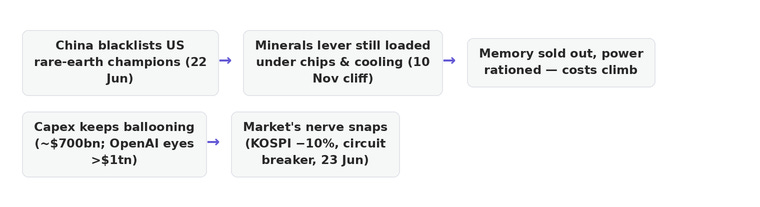
Each step is sourced above and below. The signal is the same one the model keeps surfacing: every physical limit in the stack — minerals, memory, electricity — eventually shows up as a financial strain at the top. Copper, the metal the whole buildout is wired with, set a record this month before slipping back, a reminder that the raw inputs are tightening too (Yahoo Finance, 2026). Stack enough constraints at the bottom and add a jolt in interest rates at the top, and you get a circuit-breaker day — even in a week when the underlying business is booming.
Movers
What to watch next
China’s 10 November rare-earth cliff — the date the suspended, harshest export rules are set to bite, sitting under every magnet and chip in the stack. (Mining.com, 2026)
Whether the 23 June rout was a blip or a turn — and how the big chip names trade into their next set of results. (CNN, 2026)
The grid operators’ 30- and 60-day answers to the new federal orders, and the first real test of data-center curtailment when summer heat peaks. (FERC, 2026)
Whether the faster ramp of next-generation memory eases the shortage or simply feeds bigger systems — Micron still says it is sold out for the year. (TheStreet, 2026)
The G7’s “trusted partners” idea for sharing top AI models with allied democracies, with a coordinated plan promised within a month. (CNBC, 2026)
Sources
Figures verified to the linked sources as of 24 June 2026.
***