

Powers Signal Edition 06 (August 6, 2026, covering July 23 – August 6),
Top line · this edition
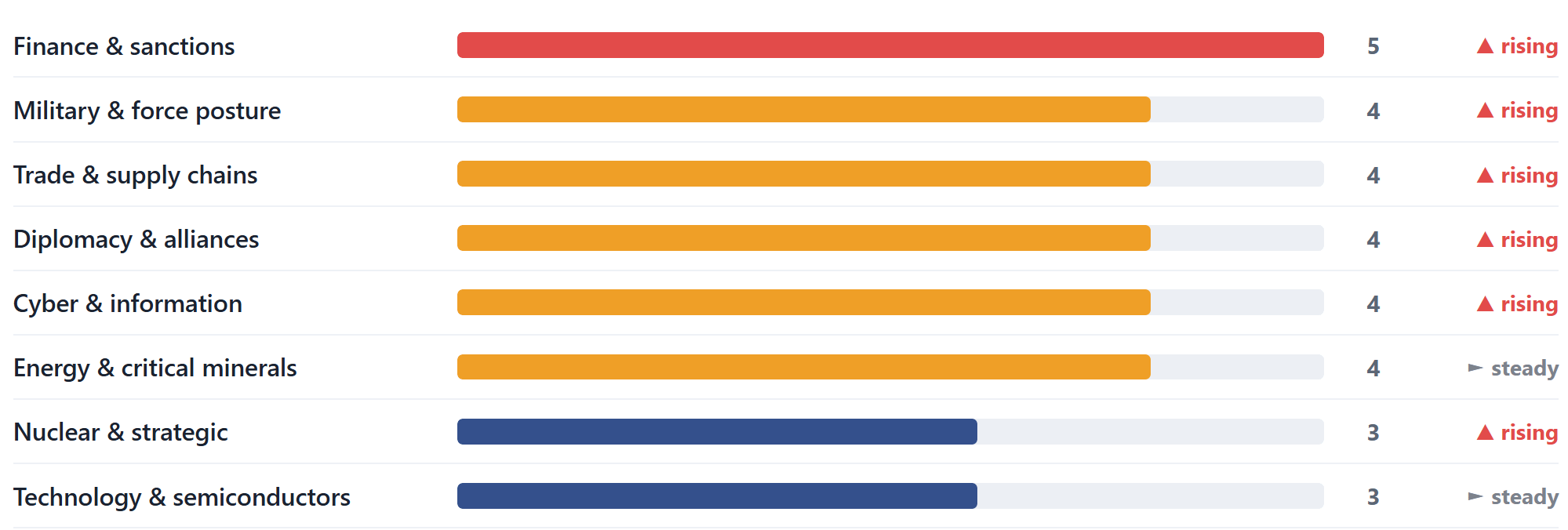
The past two weeks turned pressure on Russia into pressure on everyone who trades with it. The United States Senate advanced tariffs of up to 100 percent on the biggest buyers of Russian oil, days after the European Union adopted its largest Russia sanctions package in four years; both moves aim at Moscow but land on Beijing and New Delhi. With a Russian cruise missile detonating inside Poland and Xi Jinping due in Washington in late September, tension is highest, and rising, in finance and sanctions.
Overall heat map · eight arenas
Heat runs 1 (cool) to 5 (hot). The arrow shows which way tension is moving.
The five developments · the past two weeks
1 · Washington and Brussels (EU) move to tax Russia’s customers
Finance and sanctions · United States and European Union → Russia, China, India
What happened: On July 28 the United States Senate voted 86 to 12 to advance the Sanctioning Russia Act, which would let the president impose so-called secondary tariffs: duties of up to 100 percent aimed not at Russia itself but at the five countries that buy the most Russian energy, chiefly China and India (Congress.gov, 2026; Axios, 2026). Five days earlier the European Union adopted its 21st Russia sanctions package, its largest set of listings in four years: 218 new designations, an oil price cap frozen at 44 dollars and 10 cents a barrel, and restrictions on firms in China and India that supply Russia (Council of the European Union, 2026).
Likely response: Russia raises the stakes in Ukraine to lock in leverage before any talks (high likelihood, immediate). China rallies allies, courting India and the wider Global South ahead of September’s summit of the BRICS group of emerging economies (medium likelihood, weeks). India stands down in public and keeps buying discounted Russian crude, which ran near record levels in July (OilPrice, 2026; ThePrint, 2026) (high likelihood, immediate).
Swing factor: whether the House of Representatives passes the bill and whether the president actually uses the tariff power; the bill gives him room to waive it.
Why it matters: This would be the first American law converting another power’s energy purchases directly into tariff rates. Used in full, it would break the February trade bargain with India and put a floor under how bad relations with Beijing can get, whatever the September summit produces.
2 · Beijing answers a wave of American import bans
Trade and supply chains · United States ↔ China
What happened: Washington banned imports of new Chinese-made humanoid robots and power inverters on July 28, citing security risks to American infrastructure (CNBC, 2026; Forbes, 2026), then added 43 Chinese companies to its forced-labor import blacklist on July 31, the largest single expansion ever (Department of Homeland Security, 2026). On August 5 Beijing answered: case-by-case export reviews on drones and drone components, a trade ban on six American entities, and new probes of American software imports (CNN, 2026; NBC News, 2026).
Likely response: China matches it, keeping each counter-move proportional so the September summit survives (high likelihood, immediate). The United States mostly stands down on new measures until then, to bank deliverables on rare earths and farm purchases (medium likelihood, weeks). Japan and the European Union quietly decouple from Chinese robotics and drone supply (medium likelihood, a quarter or two). Swing factor: rare-earth magnet shipments to the United States, still running about 20 percent below pre-control levels (Bloomberg, 2026); if they recover, the truce is holding.
Why it matters: The tit-for-tat is running underneath a nominal truce, and both capitals are pricing every move against Xi Jinping’s visit to Washington, set for September 24 (Reuters, 2026). Anyone who builds with drones, robotics, or magnets now has supply that depends on summit politics.
3 · A Russian missile detonates inside Poland
Military and force posture · Russia → Ukraine, Poland, the Atlantic alliance
What happened: During a mass strike on Ukraine on July 30, a Russian cruise missile crossed into Poland and detonated near the village of Tarnawa-Kolonia; allied fighters scrambled, and no one was hurt (Al Jazeera, 2026; ABC News, 2026). In the days that followed, Russian ballistic-missile barrages killed at least 26 people in Kyiv across two nights, and Ukraine, short of interceptors for its American-made Patriot air-defense systems, shot down none of the incoming ballistic missiles (Washington Post, 2026; Foreign Policy, 2026). At the same time Washington is trying to restart diplomacy: Secretary of State Rubio met Russian Foreign Minister Lavrov in Manila on July 23 (United States Department of State, 2026) and says steps to resume negotiations are coming within weeks.
Likely response: Europe rallies allies: more air defense on the eastern flank and louder pressure on Washington to license Patriot interceptor production (high likelihood, weeks). The United States raises the stakes economically, moving the sanctions bill while keeping the new talks channel open (high likelihood, weeks). Russia keeps raising the stakes in the air war to stock up leverage before any negotiation (high likelihood, immediate). Swing factor: interceptor resupply. If the shortage closes, Russia’s air campaign loses its point; if another Russian weapon lands in allied airspace, the debate shifts to shooting them down over Ukraine.
Why it matters: Interceptor supply, not territory, is now the war’s central variable between the powers. And a live Russian warhead on the territory of the Atlantic alliance shrinks the margin for the next mistake to nothing.
4 · China wraps a squeeze on Taiwan in a police uniform
Military and force posture · China (with Russia) → Taiwan, Japan
What happened: China’s coast guard announced patrols all the way around Taiwan on July 31, extending a new pattern of “law-enforcement” operations, including east of the island, that hail passing ships and demand their details (China Coast Guard via CGTN, 2026; Al Jazeera, 2026). Days earlier, a Chinese destroyer finishing a joint patrol with Russia held a live-fire drill inside Japan’s exclusive economic zone, the offshore waters where Japan holds economic rights, a first; Beijing dismissed Tokyo’s protest as groundless (USNI News, 2026; South China Morning Post, 2026). Taiwan opened its largest-ever annual defense exercise on August 5, mobilizing reserves and American-made tanks (Taiwan News, 2026; Taipei Times, 2026).
Likely response: China keeps going grey-zone, meaning pressure kept deliberately below the level of open armed conflict, and works to make the encirclement look routine (high likelihood, ongoing). Japan rallies allies and keeps decoupling its supply chains from China (high likelihood, weeks to a quarter). Taiwan rallies allies and hardens its whole-of-society defense (high likelihood, immediate). Swing factor: if the patrols start boarding or turning away ships, the squeeze becomes a quarantine, and Washington has to choose a response with Xi Jinping’s visit on the calendar.
Why it matters: A blockade rehearsal dressed as coast-guard routine is hard to answer without being the one who escalates. That is the point of it, and it is now brushing a United States treaty ally’s waters too.
5 · A Hormuz deal nears while hackers hit American water systems
Diplomacy and alliances · United States ↔ Iran · Oman mediating · China, India, Japan, Europe exposed
What happened: Iran says talks with Oman on a safe shipping corridor through the Strait of Hormuz, the channel carrying roughly one-fifth of the world’s oil, are in their final stages, with a route agreed that runs largely through Iranian waters (Al Jazeera, 2026; Axios, 2026). Washington says a deal is close but will not accept an arrangement that leaves Iran in control of transit (Al Jazeera, 2026). Meanwhile cyberattacks on American water utilities spread from seven states to at least twelve, causing what the Federal Bureau of Investigation calls real operational disruptions; officials point to Iran-aligned actors, though there has been no formal attribution (Federal Bureau of Investigation, 2026; The Record, 2026).
Likely response: Iran keeps going grey-zone, holding deniable leverage while it negotiates (high likelihood, immediate). The United States matches it in cyber and rallies allies among the Gulf states on corridor terms (medium likelihood, weeks). China, India, and Japan stand down and quietly back any deal that reopens the strait (high likelihood, immediate). Swing factor: a public-health incident traced to the water intrusions, or an attack on the corridor itself, would collapse the talks overnight.
Why it matters: Reopening Hormuz trades cheaper energy now for Iranian leverage later. Every Asian importer will take that trade. Washington may not, and the gap between those two answers is where the next escalation lives.
Relationships to watch
United States ↔ China · the hottest pair: import bans against export controls, with the September 24 summit as the deadline both sides are pricing against.
United States ↔ India · the sanctions bill points 100 percent tariffs at India’s near-record Russian oil purchases, weeks before New Delhi hosts Putin and Xi at the BRICS summit of emerging economies on September 12 and 13.
Russia ↔ Europe · a live warhead on allied soil, the largest sanctions package in four years, and a joint Western attribution of Russian cyber-espionage (Cybersecurity and Infrastructure Security Agency, 2026), all inside two weeks.
Swing factors · what could change before the next edition
The House vote on the sanctions bill, and whether the president uses the tariff power if he gets it. This one decision resets every prediction involving China and India.
The Hormuz corridor. Signed, it cools energy markets and probably the water-system attacks. Failed, it heats both at once.
Patriot interceptor supply and the production-license decision, which together set Russia’s incentive to escalate or negotiate.
Deliverables before September 24. Rare-earth magnet flows and Chinese farm purchases are the tell for whether the summit holds.
How to read this

Predicted responses always use seven plain names: stand down (absorb it), match it (reply in the same arena), hit a different arena, raise the stakes, rally allies, decouple (reduce exposure over time), and go grey-zone (pressure kept below open conflict). Each prediction carries a likelihood (low, medium, high), a speed, and the one swing factor most likely to change the call.
Sources
Axios · Senate advances Russia sanctions bill 86 to 12 · July 29, 2026
Council of the European Union · 21st sanctions package · July 23, 2026
S&P Global · European Union freezes oil price cap · July 23, 2026
OilPrice · India keeps buying Russian oil at near-record pace · July 21, 2026
ThePrint · Russian crude still half of India’s July imports · August 2026
CNBC · United States bans new Chinese robots and inverters · July 28, 2026
Forbes · United States bans Chinese humanoid and quadruped robots · July 28, 2026
Department of Homeland Security · 43 companies added to forced-labor entity list · July 31, 2026
Bloomberg · China exporting 20 percent fewer magnets to the United States · July 20, 2026
Reuters via U.S. News · Xi to visit the United States on September 24 · July 23, 2026
Al Jazeera · Allied jets scramble as Russian missile detonates in Poland · July 30, 2026
Washington Post · Ukraine’s ballistic interceptor shortage · August 5, 2026
Foreign Policy · The Patriot interceptor shortage · August 5, 2026
United States Department of State · Rubio-Lavrov meeting · July 23,
2026China Coast Guard via CGTN · Patrols around Taiwan · July 31, 2026
South China Morning Post · Live-fire drills in Japan’s zone · July 2026
Taiwan News · Taiwan’s largest-ever Han Kuang exercise · August 3, 2026
Al Jazeera · Iran says Hormuz talks in final stages · August 5, 2026
Al Jazeera · United States says Hormuz deal close · August 4, 2026
Federal Bureau of Investigation · Water-utility attack alert · July 30, 2026
The Record · Water-utility attacks spread to twelve states · August 5, 2026
Powers Signal is a decision-support read on the moves between the United States, China, Russia, India, Japan, France, Germany, and the United Kingdom, published twice monthly by The Critical Post. Predictions are the editor’s judgment, checked against events in the next edition.
***