


Edition 05 · July 2026 · covering ~13 – 26 July 2026 · ~9 min read · Subscriber edition
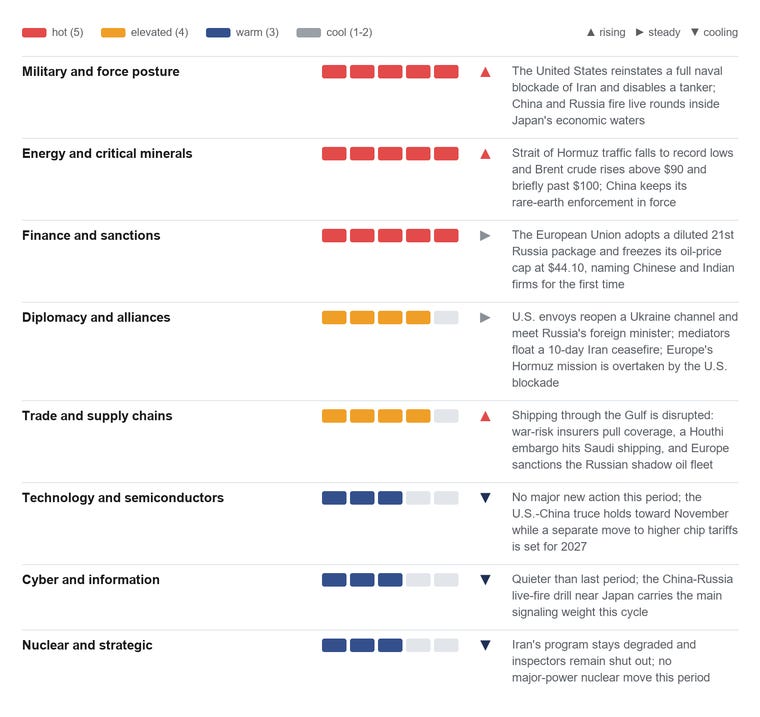
How to read this. We track the moves between the eight great powers, the United States, China, Russia, India, Japan, France, Germany, and the United Kingdom, across eight arenas of competition, from military force to trade, technology, energy, and diplomacy. Each arena gets a heat score from 1 (quiet) to 5 (very active) for the period, plus a trend arrow (▲ rising, ► steady, ▼ cooling). The edition leads with what moved, then traces how one power’s move pulls a response from the others. A map of who can pressure whom sits in the appendix at the end. Every claim links to its source.
The read across the powers
Two weeks ago the ceasefire with Iran was declared over. This period it became an open naval war, and its effects reached far past the Gulf.
The United States reinstated a full naval blockade of Iran’s ports on 16 July and disabled an oil tanker with missiles a day later. Iranian authorities said American forces struck 95 locations across 12 cities over ten days; Iran hit tankers in and near the Strait of Hormuz, and Yemen’s Houthi movement declared a shipping embargo on Saudi Arabia (USNI News, 2026; CNBC, 2026). Traffic through the strait, which carries close to a fifth of the world’s oil, fell to record lows, war-risk insurers began pulling coverage, and Brent crude rose above $90 a barrel and briefly past $100 (Bloomberg, 2026; Trading Economics, 2026).
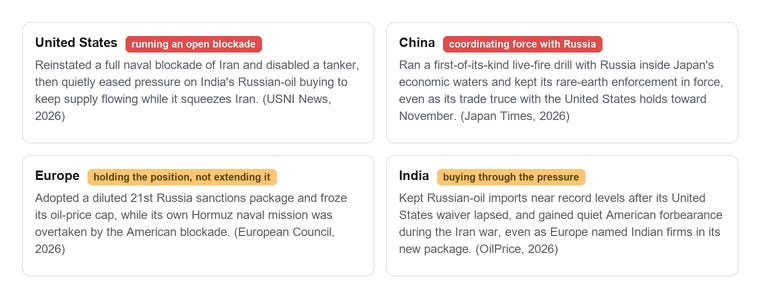
The more important story is where that oil shock traveled. It reshaped Europe’s Russia policy: rather than lower its cap on the price of Russian oil, the European Union froze the cap to avoid handing Russia extra revenue while prices climbed (European Council, 2026). And it softened American pressure on India: the United States quietly eased enforcement on India’s Russian-oil purchases during the Iran conflict (Reuters via AOL, 2026).
The takeaway for a decision-maker: the Gulf war is now the hidden variable in decisions that look unrelated to it, from Russia sanctions to India trade to the price of oil. Watch the blockade, not only the ceasefire talks, to see where those decisions go next.
The heat map
Deep dive — the Gulf goes to an open blockade, and Europe’s independent mission is overtaken
A blockade changes who decides the strait’s fate, and it strands Europe’s bid to act on its own
The United States reinstated a full naval blockade of Iran’s ports on 16 July and disabled a tanker with missiles the next day (USNI News, 2026).
A blockade is not a single raid. Once one power closes a waterway by force, every shipper, insurer, and oil importer has to reprice within days, and this time they did: transits through the strait fell to record lows and war-risk insurers began pulling coverage.
The most exposed party is global shipping through the strait, followed by the oil importers who pay the next layer through price, Japan, India, and Europe. The Gulf states that host American forces remain at risk of attack, and gain nothing from the fight.
The second-order effect is what the blockade did to Europe’s own plan. Last edition, Britain and France offered a naval force as a bid for strategic autonomy, Europe securing the strait without depending on the United States, a mission that launched within days with more than ten European states contributing warships and minehunters (The National, 2026). But the moment the United States imposed its own blockade, that mission shrank into a mine-clearing and escort role inside an American-run closure. Within a week, one regional analysis was already questioning whether the European mission still had a purpose (The National, 2026). The lesson for a decision-maker: an independent European security role is easy to announce and hard to sustain once the United States acts first and on a larger scale.
Base case: the blockade holds at a reduced but real intensity while mediators push a 10-day ceasefire meant to revive the U.S.-Iran memorandum of understanding (medium confidence).
Scenario to watch: if the ceasefire takes, oil falls sharply and the European mission regains a real purpose; if it fails and Iran mines the strait, Europe is pulled deeper into an American operation, a lower-probability but higher-consequence path.
What would confirm the reading: a firm ceasefire date or a mine-clearing engagement. What would break it: the United States lifting the blockade on its own before the next edition.
Deep dive — China and Russia fire live rounds inside Japan’s economic waters
A first-of-its-kind live-fire drill signals coordination that is now operational, not just for show
On or around 19 to 21 July, Chinese and Russian warships conducted a joint live-fire drill inside Japan’s exclusive economic zone near the Okinotorishima reef, the first such drill Japan’s defense ministry has detected and disclosed (Japan Times, 2026; USNI News, 2026).
In our model, this runs through military and force posture and cyber and information overlay at once. It builds on a slow lag of repeated drills, but this one crossed a line: live fire inside an ally’s claimed economic waters carries a sharper message than a routine transit.
Japan bears the direct cost and lodged a formal diplomatic protest with China. Japan's ally, the United States, is also being tested: the drill measures whether the American promise to defend Japan is enough to stop China and Russia from operating this close to Japanese-claimed waters.
The harder-to-see point is that China-Russia military cooperation is maturing from symbolic patrols into operational coordination: synchronized force posture, shared logistics, and now live fire. The exercise followed the “Joint Sea-2026” drill near the Chinese port of Qingdao and a joint patrol that sailed past Japan into the Pacific (Defence Security Asia, 2026). It also compounds a second pressure Japan already carries, China’s standing rare-earth squeeze, which has not eased (Morgan Lewis, 2026). Japan is now being pressed in two arenas at once, military and mineral, by a China that increasingly acts alongside Russia.
For a planner, the signal is that the two powers’ forces are becoming something to treat as a single combined capability rather than two separate ones.
Base case: continued joint drills near Japan, more protests, and no direct clash before the next edition (medium confidence).
Scenario: if a drill moves closer to Japanese-administered islands, the risk of an accidental incident rises, a lower-probability but higher-consequence path.
What would confirm the reading: another joint live-fire event near Japan. What would break it: Russia pulling its naval units back to concentrate on the war in Ukraine.
Deep dive — Europe freezes its oil-price cap rather than lower it, and names Chinese and Indian firms
The sanctions system is now shaped by the Gulf, and it is pushing China and India closer to Russia
On 23 July the European Union adopted its 21st sanctions package, freezing its cap on the price of Russian oil at $44.10 a barrel for twelve months rather than lowering it, and for the first time targeting the vessels of Russia’s shadow oil fleet and naming refiners and traders in China, India, and the United Arab Emirates (European Council, 2026; Mayer Brown, 2026).
This runs through our model’s finance and sanctions layers, which moves slowly and compounds. The reason the bloc froze the cap rather than lowered it is the Iran war. With oil rising above $90 a barrel, a lower cap would have been unenforceable, and the automatic alternative would have raised the cap and paid Russia more, so freezing the number was the only way to keep the cap effective (Bloomberg, 2026). That is the cross-arena link worth marking: a military event in the Gulf set a Russia sanctions number in Europe.
The direct targets are Russia’s oil-shipping shadow fleet and the third-country refiners that process its crude. India’s petroleum exporters are exposed because the package reaches refiners that handle Russian oil (Deccan Herald, 2026).
The second-order effect is the one to note: by naming Chinese and Indian firms directly, not only Russian ones, Europe has turned a Russia-sanctions tool into pressure on two uncommitted powers (Chinna and India), and both have reason to read it as coercion: India kept buying Russian oil at a near-record pace through July even after its United States waiver lapsed (OilPrice, 2026), and China is already in a minerals and trade contest with the West. Punishing Chinese and Indian companies over Russia could push both countries closer to Russia, the very country Europe is trying to cut off.
Base case: India holds its Russian-oil pace and protests the naming, while China objects but its trade truce with the United States holds toward its November deadline (medium-high confidence).
Scenario: if enforcement bites a specific large Indian or Chinese refiner, expect a formal diplomatic response within weeks (medium).
What would confirm the reading: an Indian or Chinese government statement protesting the package by name. What would break it: India quietly trimming Russian purchases to avoid exposure to the new measures.
Move of the period
How a naval blockade in the Gulf reached across two continents to freeze Europe’s cap on Russian oil and soften America’s pressure on India, all inside the same two weeks.

The chain shows why a single Gulf military move set the terms for decisions about Russia. Once the blockade pushed oil above $90 a barrel and put Hormuz supply at risk, Europe could not afford to lower its cap on Russian oil: a tighter cap during a supply squeeze would be ignored or push prices higher, and the automatic alternative would have raised the cap and handed Russia more revenue, so freezing the number was the only move that kept the cap working (Bloomberg, 2026; European Council, 2026). At the same time the United States, needing oil to keep flowing while it squeezed Iran, quietly eased its pressure on India’s Russian-oil purchases rather than remove a second large supplier from the market (Reuters via AOL, 2026). The loop to watch: if the blockade lifts and oil falls, both decisions could reverse, with Europe revisiting the cap and the United States re-tightening on India.
Power movers
What to watch next
Whether the 10-day ceasefire that mediators floated revives the U.S.-Iran memorandum of understanding, or the blockade continues into the next period. (CNBC, 2026)
Whether Brent crude holds above roughly $85 a barrel while the blockade stands, and how far it falls if a ceasefire lands. (Bloomberg, 2026)
Whether China and Russia repeat a live-fire drill near Japan, and whether Japan’s protest hardens into a policy response. (USNI News, 2026)
Whether the United States envoy channel, led by Steve Witkoff and Jared Kushner, turns “several plans” into a written proposal that Russia and Ukraine will engage. (Ukrainska Pravda, 2026)
Whether India trims its Russian-oil buying in response to the European Union naming Indian firms, or holds its near-record pace. (Deccan Herald, 2026)
Whether the U.S.-China trade truce holds toward its November deadline, given the separately scheduled move to higher semiconductor tariffs in 2027. (Coface, 2026; Supply Chain Dive, 2026)
Sources
Material claims are verified to the linked sources as of 26 July 2026. Two items rest on a single source or framing and carry more caution: the figure of strikes on 95 locations across 12 cities is attributed to Iranian authorities, and the reading that Europe’s Hormuz mission has lost its purpose is one regional analysis (source 8), not a settled fact. The report that the United States eased pressure on India’s Russian-oil buying rests on a single wire report (source 6). Several 2026 events remain fast-moving and dates may be revised as reporting develops.