


Top line · this edition
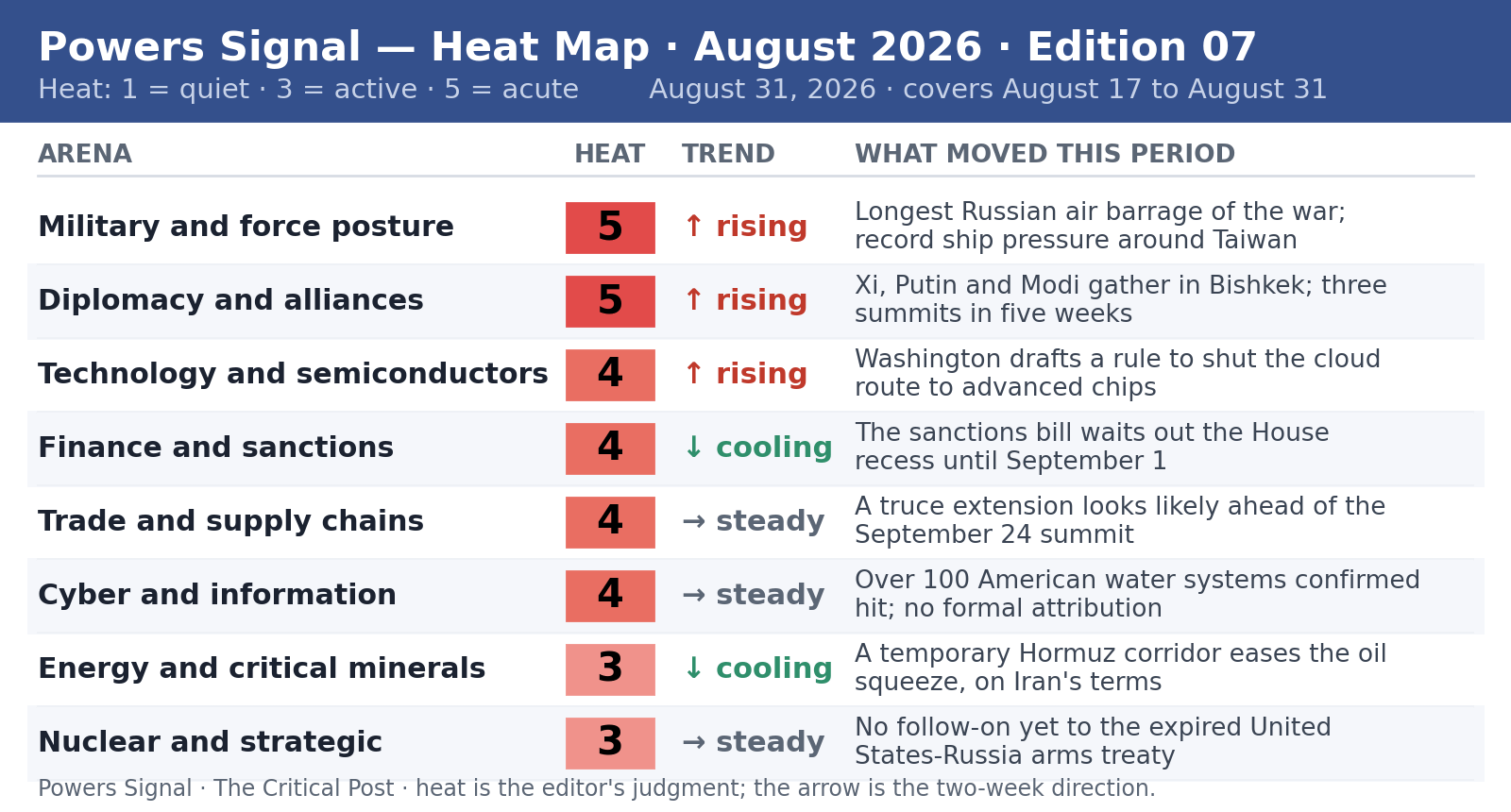
The center of gravity moved east this period. Xi Jinping, Vladimir Putin and Narendra Modi closed ranks at the Shanghai Cooperation Organisation summit in Bishkek, the first stop in a five-week run of summits that ends at the White House on September 24, while Iran and Oman agreed a temporary shipping corridor through the Strait of Hormuz without Washington at the table. Russia spent the same two weeks mounting its longest air barrage of the war. Tension is highest, and rising, in military posture and in diplomacy.
Overall heat map · eight arenas
Heat runs 1 (cool) to 5 (hot). The arrow shows which way tension is moving.
The five developments · the past two weeks
1 · Xi, Putin and Modi close ranks in Bishkek
Diplomacy and alliances · China, Russia, India (with Iran) → United States, Europe
What happened: On August 31 the Shanghai Cooperation Organisation, the China-and-Russia-led security bloc, opened its summit in Bishkek, Kyrgyzstan, bringing Xi Jinping, Vladimir Putin, Narendra Modi and Iranian President Masoud Pezeshkian to the same table for the first time since American and Israeli military operations against Iran began (The National, 2026; Outlook India, 2026). On the sidelines Putin proposed making visa-free travel between Russia and China permanent, and told Modi that Russia is “moving along” the path toward a Ukraine settlement (TASS, 2026). The calendar behind the photo: New Delhi hosts Putin and Xi at the summit of the BRICS group of emerging economies on September 12 and 13 (The Indian EYE, 2026), and Xi lands in Washington on September 24.
Likely response: China rallies allies, converting the bloc’s optics into bargaining position before the White House visit (high likelihood, immediate). The United States rallies its own allies and moves the sanctions bill when Congress returns on September 1 (medium likelihood, weeks). India stands down in public and keeps taking deals from every side (high likelihood, ongoing). Swing factor: whether Washington triggers a tariff move against India’s Russian oil purchases before the New Delhi summit; that single decision would push India visibly toward the bloc it is now hosting.
Why it matters: The bloc still has no development bank, no payment system and few real mechanisms; analysts called the Bishkek display “symbolic solidarity.” But symbolism sets prices. Every negotiation in September, from tariffs to Taiwan, now starts from a photograph of the other side standing together.
2 · Russia mounts its longest air barrage of the war
Military and force posture · Russia → Ukraine, Europe, United States
What happened: On August 20 a Russian missile and drone attack killed 17 people in Kyiv, striking a residential district, a school and a children’s hospital (The Moscow Times, 2026; CBC News, 2026). On August 28 and 29 Russia followed with a combined strike campaign that kept air-raid alerts on for roughly 28 hours straight, launching more than 550 drones and loitering munitions; one strike hit an ammunition warehouse near Myla outside Kyiv, and the secondary blast killed at least 37 people and damaged some 130 residential buildings (Institute for the Study of War, 2026; CNBC, 2026). The Institute for the Study of War also reports that Russia’s political leadership has ordered its forces to reach the full administrative borders of the Donetsk and Luhansk regions by December 31. A former Ukrainian defense minister told Reuters that Ukraine is “gradually, slowly losing” and has “only several months to change course” (Russia Matters, 2026).
Likely response: Russia keeps raising the stakes in the air war to bank leverage while the talks track produces no dates (high likelihood, immediate). Ukraine and Europe rally allies for interceptors and air defense on the eastern flank (high likelihood, weeks). The United States raises the stakes economically by moving the sanctions bill rather than militarily (medium likelihood, weeks). Swing factor: interceptor resupply. Ukraine intercepted about 86 percent of the drones in the late-August barrage and still lost whole buildings; if the interceptor pipeline thins further, Russia’s exhaustion strategy starts working on its own schedule.
Why it matters: A 28-hour barrage is designed to drain air defenses, not just to destroy targets. Paired with the December 31 order on Donetsk, it reads as a timetable: escalate through the autumn, negotiate from altitude in the winter.
3 · Iran and Oman open a Hormuz corridor without Washington
Energy and critical minerals · Iran, Oman → United States, China, India, Japan, Europe
What happened: The 60-day window for a United States–Iran deal expired on August 17, and President Trump marked the day by demanding Iran “put up the white flag of surrender” and threatening to bomb Oman if it “gets in the way” of Hormuz arrangements (The Washington Post, 2026; Al Jazeera, 2026). Nine days later Tehran and Muscat announced a deal anyway: a temporary shipping corridor through the Strait of Hormuz, the channel that normally carries about one-fifth of the world’s oil, roughly seven miles wide and running through Iranian territorial waters, with transit revenue shared between the two countries (Al Jazeera, 2026; Bloomberg, 2026). Iran says the strait will not fully reopen until Washington fulfils its commitments under the June interim deal.
Likely response: China, India and Japan stand down and quietly route tankers through the corridor (high likelihood, immediate). The United States hits a different arena, tightening financial pressure on Iran while refusing to bless a route that leaves Tehran in control of transit (medium likelihood, weeks). The Gulf states rally allies around corridor terms that dilute Iran’s hand (medium likelihood, weeks). Swing factor: the first tanker transits. A clean first month makes the corridor a fact on the water; one incident, or an American strike decision, collapses it overnight.
Why it matters: The corridor trades cheaper energy now for Iranian leverage later, and it was built around Washington rather than with it. Every Asian importer will take that trade. The United States has not, and the gap between those answers is where the next escalation lives.
4 · Washington moves to shut the cloud door on Chinese artificial intelligence
Technology and semiconductors · United States ↔ China · Southeast Asia in the middle
What happened: The Commerce Department is drafting a rule to stop Chinese firms from renting advanced Nvidia computing capacity through data centers in Thailand and Singapore, closing the loophole that let Chinese developers train frontier artificial-intelligence models on chips they cannot legally import; a draft is expected to reach industry groups in September (CNBC, 2026; Tech Times, 2026). The trigger: a Bloomberg investigation confirmed that Chinese developer Moonshot trained its latest model on roughly 20,000 restricted Nvidia chips accessed through Alibaba’s offshore cloud. At the same time, China’s Foreign Minister Wang Yi told the American ambassador on August 27 to “remove interference” and “overcome obstacles” before Xi’s visit (MercoPress, 2026), and South China Morning Post reporting says an extension of the one-year trade truce is “almost certain” (South China Morning Post, 2026).
Likely response: China matches it over time, accelerating domestic computing capacity and stockpiling whatever still ships (high likelihood, a quarter or two). In public, Beijing stands down until September 24 to protect the summit and the truce extension (medium likelihood, immediate). Cloud providers and their Southeast Asian hosts comply partly and quietly, protecting American market access over Chinese rental revenue (medium likelihood, weeks). Swing factor: timing. Publishing the rule before September 24 is a pressure move; holding it until after tells you Washington wants the summit more.
Why it matters: The control point is moving from the shipping crate to the cloud contract. If compute rental is the next gate, every data-center host from Bangkok to Tokyo becomes a party to the technology fight, whether it wants to be or not.
5 · China’s ship pressure on Taiwan sets a third straight record
Military and force posture · China → Taiwan, Japan, the Philippines
What happened: Taiwan’s defense ministry detected Chinese government vessels around the island 118 times in the first 24 days of August, beating July’s 117 and June’s 111; before this run, the monthly record was about 50. Chinese coast-guard ships have hailed nearly 200 commercial vessels demanding port and crew details, and survey operations have come within 50 nautical miles of Taiwan (The Star, 2026, reporting Taiwan defense ministry data and analysis by the Asia Maritime Transparency Initiative). Analysts link the surge to maritime boundary talks between Japan and the Philippines that Beijing calls “illegal, null and void.” Taiwanese officials warn the aim is a “new status quo” across the first island chain, the line of islands from Japan through Taiwan to the Philippines.
Likely response: China keeps going grey-zone, meaning pressure held deliberately below the level of open armed conflict, making the presence look routine (high likelihood, ongoing). Japan rallies allies and keeps decoupling its supply chains from China (high likelihood, weeks to a quarter). Taiwan rallies allies and documents every contact (high likelihood, immediate). The United States stands down in public until the summit passes (medium likelihood, immediate). Swing factor: the first boarding. If a patrol boards or turns away a commercial ship, the squeeze becomes a quarantine while Xi is on American soil.
Why it matters: Three record months in a row is a trend line, not a spike. Each quiet week of record patrols makes the encirclement more normal, and makes the eventual response to it look more like the escalation.
Relationships to watch
China ↔ India ↔ Russia · the Bishkek-to-New-Delhi corridor: two summits in two weeks, while an American tariff bill aimed at their oil trade waits out the House recess.
United States ↔ China · calm on the surface, with a truce extension likely; contested underneath, with the cloud-computing rule drafted and Taiwan pressure at record levels. Everything is priced against September 24.
Russia ↔ Ukraine and Europe · the longest barrage of the war against a talks track with no dates, and a December 31 territorial order that reads like a negotiating calendar.
Swing factors · what could change before the next edition
The House returns September 1. Whether the sanctions bill moves, and whether the president uses the 100 percent tariff power against Russia’s customers before the New Delhi summit on September 12 and 13, resets every prediction involving China and India.
The cloud rule’s timing. Published before September 24, it is a pressure move; held until after, it is a concession. Either way it tells you who wants the summit more.
First transits through the Hormuz corridor. A clean first month makes it a fact on the water; one incident collapses it, and oil prices with it.
Interceptor resupply for Ukraine. The variable that decides whether Russia’s air campaign is a negotiating tactic or a war-winning one.
A boarding near Taiwan. One commercial ship stopped converts record patrols into a quarantine, with Xi Jinping on American soil.
How to read this
Heat runs 1 (cool) to 5 (hot) and says how tense each arena is now. Trend arrows say which way it is moving: ▲ rising, ► steady, ▼ cooling. The eight arenas are the same every edition, so you only learn them once: military and force posture; nuclear and strategic; technology and semiconductors; finance and sanctions; trade and supply chains; energy and critical minerals; diplomacy and alliances; cyber and information.
Predicted responses always use seven plain names: stand down, match it, hit a different arena, raise the stakes, rally allies, decouple, and go grey-zone (pressure kept below open conflict). Each comes with a likelihood (low, medium, high), a speed, and the one swing factor most likely to change the call.
Sources
TASS · Putin’s meetings with China and India leaders in Bishkek · August 31, 2026
The Week · Modi arrives in Kyrgyzstan for the summit · August 31, 2026
The Indian EYE · India invites President Putin for the BRICS summit in New Delhi · August 25, 2026
The Moscow Times · Russian missile and drone attack kills 17 in Kyiv · August 20, 2026
CBC News · Russian barrage in Ukrainian capital region kills 17 · August 20, 2026
Institute for the Study of War · Russian offensive campaign assessment · August 29, 2026
CNBC · Russian strike on Kyiv-area warehouse causes detonation · August 29, 2026
Russia Matters · Russia-Ukraine war report card · August 25, 2026
The Washington Post · Trump threatens to bomb Oman if it “gets in the way” · August 17, 2026
Al Jazeera · Trump demands Iran’s surrender as the memorandum expires · August 17, 2026
Al Jazeera · Iran and Oman agree on a temporary Hormuz route · August 26, 2026
Bloomberg · Iran and Oman agree to share Strait of Hormuz revenue · August 26, 2026
CNBC · The United States moves to close the cloud loophole on advanced chips · August 19, 2026
Tech Times · Commerce drafts the cloud-access chip rule · August 29, 2026
Al Jazeera · United States Senate passes the Russian energy sanctions bill · August 8, 2026
Powers Signal · Edition 07 · a decision-support read on the moves between the United States, China, Russia, India, Japan, France, Germany, and the United Kingdom, published twice monthly by The Critical Post. Plain language, no acronyms, every arena spelled out. Predictions are the editor’s judgment, checked against events in the next edition.
***