


The National Read
Nonfarm payrolls fell by 23,000 in July, the first real drop in months, and the Bureau of Labor Statistics quietly rewrote the two months before it: May and June together lost 103,000 jobs that earlier prints said existed. The unemployment rate ticked up to 4.1%. Wage growth held at 3.2% (Bureau of Labor Statistics, Aug. 7, 2026).
That’s the crack in the floor. It landed four days after the Federal Reserve’s policy committee held its benchmark interest rate at 3.50% to 3.75% for a fifth straight meeting, but only by a 9-3 vote. Three governors wanted a hike, the widest hawkish split in almost a decade (Federal Reserve, July 29, 2026). New Chair Kevin Warsh used his first press conference to insist there is “no soft target, only 2%” on inflation, even as June’s headline price data actually cooled.
Now layer in a stock market that doesn’t seem to have noticed any of this. Major indexes pushed to new records in the same two weeks, carried by an artificial-intelligence spending boom. That same boom is the reason electricity costs are climbing for households in a growing list of states this summer.
The labor market, the Federal Reserve, and the market are telling three different stories about one economy. The Fed’s September meeting is where they have to reconcile, and right now nobody knows which story wins.
Deep Dive · Heat 5, Trending Up
Technology & the Digital Economy
Big Tech’s second-quarter earnings week produced the clearest split yet in how markets judge artificial-intelligence spending. Fortune reported that Alphabet posted negative free cash flow for the first time since its 2004 initial public offering, and its shares fell more than 7% on the news (Fortune, July 26, 2026). Meta’s revenue beat estimates at $60.8 billion, up 28% from a year earlier, but its earnings missed and its stock also fell roughly 7% as investors focused on the cash the spending is consuming (TradingKey, July 29, 2026).
Microsoft and Amazon had the opposite week. Microsoft’s stock rose about 8% after it reported Azure cloud revenue growing roughly 43% and told investors demand is outrunning supply, guiding next year’s capital spending toward $255 billion to $260 billion. Amazon rose 8% to 10% after Amazon Web Services grew 37%, its fastest pace since 2021, and the company raised its 2026 capital budget to $220 billion, saying that still won’t fully meet the demand it’s forecasting (TradingKey; CNBC, July 29-30, 2026). Combined 2026 capital-spending guidance across the four companies is now tracking near $724 billion.
The market, in other words, isn’t punishing artificial-intelligence spending on principle. It’s punishing spending that isn’t visibly matched by paying customers yet, and rewarding spending that is. That distinction matters because the investment keeps flowing regardless of the stock reaction: durable-goods orders for computers and electronic products hit a record $31.1 billion in June, up 16.7% from a year earlier, a gain the Census Bureau’s own data ties to the broader data-center building wave (Census Bureau, July 27, 2026).
All of that capital has to become electricity somewhere, and the Energy domain below is where that bill starts to come due. Watch Nvidia’s next earnings report, expected around August 27, as the next hard test of whether chip demand still supports the spending gap between the companies markets are rewarding and the ones they’re punishing… We will report…
Deep Dive · Heat 5, Trending Down
Labor, Demographics & Human Capital
Friday’s jobs report did more than miss expectations. It rewrote the recent past. Nonfarm payrolls fell 23,000 in July, and the Bureau of Labor Statistics cut May’s initial gain from 129,000 to 63,000 and June’s from 57,000 to 20,000, a combined 103,000 jobs erased from a spring that looked far sturdier at the time (Bureau of Labor Statistics, Aug. 7, 2026). The unemployment rate rose to 4.1%. Local government education lost 50,000 positions and retail trade lost 19,000, while health care added a slower-than-usual 22,000.
A second, less-discussed number sat inside the same report. The foreign-born labor force fell by 550,000 over the past year, with foreign-born men in the labor force down 962,000. That’s a labor-supply story tied to immigration enforcement, and it means fewer workers are available even as demand for them cools, a genuine cross-current rather than a simple slowdown.
The Job Openings and Labor Turnover Survey for June, released days earlier, showed a labor market frozen rather than falling: openings, quits, hires, and layoffs all sat roughly flat month over month (Bureau of Labor Statistics, Aug. 4, 2026). Employers aren’t firing. They also aren’t hiring. Second-quarter productivity data fits the same pattern: output rose 1.7% while hours worked rose only 0.3%, meaning the gains are coming from existing workers doing more, not from new hires (Bureau of Labor Statistics, Aug. 6, 2026).
This is the data point most likely to move the Federal Reserve. A weakening reading on the employment side of its dual mandate, next to a committee that just split 9-3 toward wanting a hike on the inflation side, sets up a genuinely contested September meeting where a hike, a hold, and a cut are all live possibilities. Watch the August 11 household-debt report from the Federal Reserve Bank of New York for whether consumer stress is starting to follow labor weakness.
Deep Dive · Heat 5, Trending Up
Federal Fiscal & the Executive
The Treasury raised its borrowing estimate for the current quarter by $68 billion to $739 billion and confirmed $125 billion in new note and bond auctions at its August 5 quarterly refunding, holding coupon sizes steady but signaling more debt is coming (U.S. Treasury, Aug. 3 and Aug. 5, 2026). That borrowing lands against a backdrop the Committee for a Responsible Federal Budget flagged in July: the federal government had already borrowed $1.4 trillion through nine months of the fiscal year, on pace for a full-year deficit of $2 trillion or more.
Congress, for its part, chose to defer rather than resolve. The Senate advanced a bipartisan funding deal 89-4 on August 3 that keeps the government open through December 11, past the November midterms, holding spending flat and extending highway funding to states (Government Executive; PBS NewsHour, Aug. 2-3, 2026). Majority Leader John Thune’s framing was blunt: the country has already lived through two record-breaking shutdowns in ten months, and nobody wanted a third during campaign season.
The most consequential item here is a governance story, not a budget one. On August 7, the White House restarted removal proceedings against Federal Reserve Governor Lisa Cook, giving her three weeks to respond, after the Supreme Court ruled in June that she was entitled to notice before removal (NPR; ABC News, Aug. 7, 2026). Whatever the outcome, a sitting administration actively trying to remove a Fed governor is a new kind of pressure on the central bank’s independence, and bond markets that already pushed the 30-year Treasury yield to its highest level since 2007, above 5.2%, will be watching for any sign the fight is bleeding into policy expectations.
Where this goes next: watch the mid-August refunding auctions for demand signals at the new, higher borrowing pace, and watch Cook’s response deadline around August 28.
Chain of the Period
AI capex → the household electric bill → the Fed
Start at Technology. Hyperscaler capital spending, guided toward $724 billion for 2026, isn’t an abstraction anymore. It’s already showing up as data-center construction and record durable-goods orders. That spending needs power, and the mid-Atlantic grid operator PJM has now hit its capacity-auction price cap for a third consecutive cycle, driven explicitly by data-center load, pushing the region’s annual capacity costs from roughly $2.2 billion to $14.7 billion (PJM auction results, as reported July 15, 2026).
Higher capacity costs flow into retail electricity bills, the fastest and hardest sentiment trigger in the US economy. Those bills then feed into the price data the Federal Reserve watches most closely. This is a chokepoint: don’t expect the effect to fade as it crosses into the Fed’s domain, the way it would in an ordinary three-step chain. A boom that looks confined to technology stocks is, within a few steps, a household-budget story and an interest-rate story at once.
Sector & Region Movers
Big Tech’s capex divide. Microsoft and Amazon rose 8% to 10% on earnings tied to visible cloud demand; Alphabet and Meta each fell roughly 7% on spending investors read as outrunning revenue. Same boom, two different verdicts (TradingKey, July 26-31, 2026).
PJM grid states. Virginia, Texas, North Carolina, Indiana, Illinois, and Michigan are absorbing the bulk of a data-center construction wave that hit an estimated $22.3 billion in June alone, the second-highest month on record, while facing the country’s steepest capacity-cost increases (ConstructConnect, reported July 28, 2026).
The defense-industrial base. Lockheed Martin and the submarine builders General Dynamics Electric Boat and HII Newport News Shipbuilding split more than $135 billion in contracts in a single week for Patriot interceptors and next-generation submarines, a multiyear mover for shipbuilding and missile-producing regions (reported July 30, 2026).
Multifamily commercial real estate. Delinquencies on commercial mortgage-backed securities backed by apartment buildings jumped roughly half a percentage point in July, per Trepp data, with the sharpest increases concentrated in Ohio, Texas, and New York as refinancing failed rather than operations weakening (Connect CRE, Aug. 6, 2026).
Chip-fabrication reshoring, Arizona. Taiwan Semiconductor Manufacturing Company raised its total committed Arizona investment to $265 billion across a dozen planned facilities, the clearest single marker that chip-fabrication reshoring keeps scaling even as the broader manufacturing picture stays mixed (TechTimes; Digitimes, July 17-24, 2026).
What to Watch
September 16-17 Federal Open Market Committee meeting. A weak jobs report next to a 9-3 hawkish-leaning vote makes this the most genuinely contested rate decision in years, with a hike, a hold, and a cut all plausible.
August 11 Federal Reserve Bank of New York household-debt report. The first fresh, dated read on consumer credit stress since the first quarter, arriving after multiple signs of rising auto and card delinquency this summer.
August 12 Consumer Price Index. The first inflation print since the weak jobs report. A soft number strengthens the case for a September cut; a hot one sides with the committee’s dissenters.
August 11-13 Treasury refunding auctions. A live test of demand at the newly higher borrowing pace, with the 30-year yield already at its highest level since 2007.
Nvidia’s fiscal second-quarter earnings, expected around August 27. The next hard data point on whether chip demand still supports the hyperscaler spending gap, alongside a pending US review of Chinese firms’ offshore access to Nvidia chips.
Lisa Cook’s response deadline, on or around August 28. How the Federal Reserve governor removal fight resolves will shape how markets read the central bank’s independence heading into the September meeting.
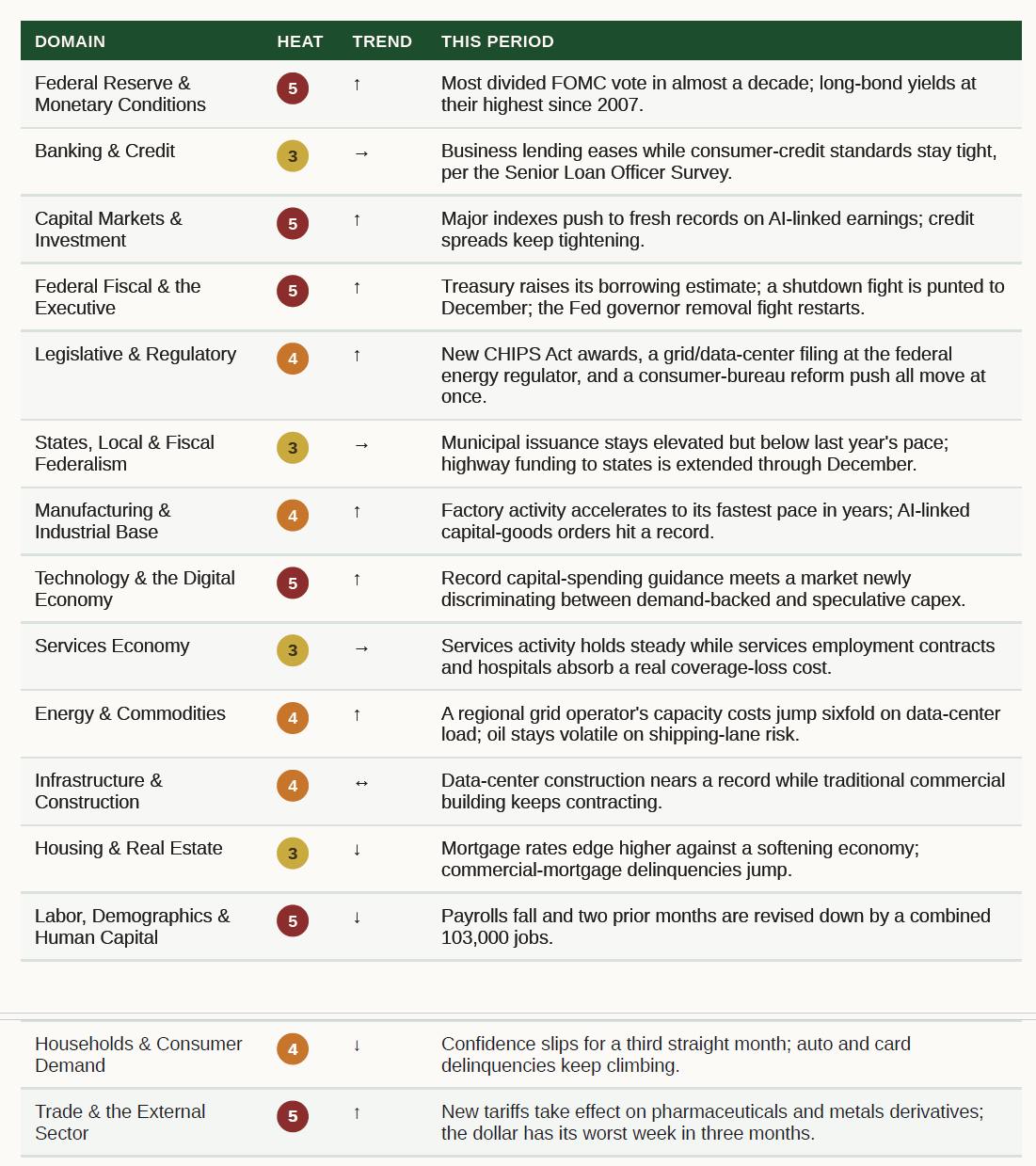
Appendix: The Heat Map
All fifteen domains, re-scored this period. Heat is 1 (dormant) to 5 (highest intensity); it measures activity, not whether the news is good or bad.
Sources
Bureau of Labor Statistics — “Employment Situation — July 2026,” Aug. 7, 2026. bls.gov/news.release/empsit.nr0.htm
Bureau of Labor Statistics — “Job Openings and Labor Turnover Survey — June 2026,” Aug. 4, 2026. bls.gov/news.release/jolts.nr0.htm
Bureau of Labor Statistics — “Productivity and Costs — Second Quarter 2026, Preliminary,” Aug. 6, 2026. bls.gov/news.release/archives/prod2_08062026.htm
Federal Reserve — FOMC statement, July 29, 2026. federalreserve.gov/newsevents/pressreleases/monetary20260729a.htm
Federal Reserve — Chair press conference transcript, July 29, 2026. federalreserve.gov/mediacenter/files/FOMCpresconf20260729.pdf
Federal Reserve — Senior Loan Officer Opinion Survey, Aug. 3, 2026. federalreserve.gov/data/sloos/sloos-202607.htm
Bureau of Economic Analysis — “Personal Income and Outlays, June 2026,” July 30, 2026. bea.gov/news/2026/personal-income-and-outlays-june-2026
Bureau of Economic Analysis — “Gross Domestic Product, Second Quarter 2026 (Advance Estimate),” July 30, 2026. bea.gov/news/2026/gdp-advance-estimate-2nd-quarter-2026
Bureau of Economic Analysis — “U.S. International Trade in Goods and Services, June 2026,” Aug. 4, 2026. bea.gov/news/2026/us-international-trade-goods-and-services-june-2026
U.S. Census Bureau — Advance Report on Durable Goods, June 2026, July 27, 2026. census.gov/manufacturing/m3/adv/pdf/durgd.pdf
U.S. Treasury — Quarterly refunding press releases, Aug. 3 and Aug. 5, 2026. home.treasury.gov/news/press-releases
Institute for Supply Management — Manufacturing PMI, July 2026, Aug. 3, 2026. prnewswire.com (ISM Manufacturing PMI)
Institute for Supply Management — Services PMI, July 2026, Aug. 5, 2026. prnewswire.com (ISM Services PMI)
Freddie Mac — Primary Mortgage Market Survey, Aug. 6, 2026. freddiemac.gcs-web.com
Federal Register — Proposed Section 232 derivative-product tariffs, Aug. 6, 2026. federalregister.gov/documents/2026/08/06/2026-15961
Committee for a Responsible Federal Budget — FY2026 deficit-trajectory estimate, July 9, 2026. crfb.org
Government Executive — “Funding deal could spare agencies another shutdown fight,” Aug. 3, 2026. govexec.com
PBS NewsHour — “Senate leaders reach funding deal to avoid shutdown during campaign season,” Aug. 2, 2026. pbs.org/newshour
NPR — “Trump moving forward with attempt to fire Lisa Cook from the Federal Reserve,” Aug. 7, 2026. npr.org
ABC News — “Trump moving forward on attempt to fire Lisa Cook,” Aug. 7, 2026. abcnews.go.com
NPR — “US and Japan intervene in currency markets,” Aug. 3, 2026. npr.org
Fortune — “Big Tech earnings slam into a market in revolt over AI spending,” July 26, 2026. fortune.com
TradingKey — Meta Platforms Q2 2026 earnings coverage, July 29, 2026. tradingkey.com
TradingKey — “Big Tech Earnings Scorecard: Microsoft, Amazon, Apple,” July 31, 2026. tradingkey.com
Census Bureau data via Wolf Street — “AI Data Center Investment Pushes... Durable Goods Orders,” July 27, 2026. wolfstreet.com
ConstructConnect — “August 2026 Data Center Report,” July 28, 2026. constructconnect.com
Sierra Club, citing PJM Interconnection auction results — “PJM Capacity Auction Hits Price Cap Third Consecutive Time,” July 15, 2026. sierraclub.org
Connect CRE, citing Trepp data — “CMBS Delinquency Rate Adds 51 Basis Points in July 2026,” Aug. 6, 2026. connectcre.com
Benzinga — “Pentagon Commits Over $135 Billion to Patriot Missiles, Nuclear Submarines,” July 30, 2026. benzinga.com
TechTimes — “TSMC Lifts Arizona Investment to $265 Billion,” July 17, 2026. techtimes.com
***