

Edition 01 · June 2026 · covering ~5–22 June 2026 · ~9 min read · Subscriber edition
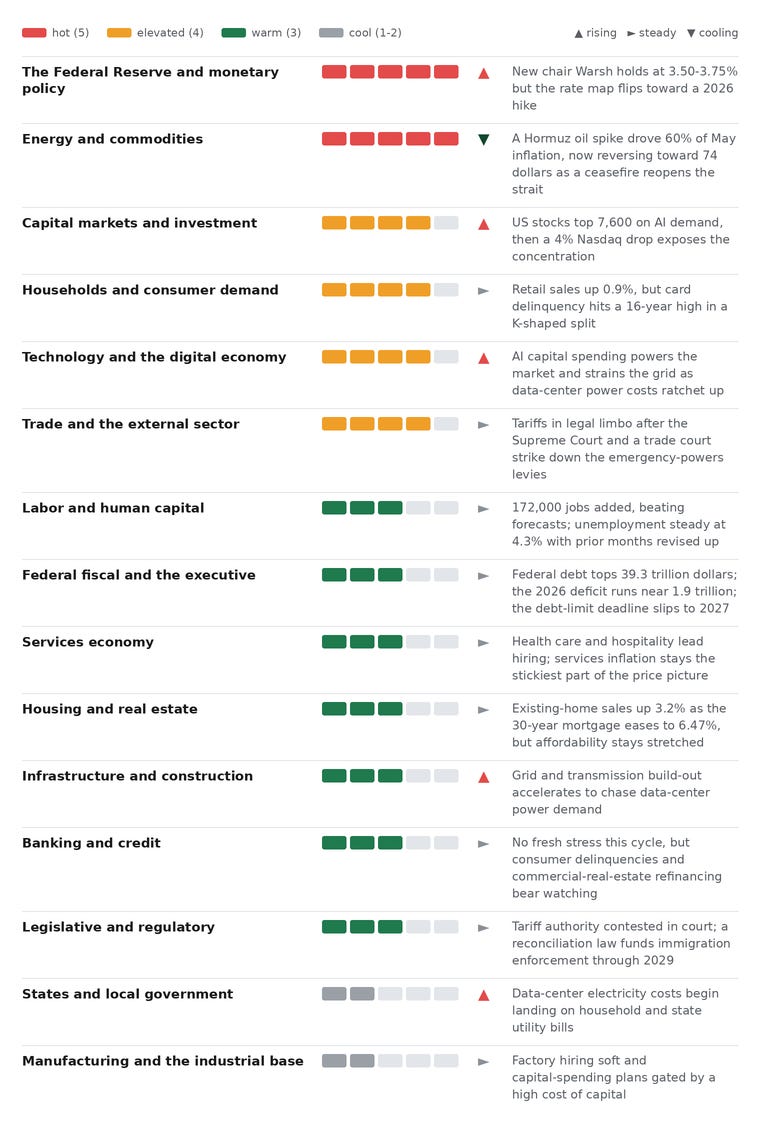
How to read this. We track the US economy as one connected system across fifteen domains — the big moving parts, from the Federal Reserve and banking to energy, housing, jobs, and the consumer. Each gets a heat score from 1 (quiet) to 5 (very active) for the period, plus a trend arrow (▲ rising · ► steady · ▼ cooling). The edition leads with what moved most, then traces how a shock in one domain travels into others. Every claim links to its source; the full list is at the end, and the full heat map sits in the appendix.
The national read
On 17 June, in his first meeting as chair of the Federal Reserve, Kevin Warsh held interest rates where they were — a target range of 3.50% to 3.75% — and let the projections do the talking. They talked hawkish.
The Fed’s own rate map, the “dot plot,” flipped from pointing at a cut to pointing at a hike before year-end, and seventeen of eighteen officials now see inflation risks tilted to the upside (Federal Reserve, 2026; CNBC, 2026). The reason sat in the inflation report six days earlier: consumer prices rose 0.5% in May and 4.2% over the past year, with energy alone accounting for more than sixty percent of the monthly jump (Bureau of Labor Statistics, 2026).
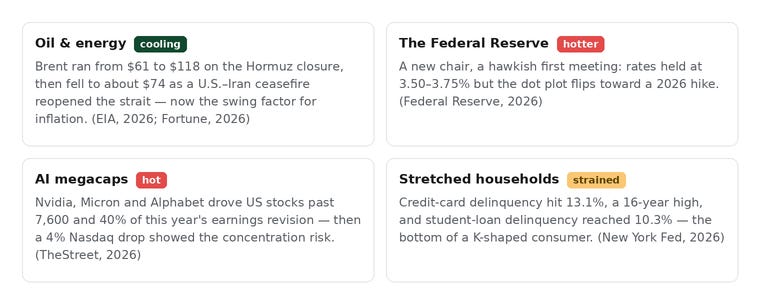
That energy spike has a single cause — a war. After military action in the Middle East on 28 February effectively closed the Strait of Hormuz, the world’s most important oil chokepoint, Brent crude leapt from $61 a barrel in January to $118 by the end of March, the sharpest inflation-adjusted jump in the data since 1988 (U.S. Energy Information Administration, 2026).
Here is the twist the model exists to catch: the shock is already reversing. On 15 June the United States and Iran announced a deal to end the war and reopen the strait, and oil has fallen back to around $74 (NPR, 2026; Fortune, 2026). So the Fed is turning hawkish just as the force that made it hawkish is fading. The rest of the economy looks oddly fine on the surface — jobs beat expectations, shoppers kept spending — even as the bottom third of households falls behind on its bills at the fastest rate in sixteen years. This edition traces how a closed strait became a hawkish Fed, and why the timing matters.
Deep dive — Energy: a war set the price, and a ceasefire is taking it back
The oil shock that drove the inflation number is already unwinding
For four months, one number explained most of America’s inflation problem, and it was set 7,000 miles away. The February closure of the Strait of Hormuz — the passage for roughly a fifth of the world’s oil — sent Brent from $61 in January to $118 by the end of the first quarter, the largest inflation-adjusted quarterly increase the Energy Information Administration has on record back to 1988 (U.S. Energy Information Administration, 2026). That fed straight into the consumer’s wallet: the energy index rose 3.9% in May and accounted for more than sixty percent of the entire monthly rise in consumer prices (Bureau of Labor Statistics, 2026).
Then the war started to end. On 15 June the United States and Iran announced an initial deal to halt the fighting and reopen the strait, with a signing set for Switzerland and a 60-day roadmap toward a permanent agreement (NPR, 2026). Crude has slid back to around $74 a barrel, near its lowest since early March (Fortune, 2026). U.S. officials say tanker traffic through Hormuz is climbing again, though the central shipping lane is still mined and only the side routes are fully open — so the relief is real but not yet complete (CBS News, 2026).
In the model, energy is the input-price spine: it touches almost everything, and the link from gasoline and utility bills to household budgets is the fastest, hardest-hitting channel in the whole US system. That cuts both ways. The same channel that pumped four months of inflation into the economy is now set to drain some of it back out — if the ceasefire holds. The catch is timing. Price relief at the pump shows up in the inflation data with a lag of weeks, which means the Fed made its hawkish turn on the old, high numbers, not the new, falling ones. Keep one eye on the strait; the inflation path runs through it.
Deep dive — The Federal Reserve: a new chair, a hawkish map, a credibility test
Warsh holds the line and signals a possible hike — into a shock that may be fading
Kevin Warsh’s first meeting as Fed chair set a clear tone. The committee left its policy rate unchanged at 3.50%–3.75% by a unanimous 12–0 vote, but the projections turned sharply more aggressive: the median official now expects the rate to end 2026 at 3.8% — above today’s level — a flip from March, when the median still penciled in a cut (Federal Reserve, 2026; CNBC, 2026). Nine of eighteen policymakers see at least one hike this year; only one sees a cut. The Fed also lifted its year-end forecast for its preferred inflation gauge to 3.6%, up from 2.7% in March.
This is the Fed’s central chokepoint behavior, and the model treats it as a link that does not weaken: when the Fed moves, it reprices money for every other domain — banks, markets, housing, and business investment all feel it first and fastest. A hawkish hold keeps the 30-year mortgage parked in the mid-6% range (Freddie Mac, 2026), keeps the cost of capital high for factories and builders, and supports the dollar.
The harder question is whether the map is already out of date. The inflation it responds to was driven by an oil shock that is now reversing; if energy keeps falling, the 4.2% headline could ease on its own well before any hike is needed. Warsh, notably, declined to submit his own dot, reflecting a long-standing skepticism of forward guidance (Fox Business, 2026) — a hint that the new chair would rather keep his options open than commit to the very rate path his colleagues just published. The risk the model flags: tightening into a fading shock, and finding the brakes were tapped a cycle too late.
Deep dive — Technology and power: the market’s engine is the grid’s new burden
AI spending is lifting the stock market and, quietly, your electricity bill
While oil made the headlines, a second, slower energy story ran underneath — and it points the other way. The artificial-intelligence build-out that has carried the stock market is now one of the fastest-growing sources of electricity demand in the country. The S&P 500 closed above 7,600 for the first time in early June, led by chipmakers, and just three companies — Nvidia, Micron, and Alphabet — account for more than forty percent of this year’s upward revision to S&P 500 earnings (TheStreet, 2026; CNBC, 2026). That concentration is a strength and a fragility at once: when the group stumbled, the Nasdaq fell 4% in a single session, its worst day in more than a year.
The power side is the part households will feel. Data centers already use roughly 180 terawatt-hours of US electricity a year, and credible forecasts have that reaching 400–600 terawatt-hours by 2030 (Belfer Center, 2026). The strain is showing up in prices: in the PJM grid that serves the mid-Atlantic, capacity prices for 2026–27 cleared above $329 per megawatt-day, more than ten times the level two years earlier, with data-center growth named as a major cause (NPR, 2026; Spotlight PA, 2026).
This is the seam to our AI Signal, and it carries a cross-current worth holding in mind. The AI boom lifts household wealth through the market — a cushion against the energy-cost hit on the consumer — while at the same time raising the electricity bills of the households near its data centers. The oil shock is reversing; this one is a ratchet. It does not turn back when a strait reopens.
Chain of the period
How a closed strait 7,000 miles away became a hawkish Fed at home — the kind of cross-domain link the model is built to trace, and one that crosses two chokepoints without weakening.
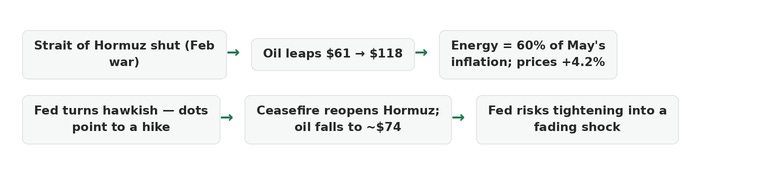
Each step is sourced above. The chain runs through two points the model never discounts: the energy-to-consumer channel, the fastest sentiment trigger in the US economy, and the Federal Reserve itself, which passes its decisions to every other domain. That is why a Middle East ceasefire and a Washington rate decision belong in the same sentence. The signal: the inflation that pushed the Fed hawkish was largely imported and is now reversing, so the most important number of the next cycle is not a US data release at all — it is the price of a barrel of oil as the strait clears. If energy keeps falling, the hawkish dot plot may quietly expire before it is ever acted on.
Sector & region movers

What to watch next
The Switzerland signing and whether Hormuz’s central, mined shipping lane gets cleared — the single biggest swing factor for energy and inflation this cycle. (NPR, 2026; CBS News, 2026)
The May reading of the Fed’s preferred inflation gauge (personal-consumption prices), due 27 June — whether it confirms the three-year high that April set at 3.8%. (Bureau of Economic Analysis, 2026)
June consumer prices, due 14 July — the first clear read on whether falling oil pulls the 4.2% headline down. (Bureau of Labor Statistics, 2026)
The 28–29 July Fed meeting — whether the hawkish dot plot becomes an actual hike, or quietly fades with energy. (Federal Reserve, 2026)
Next month’s jobs report — whether the 4.3% unemployment rate and the run of upward revisions hold. (Bureau of Labor Statistics, 2026)
Household-credit data — whether record card and student-loan delinquencies begin to dent the resilient top-line spending. (New York Fed, 2026)
The heat map — all fifteen domains
Sources
[1] Federal Reserve — “FOMC statement,” 17 Jun 2026. federalreserve.gov (accessed 22 Jun 2026).
Every material claim is verified to one primary (Tier-1) source or two independent reputable (Tier-2) sources. Items resting on a single secondary source — the exact spot price of oil and the operational status of the Strait of Hormuz — are stated as such in the text.
***