

Edition 05 · July 2026 · covering 10 – 23 July 2026 · ~9 min read · Subscriber edition

How to read this. AI Signal reads the AI build-out as one system, in eight layers: from the raw minerals and chips at the bottom, through data centers, power and models, up to users and the capital paying for it all. Each layer gets a heat score from 1 (quiet) to 5 (very active) and a trend arrow (▲ rising · ► steady · ▼ cooling). We lead with what moved and trace how a shock in one layer travels into the others. Every claim links to its source.
The build-out read
Last edition, the rules of the AI build-out moved in three layers at once. This period one of those rules loosened, and it changed almost nothing, which is the story.
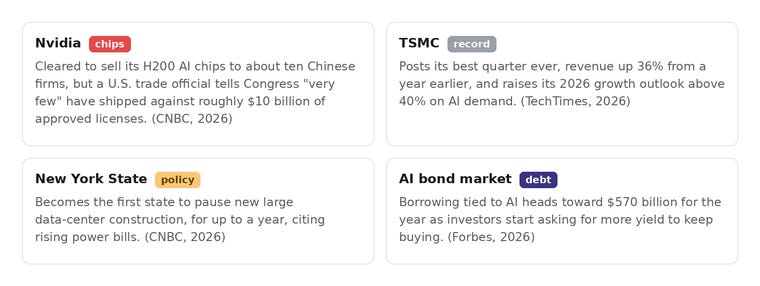
On 14 July, a senior U.S. trade official told Congress that “very few” of Nvidia’s most capable exportable AI chips have actually reached China, even though Washington has approved roughly $10 billion in licenses to sell them there (CNBC, 2026). The valve is open; almost nothing is flowing through it. China is steering its own buyers toward home-grown chips and models, and is now drafting rules to keep its best models from leaving the country (Trivium China, 2026). One wall came down while two others went up.
The physical demand underneath is not in doubt. On 16 July Taiwan’s TSMC, the company that makes most of the world’s advanced chips, posted its best quarter ever and raised its outlook for the year (TechTimes, 2026). What is changing is where the build-out now meets resistance. Not on the chip line, but on the electricity bill: studies this period tied about $23 billion of higher U.S. power bills to data centers, and New York’s governor became the first to halt new construction outright (Fortune, 2026; CNBC, 2026). The build-out’s limit is turning political.
The heat map
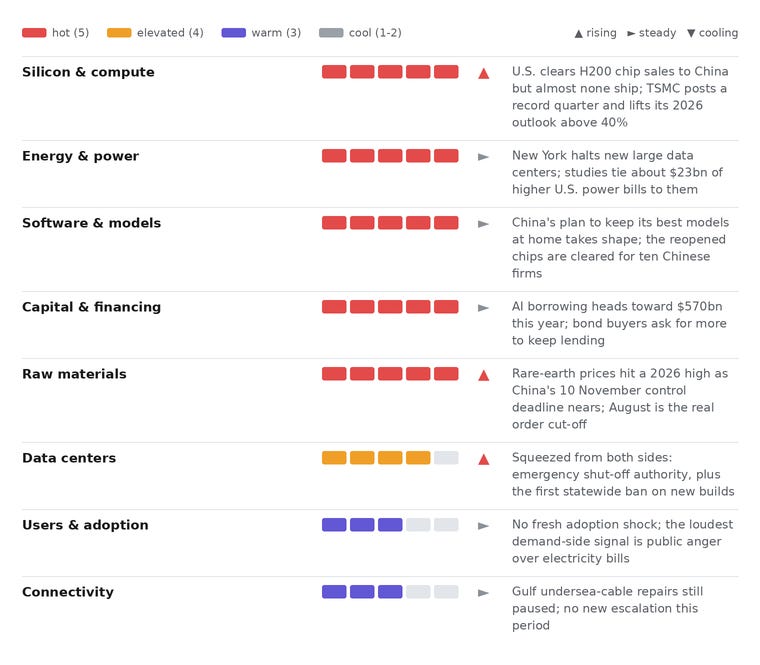
Deep dive — software & models: a chip control loosened, and reconnected nothing
One wall comes down, and two go up
On 14 July a senior U.S. trade official told Congress that “very few” of Nvidia’s H200 AI chips have reached China, even though Washington has approved around $10 billion of licenses to sell them there (CNBC, 2026). The number is the news. For two years the United States treated access to its best chips as a valve it could open or shut on China. It has now opened the valve: roughly ten Chinese firms, including Alibaba, Tencent and the AI developer DeepSeek, are cleared to buy, in exchange for a 25% cut of each sale going to the U.S. government and security checks on every buyer (TechTimes, 2026). And almost nothing has moved through it.
Who gains from the opening, and who does not? Nvidia gets paper permission to sell back into its largest lost market, but little revenue so far. The Chinese buyers get two-year-old chips they increasingly do not want, because Beijing is pushing them toward domestic parts. The clearest winner is the U.S. Treasury’s 25% cut, if the chips ever ship in size.
Here is the part a headline reader may miss: Reopening one control did not reconnect the two systems, because the demand on the other side has been redirected on purpose. And on 22 July, reporting firmed up that China is drafting its own rules to keep its best AI models at home: a tiered plan that would let weaker open models out with a simple filing, put stronger ones through a security review, and possibly bar release of the most capable (TechTimes, 2026; Trivium China, 2026). One wall came down while two went up. Base case: the chips trickle rather than flow, and the two AI worlds keep drifting apart on both chips and models. The alternative, real volume moving while China keeps its models open, looks unlikely while Beijing is chasing self-sufficiency, but it would matter, because it would mean the split is still reversible. A jump in actual chip shipments would confirm a reconnection; a formal Chinese rule locking its models at home would confirm the separation.
Deep dive — energy: the build-out’s new limit is the power bill
The bill lands, and a state says stop
On 14 July, New York’s governor signed the first statewide order in the country pausing new large data-center construction for up to a year (CNBC, 2026). What matters is what it does to the limit on the whole build-out. Until now that limit has been physical: the multi-year wait to connect a new site to the electricity grid. This adds a political limit that works faster. A state can simply stop new construction, and it can do so in weeks, where a grid queue takes years.
The trigger is the household electricity bill as we discussed in our Critical Post “Finite Resources: Who Gets the Power?” A study this period tied about $23 billion of higher U.S. power bills to data centers, and the price generators charge just to keep power on standby has climbed to $325 per megawatt-day, roughly $16.4 billion passed through to customers, of which data centers account for about $6.3 billion (Fortune, 2026). Data-center developers now carry a new risk directly: a project that cleared every engineering hurdle can be stopped by a permit freeze. Households and their advocates gain leverage; 78% of Americans say they are worried these buildings will raise their bills (Consumer Reports, 2026). Utilities sit in between, wanting the load and answering to the voters.
Set this beside last edition’s news and a pattern appears: Two weeks ago the federal government gave the largest grid operator the authority, for the first time, to switch big data centers off during an emergency (E&E News, 2026). Now a state has claimed the power to stop them being built at all. In two editions the grid has learned to say no in both directions: it can turn existing campuses off, and it can keep new ones from going up.
Base case: New York stays an outlier and the national build-out keeps pace, because most data-center growth sits in states that still want it. The scenario to watch is spread, to other states or to the data-center-heavy grid that runs from New Jersey to Virginia, several of which are already weighing the same pause (Axios, 2026). A second state pause this summer would confirm the reading; a quiet permitting season would break it.
Deep dive — capital: the demand is real, the money is getting choosier
Record demand, choosier money
On 16 July TSMC, the Taiwanese company that makes most of the world’s advanced chips, reported its best quarter ever and raised its outlook for the year: revenue of about $40 billion, up 36% from a year earlier, with full-year growth now expected above 40% (Investing.com, 2026). So demand for the physical build-out is not the question. The question sits one layer up, in the money that pays for it.
That building is increasingly funded with borrowed money, and this period the lenders started asking for more. By one analysis, borrowing tied to AI is heading toward $570 billion for the year, and bond investors are visibly pushing back: the cushion of demand for each new bond from the big cloud companies is thinning, a sign buyers will soon want higher interest to keep lending (Forbes, 2026). The split in fortunes is the point. The strongest borrowers, the handful of trillion-dollar cloud firms, can still raise tens of billions at a small premium. The weakest, smaller data-center builders and the specialist computing-rental firms, feel any rise in borrowing cost first and hardest. A growing share of the lending has also moved into private credit, loans made away from public markets, where roughly $200 billion is already out and one bank expects another $800 billion over two years (Bloomberg, 2026). Losses there are harder to see coming.
The two facts belong together: Record physical demand and choosier money are arriving in the same two weeks — the split this newsletter keeps flagging, in which the build-out runs on multi-year contracts while the money that funds it reprices in weeks. And it still hangs on last edition’s open question: whether Meta’s plan to rent out spare computing power makes computing cheaper, which would undercut the assumption of permanent scarcity the whole debt pile is priced on. Base case: an orderly repricing, where buyers get a little more yield, issuance continues, and the strongest names are unaffected. The scenario to watch is a funding air-pocket for the weakest borrowers, where a single failed or badly-priced bond forces the market to reprice the rest. The big cloud companies’ late-July results, with their construction-spending plans, are the near-term test. A hyperscaler bond that struggles to sell would confirm the strain; a smooth run of summer borrowing would ease it.
Charter Subscriber — 50% Off. Lock in 50% off your subscription for your first three months when you join by September 30, 2026.Claim the Charter rate →
Chain of the period
How a hot summer on top of a booming build-out turned into higher household bills, and then into the first state ban on new data centers.

Each step is sourced above. Note what did not move: the chip lines are still full, TSMC just booked a record quarter, and the power queues are still long. What changed is who is pushing back. Last edition the shock traveled through the money layer, from a business plan to a stock repricing to a borrowing cost. This one traveled through the people who pay the electricity bill, from a hot afternoon to a household charge to a governor’s order. The build-out’s fastest-moving limit is no longer the grid queue. It is the voter looking at a power bill.
Movers
What to watch next
The big cloud companies’ late-July results — Alphabet on 22 July, Microsoft and Meta on 29 July, Amazon on 30 July — for their construction-spending plans and any word on renting out spare computing power. A surprise could set off another sell-off. (Motley Fool, 2026) See our post on Alphabet earnings report.
Whether China turns its draft into a formal, tiered system for keeping its best AI models at home, and whether any open-model releases pause while it decides. (TechTimes, 2026)
Whether the approved Nvidia chips actually start flowing to China in volume, or stay “very few” — the clearest gauge of how far the two AI systems have separated. (CNBC, 2026)
Whether other states follow New York’s pause on new data centers, especially across the data-center-heavy grid that runs from New Jersey to Virginia. (Axios, 2026)
The 10 November deadline when China’s suspended rare-earth and magnet export controls are set to return. Traders say August is the real cut-off for placing fourth-quarter orders of the scarcest materials. (Mainrich, 2026)
Any repeat federal emergency order to switch data centers off during the next heat wave. (E&E News, 2026)
Sources
[15] Axios — “AI continues to pressure power prices,” 16 Jul 2026. axios.com (accessed 23 Jul 2026).
Figures verified to the linked sources as of 23 July 2026.
***