


Edition 05 · August 2026 · covering ~20 July – 4 August 2026 · ~10 min read · Subscriber edition
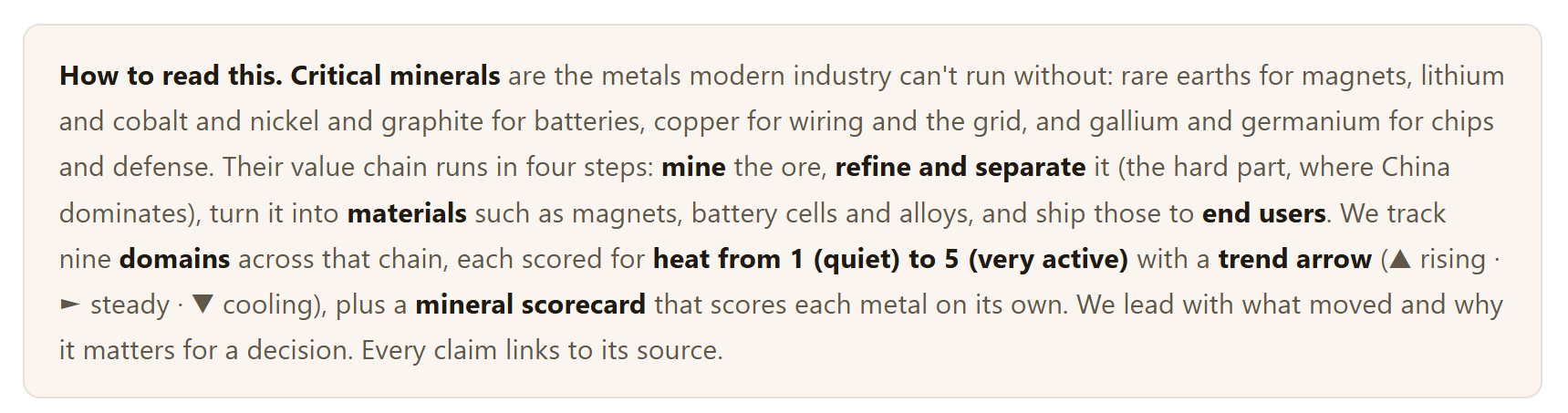
The chain read
For a year the question in this market was how much metal China would let out. This period, for the first time, the United States started deciding what it will let out.
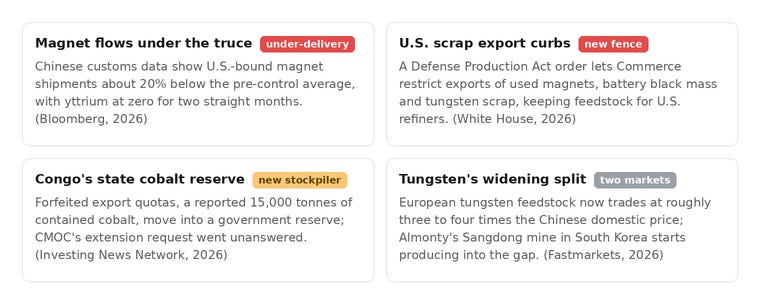
Three facts define the two weeks. First, Chinese customs data published July 20 show that magnet shipments to the United States ran about 20% below their pre-control average through the first half of 2026, truce or no truce, and that shipments of yttrium, a rare earth used in jet-engine coatings, fell to zero for two straight months (Bloomberg, 2026). Second, on July 30 President Trump invoked the Defense Production Act to let the Commerce Department restrict exports of America’s own recyclable mineral feedstock: used rare-earth magnets, shredded battery material known as black mass, and tungsten scrap (White House, 2026). Third, the Democratic Republic of the Congo moved forfeited cobalt export quotas, a reported 15,000 tonnes of contained metal, into a state strategic reserve (Investing News Network, 2026).
Put the three together and the pattern is hard to miss. At the mine, in the middle of the chain, and at the end of it, governments are now holding material back and building stocks of their own. Trade in these metals is shifting from prices to permissions. That shift, and who it helps and hurts, is what this edition traces.
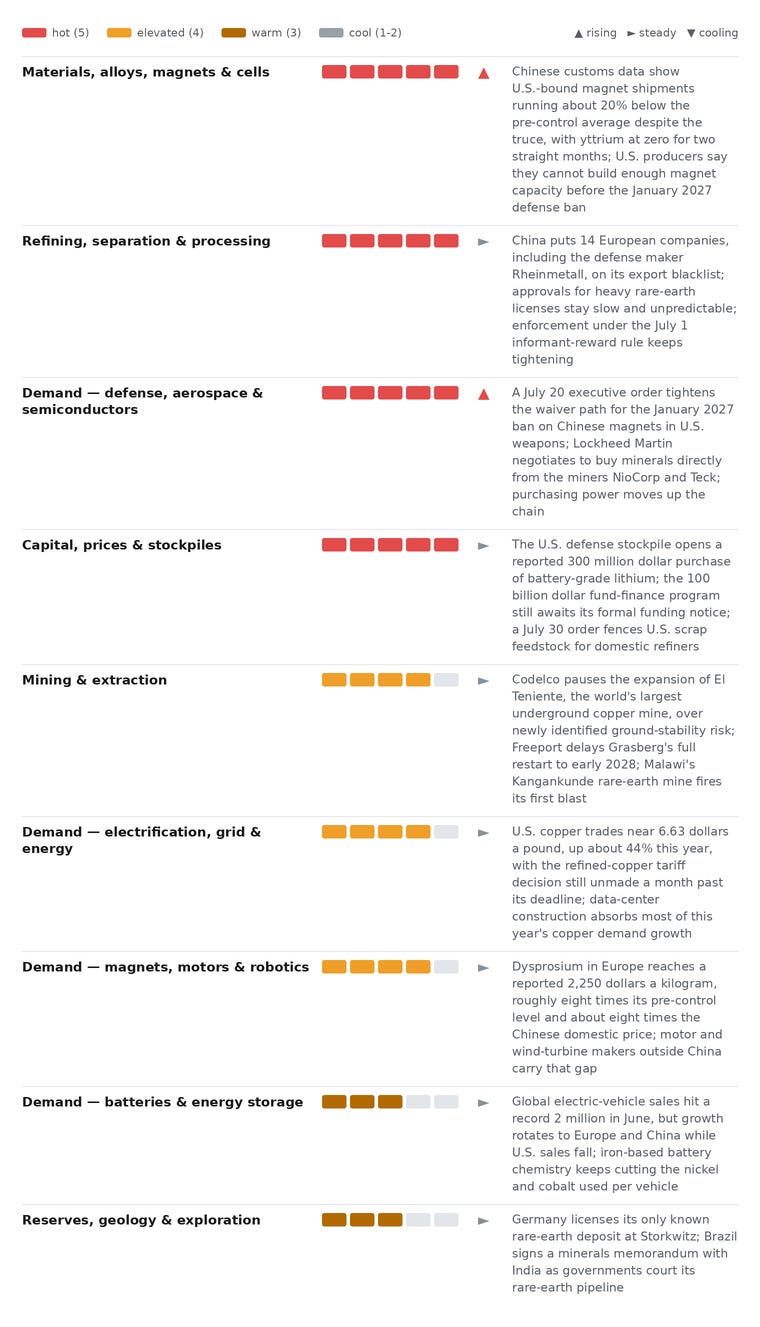
The heat map
The mineral scorecard
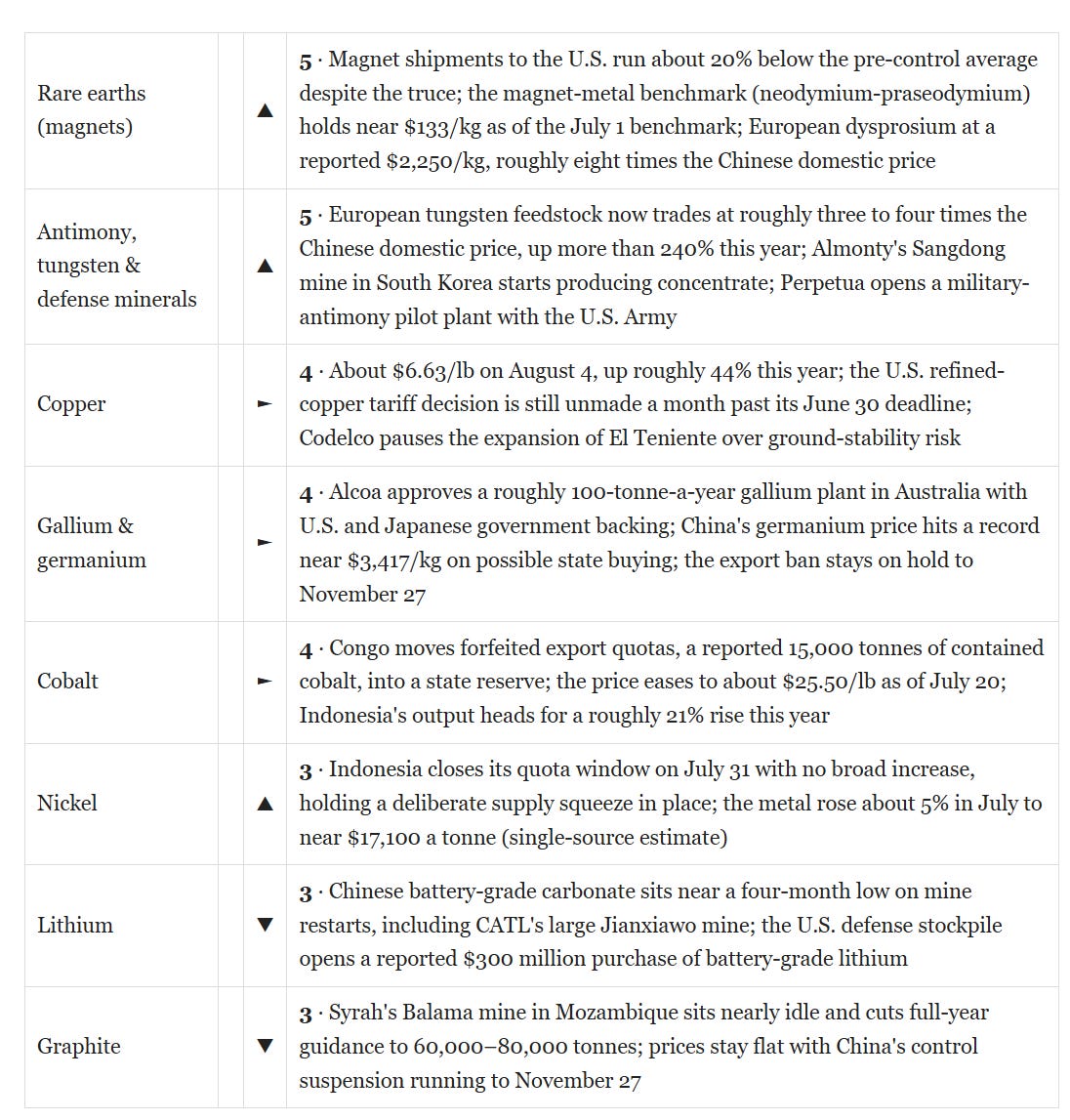
The same story, broken out by metal. Jump to the one you follow. Heat: 1 (quiet) to 5 (very active). Prices are estimates from markets with few buyers and sellers, so treat them as approximate.
Deep dive — the quiet throttle: the magnet truce delivers less than it promised
Customs data show the shortfall; the January 2027 ban turns it into a collision
Chinese customs data published July 20 show that rare-earth magnet shipments to the United States averaged 479 tonnes a month through the first half of 2026, about 20% below the 2022–2024 average, and that yttrium shipments to the U.S. fell to zero for two straight months (Bloomberg, 2026).
The channel is licensing at the refining and materials step, the narrowest point of the chain. China does not need to break the truce to under-deliver on it. It approves licenses slowly, demands heavy end-use paperwork, and blacklists specific buyers: on July 24 it barred exports of controlled items to 14 European companies, including the German defense maker Rheinmetall (S&P Global, 2026). The price effect is immediate. The production effect arrives over months, as buyer stockpiles run down.
The exposure falls on U.S. and European defense and aerospace makers, who need exactly the heavy rare earths that get the fewest licenses. The relative winners are producers outside China selling into the scarcity: Lynas booked a record average selling price of A$98.2 a kilogram this quarter, up 63% in a year, even as its production fell short of plan (Reuters via Mining Weekly, 2026).
The second-order effect is a collision most readers have not priced. U.S. law bans Chinese magnets from defense systems starting January 1, 2027, and this period U.S. producers including MP Materials, Lynas and USA Rare Earth told Reuters they cannot build enough capacity in time (Reuters via OilPrice, 2026). So the decision that matters over the next five months is not production; it is the waiver process, which a July 20 executive order just tightened. That is also why Lockheed Martin, the largest defense contractor, is now negotiating to buy minerals directly from the miners NioCorp and Teck rather than waiting on its suppliers (Reuters via Mining.com, 2026). Purchasing power is moving up the chain.
The base case is that flows stay throttled and narrow waivers bridge the 2027 deadline. The softer scenario, perhaps one chance in four, is that Xi Jinping’s planned September 24 visit to the United States produces a real restoration of magnet flow; the July 30 call between Treasury Secretary Bessent and Vice Premier He Lifeng pointed every open question at that meeting (South China Morning Post, 2026). What confirms the reading: monthly customs magnet volumes staying below the pre-control average. What breaks it: volumes recovering above that average, or yttrium flowing again.
Deep dive — the scrap fence: the United States starts export controls of its own
A July 30 order treats used magnets and battery scrap as strategic material
On July 30, President Trump signed a determination under the Defense Production Act that lets the Commerce Department restrict exports of recoverable critical minerals: used rare-earth magnets, battery scrap known as black mass, tungsten scrap, and similar feedstock (White House, 2026; Bloomberg, 2026).
The mechanism runs through the one feed source that skips the mine entirely. Scrap and recycled material bypass primary mining and go straight to refiners, and today the United States exports much of that material to Asia. Keeping it home is the fastest way to feed the new American refining and magnet plants, faster than any mine. The lag is short: export contracts and broker flows reprice within months, not years.
The direct winners are U.S. recyclers and the refiners built around scrap feed. USA Rare Earth just produced magnet-grade oxides from its own plant scrap, and the refiner ReElement signed a five-year deal to supply oxides to the magnet maker Vulcan Elements (Metal Tech News, 2026). The hurt falls on scrap dealers and exporters, and on the overseas refiners that buy American scrap: in South Korea, Japan and Europe as well as China.
The second-order effect is the uncomfortable one. The United States is now running the playbook it protests: export controls at the feedstock step. That has two consequences a headline reader may miss. First, allied refiners sit behind the same fence as Chinese ones, which strains the G7 minerals alliance the U.S. spent this spring building. Second, it changes the logic of the autumn talks: when both sides restrict exports, the negotiation becomes a trade of permissions, not just tariffs, and each side now holds something the other’s industry needs.
The base case is that Commerce issues a targeted licensing rule this fall and scrap stays home. The alternative, roughly one chance in three, is that pressure from allies waters the rule down to reporting requirements with carve-outs for partner countries. What confirms the reading: a formal Commerce rule that requires export licenses. What breaks it: broad exemptions for allied buyers.
Deep dive — the mine-end stockpile: Congo starts holding cobalt itself
A paperwork failure turned into a state reserve
Congo’s minerals regulator let its July 5 use-or-lose export deadline stand even though its own customs platform was down, and the forfeited volumes, a reported 15,000 tonnes of contained cobalt, moved into a state strategic reserve (Investing News Network, 2026; Fastmarkets, 2026).
The mechanism is new for Congo: a quota system plus a reserve means the state now holds physical metal it can sell or withhold at its own choosing, a price instrument independent of the mining companies. Expectations move now; physical flows adjust over months. CMOC, the holder of the largest single quota, asked for a one-month extension and received no answer (Reuters via Kitco, 2026).
The hurt falls on CMOC, Glencore and the other quota holders, whose licensed volumes shrank without compensation, and on buyers who now face an opaque new seller of last resort. The relative winner outside Congo is Indonesia, whose cobalt output is on track to rise about 21% this year and which gains customers every time Congo looks unreliable (Mining Technology, 2026).
The second-order effect comes in two parts. First, counterparty risk in Congo is now administrative, not just political: a customs platform outage, not a decree, is what took the metal. Second, and wider, look at where government inventory now sits. Congo holds a reserve at the mine end. China holds the licenses in the middle. The U.S. defense stockpile is buying at the demand end, most recently a reported $300 million purchase of battery-grade lithium opened July 2 (Investing News Network, 2026). Every government stock removes metal from the open market, so the traded market gets smaller and prices swing harder on each headline, in both directions.
The base case is that some forfeited quotas are quietly restored but the reserve stays and grows. The harder scenario, roughly one chance in three, is that the state begins selling directly from the reserve and becomes a trading house in its own right. What confirms the reading: the regulator publishing rules for how the reserve will be used. What breaks it: full restoration of the forfeited quotas and a public extension of the deadline.
Charter Subscriber — 50% Off.Lock in 50% off your subscription for your first three months when you join by September 30, 2026.Claim the Charter rate →
Chain of the cycle
How a licensing slowdown in the middle of the chain forces buyers, governments and capital to reorganize around it: the cross-domain effect the model is built to trace.
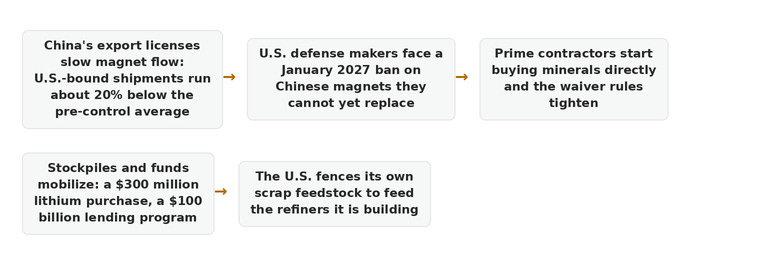
Each step is sourced above. The signal: the squeeze sits in the middle of the chain, at refining and magnet-making, and every response this period, direct buying, stockpiling, scrap controls, is an attempt to route around that middle or rebuild it at home.
China’s near-term position holds: its licenses still decide how much magnet material the West receives each month;
the cost is that every under-delivered month gives the West another reason, and now another tool, to build the replacement.
This chain runs straight into our US Economy Signal newsletter, where the scrap order and the $100 billion lending program are industrial-policy stories; it feeds the hardware layer under our AI Signal newsletter, since gallium and germanium sit inside chips and magnets sit inside data-center cooling and motors; and the cobalt and copper producer threads are the link to our Africa Signal newsletter.
Movers
What to watch next
MP Materials reports second-quarter results on August 6: the first full read on what a $110-per-kilogram government price floor is worth when the market price sits near $133. (Business Wire, 2026)
Xi Jinping’s planned September 24 visit to the United States, now the meeting point for every open minerals question, ahead of the November 10 and November 27 expiry dates for China’s control suspensions. (South China Morning Post, 2026)
The Commerce Department’s refined-copper tariff decision, still unmade more than a month past its June 30 deadline, while roughly $400 a tonne separates U.S. and world copper prices. (Crux Investor, 2026)
The formal funding notice for the U.S. Department of War’s $100 billion National Security Fund Finance program: no fund managers had qualified as this went out. (U.S. Department of War, 2026)
Whether Congo’s regulator publishes rules for the new cobalt reserve, restores the forfeited quotas, or answers CMOC’s extension request. (Fastmarkets, 2026)
India opens technical bids on August 13 for its roughly $870 million magnet-manufacturing subsidy scheme, the first serious Indian entry into magnet capacity outside China. (Government of India, 2026)
Sources
Every material claim is verified to one primary source or two independent reputable sources. Price figures come from markets with few buyers and sellers and are stated as estimates with their as-of dates; verify against a specialist benchmark before trading on them.
***