


Edition 03 · July 2026 · covering ~24 June–5 July 2026 · ~10 min read · Subscriber edition
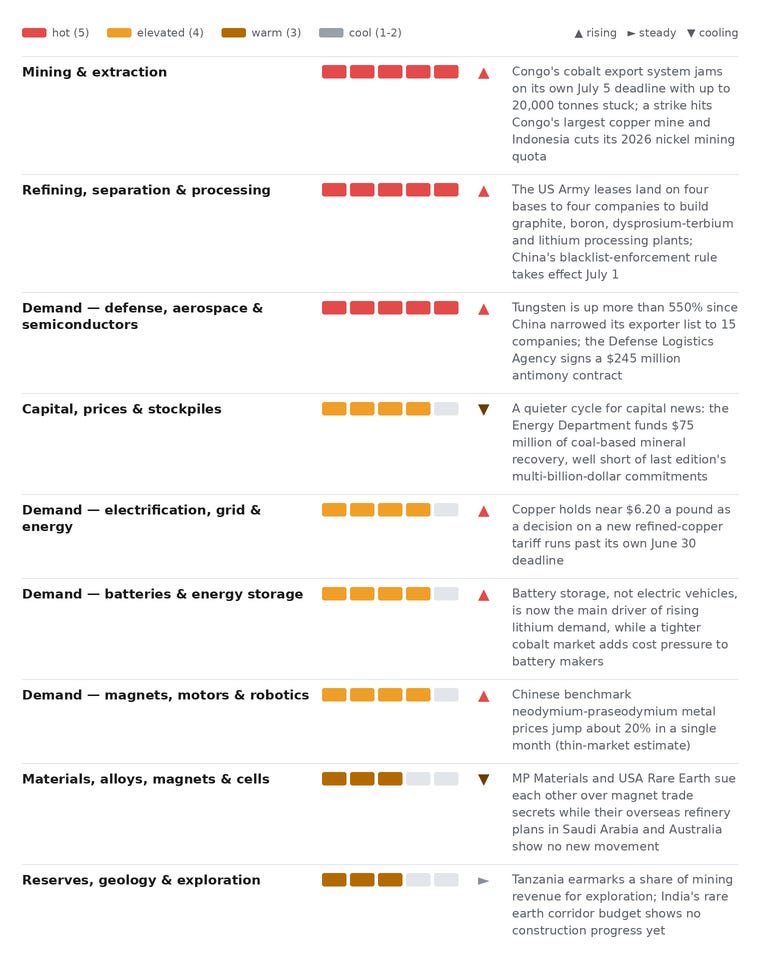
How to read this. Critical minerals are the metals modern industry can’t run without — rare earths for magnets, lithium and cobalt and nickel and graphite for batteries, copper for wiring and the grid, and gallium and germanium for chips and defense. Their value chain runs in four steps: mine the ore, refine and separate it (the hard part, where China dominates), turn it into materials — magnets, battery cells, alloys — and ship those to end users. We track nine domains across that chain, each scored for heat from 1 (quiet) to 5 (very active) with a trend arrow (▲ rising · ► steady · ▼ cooling), plus a mineral scorecard that scores each metal on its own. We lead with what moved and why it matters for a decision. Every claim links to its source.
The chain read
Today is the deadline, and the computer system built to enforce it is down.
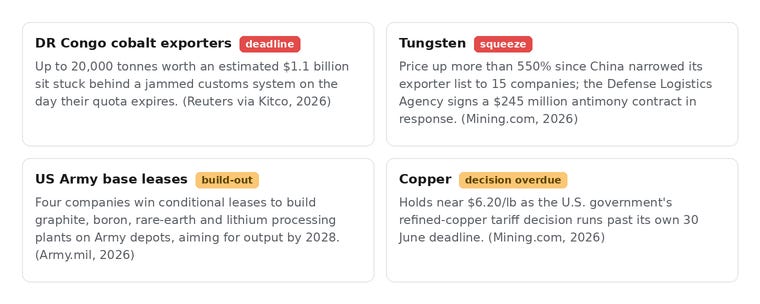
The Democratic Republic of Congo’s mineral regulator, ARECOMS, told cobalt miners that any first-half 2026 export quota not shipped and formally declared through customs by 5 July would be forfeited, no exceptions. Since 1 July, producers say the customs platform has been unable to process that paperwork at all — not because demand collapsed, but because the regulator never sent the system the authorization it needed to keep working. As much as 20,000 tonnes of cobalt, worth an estimated $1.1 billion, is stuck behind that gap, and CMOC — the world’s largest cobalt producer — has asked for a one-month extension it had not received as this went to press (Reuters via Kitco, 2026; Mining Weekly, 2026).
That is exactly the kind of failure this newsletter exists to catch: a government tightening its own grip on a resource ends up choking its own export system instead. The pattern from last edition also holds, just relocated. The push to build mineral processing outside China showed up somewhere new this cycle — not a foreign refinery deal, but four U.S. Army bases, where four companies just signed leases to build the country’s next graphite, boron, dysprosium-terbium and lithium processing plants. And a metal almost nobody outside the defense industry usually tracks, tungsten, quietly became one of the period’s biggest movers, up more than 550% since China narrowed the list of companies allowed to export it. Three different chokepoints, one shared lesson: the tight spot is never really the mine. It is the paperwork, license or permit standing between the ore and the buyer, and it keeps moving.
The heat map
The mineral scorecard
The same story, broken out by metal. Jump to the one you follow. Heat: 1 (quiet) to 5 (very active). Prices are thin-market estimates, so treat them as approximate.
Rare earths (magnets)▲5 · Chinese benchmark neodymium-praseodymium metal near $146/kg, up roughly 20% in a month (thin-market estimate, industry-benchmark sourced); MP Materials and USA Rare Earth are now suing each other over magnet trade secrets even as both remain on China’s export blacklistCobalt▲5 · Congo’s ship-or-forfeit export deadline lands today with the customs system jammed; metal price already up roughly 160% since February 2025 to about $26/lbAntimony, tungsten & defense minerals▲5 · Tungsten up more than 550% since China narrowed its export list to 15 approved companies; the Defense Logistics Agency signs a $245 million antimony contract; the military-end-use export restriction stays in forceCopper▲4 · Holding near $6.20/lb as a decision on a new refined-copper tariff runs past its own 30 June deadline; forecasters split from a 600,000-tonne deficit call to a small-surplus callLithium►4 · Battery-grade carbonate and hydroxide near $20–22.50/kg; the International Energy Agency says battery-storage projects, not electric vehicles, now drive most of the demand growthGraphite►3 · A quiet cycle: spherical graphite steady near $1,700–1,800/tonne; China’s suspended export limits still run to 27 NovemberNickel►3 · Indonesia raised ore royalties and cut its 2026 mining quota even as prices eased in June (single-source estimate)Gallium & germanium►3 · Licensing unchanged and the ban stays paused to 27 November; prices firm modestly while a U.S. Department of Energy program funds a new coal-based recovery route
Deep dive — Congo’s cobalt clock: when the regulator becomes the risk
A ship-or-forfeit deadline meets a customs system that cannot process the paperwork
Congo’s mineral regulator set 5 July as the day any unused first-half 2026 cobalt export quota gets forfeited, and since 1 July, producers say the customs platform needed to file that paperwork has simply not worked (Mining Weekly, 2026).
The mechanism here is almost immediate: cobalt cannot leave the country without a customs declaration, so a software failure at the border behaves exactly like an export ban, even though no one intended to block anything. Congo supplies roughly 70% of the world’s mined cobalt, so a stoppage lasting even days shows up in battery-maker inventories within weeks, not months (Reuters via Kitco, 2026).
CMOC, the world’s largest cobalt producer, is the most exposed name: it and Glencore, together with a handful of others, hold more than 60% of the national quota, and CMOC has asked for a one-month extension it had not received as of this writing. The clearest losers if the deadline stands are Congo’s own miners and, further downstream, battery-cell makers who now pay into an already tight metal market; the relative winner is any producer sitting on unsold above-ground stock who can sell into the scramble (Mining.com, 2026).
The quieter effect is on next year’s quota. Forfeited volumes are not carried forward; they are simply deducted from a company’s allocation baseline, permanently shrinking its future export rights. A bureaucratic glitch in July becomes a multi-year loss of market access, not a one-time shipping delay — and it hands Congo’s regulator a tool that penalizes companies for a problem the regulator itself caused.
The base case is a short administrative fix, most likely the one-month extension CMOC has requested, since a permanent forfeiture would also cost Congo real export revenue. A harder scenario, maybe one chance in four, has the state using the confusion to claw volume into its own “strategic” allocation, tightening global supply further and pushing prices higher still. Watch for an ARECOMS notice in the days after 5 July: a granted extension confirms the base case, while forfeiture notices with no extension would confirm the harder read.
Deep dive — tungsten’s quiet 550% squeeze: the license, not the mine
A metal defense buyers rarely discuss just became one of the cycle’s biggest movers
China’s decision to let only 15 companies export tungsten in 2026 and 2027 has pushed prices for the processed tungsten chemical that feeds cutting tools, ammunition and jet engines up more than 550% since the controls began, while the U.S. Defense Logistics Agency separately signed a $245 million contract for antimony, a metal used in ammunition primers and flame retardants (Mining.com, 2026; AccessNewswire, 2026).
The mechanism is a licensing chokepoint, not a mining shortage — China still holds most of the world’s tungsten and antimony processing capacity, so shrinking the approved-exporter list tightens the tap immediately, even though the ore in the ground has not moved. Because these are processed metals bought under long-lead-time defense and industrial contracts, the price shows up in buyers’ costs within weeks, while a new Western mine or refinery able to replace that volume is still years away (Asian Metal, 2026).
Defense contractors, ammunition makers and toolmakers that rely on tungsten carbide absorb the cost most directly and fastest. Junior producers positioned outside China’s export list — smaller Western tungsten miners and U.S. Antimony Corporation, the Defense Logistics Agency’s new antimony supplier — are the clearest near-term winners.
The second-order effect matters more than the price itself. Tungsten and antimony draw far less public attention than rare earths, yet China has now shown the same exporter-list tool works on almost any metal it dominates. A reader tracking only rare earths and gallium is missing a live demonstration that the same lever now reaches the metals inside ammunition and machine tools — the industrial base behind the defense build-out, not just its showcase magnets (CNBC, 2026).
The base case is that prices stay elevated through 2026 as Western stockpiling, including the new Defense Logistics Agency contract, adds demand on top of a shorter export list. A milder scenario, roughly one chance in three, has China widening its 15-company list once it judges the message received, easing prices back down. Watch whether China adds more names to its designated-exporter roster before year-end, and whether the Defense Logistics Agency signs further single-metal contracts beyond antimony and tungsten.
Deep dive — the build-out moves onto federal land
Army depots become the newest processing sites in the counter-China supply chain
The U.S. Army has signed conditional long-term leases with four companies — a Titan Mining subsidiary, Ioneer, REalloys and EnergyX — to build graphite, boron, dysprosium-terbium and lithium processing plants on underused land at four Army depots, while the U.S. Department of Energy separately awarded $75 million to five projects recovering rare earths, gallium and germanium from coal byproducts (Army.mil, 2026; U.S. Department of Energy, 2026).
The channel here is permitting speed, the biggest brake in this whole system. Building a processing plant on land the government already owns, under a lease rather than a fresh industrial permit, can cut years off the timeline that has stalled the Saudi Arabia and Australia refinery deals covered in earlier editions. Construction is still slated to begin in 2027, with initial output only by 2028 — the lag is real, just shorter than the overseas alternative (North American Mining, 2026).
The four companies and their government partners gain the most direct benefit: guaranteed land access and a defense-linked customer relationship without a years-long fight for a new environmental permit. Communities near the four host depots gain new industrial activity; existing Chinese processors of graphite, boron and heavy rare earths face a longer-run competitor they cannot easily out-price on cost, because these plants are being justified on security grounds rather than economics.
The second-order effect is structural: this is the first clear sign the U.S. government-led build-out has stopped trying to replicate China’s low-cost model overseas and started building smaller, security-justified plants at home instead, on land it already controls. That is a cheaper, faster path to some domestic capacity, but a narrower one — these are single-purpose, defense-adjacent facilities, not the scale of a national refining industry.
The base case is that at least one of the four projects breaks ground on schedule in 2027, since land access removes the main permitting risk. The harder case has financing or technology delays pushing output past 2028, which would matter because that is the same year several of China’s export-control suspensions could lapse. Watch for the first construction start among the four sites, and for the second tranche of Department of Energy coal-recovery awards the agency has already signaled is coming.
Charter Subscriber — 50% Off.Lock in 50% off your subscription for your first three months when you join by September 30, 2026 Claim the Charter rate →
Chain of the cycle
How a regulator’s own paperwork failure becomes a supply shock, and why the fix works against the country that caused it: the cross-domain effect the model is built to trace.
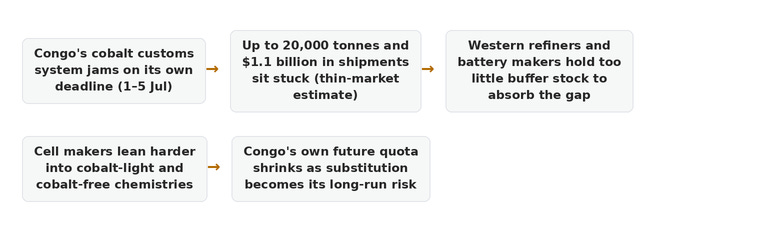
Each step is sourced above. The signal: a government trying to tighten its grip on a resource can damage its own leverage faster than any foreign buyer could, and the companies most exposed to the damage are the ones least able to walk away.
Congo’s short-run fix is bureaucratic — an extension or a software patch;
its long-run risk is that battery makers design cobalt out faster than the country can restore trust in its own export system.
This chain lands squarely in our Africa Signal newsletter, where Congo is a lead producer story; it touches the raw-materials layer under our AI Signal newsletter’s battery and power-storage coverage; and the Army base-lease and coal-recovery threads above feed directly into the industrial-policy story in our US Economy Signal newsletter.
Movers
Subscribe to Critical Minerals & REE Signal
What to watch next
Whether ARECOMS grants Congo’s cobalt miners the one-month extension CMOC has requested, or lets the forfeitures stand. (Reuters via Kitco, 2026)
The still-pending U.S. decision on a phased refined-copper tariff, due after Commerce Secretary Lutnick’s 30 June market assessment. (Mining.com, 2026)
Whether China adds more names to its 15-company tungsten exporter list or holds the line through year-end. (Asian Metal, 2026)
Ground-breaking progress, or delay, at the first of the four Army-base mineral processing sites, targeted for 2027 construction. (Army.mil, 2026)
Whether the MP Materials-Maaden refinery planned for Saudi Arabia shows any new movement, given China’s June blacklist of MP Materials itself.
Mozambique’s new mining law, which requires an export-processing plan before raw mineral exports are approved — a rule that could squeeze Syrah Resources’ Balama graphite mine as it phases in from 2027. (Mining Weekly, 2026)
Sources
[18] Fastmarkets — “Lithium prices,” Jun 2026. fastmarkets.com (accessed 5 Jul 2026).
Every material claim is verified to one primary source or two independent reputable sources. Price figures are thin-market estimates and are stated as such; verify against a specialist benchmark before trading on them.
***