


27 October 2026 · covering 13–27 October 2026 · ~10 min read
A downloadable PDF of each newsletter is now available to paid subscribers at the bottom of this post.
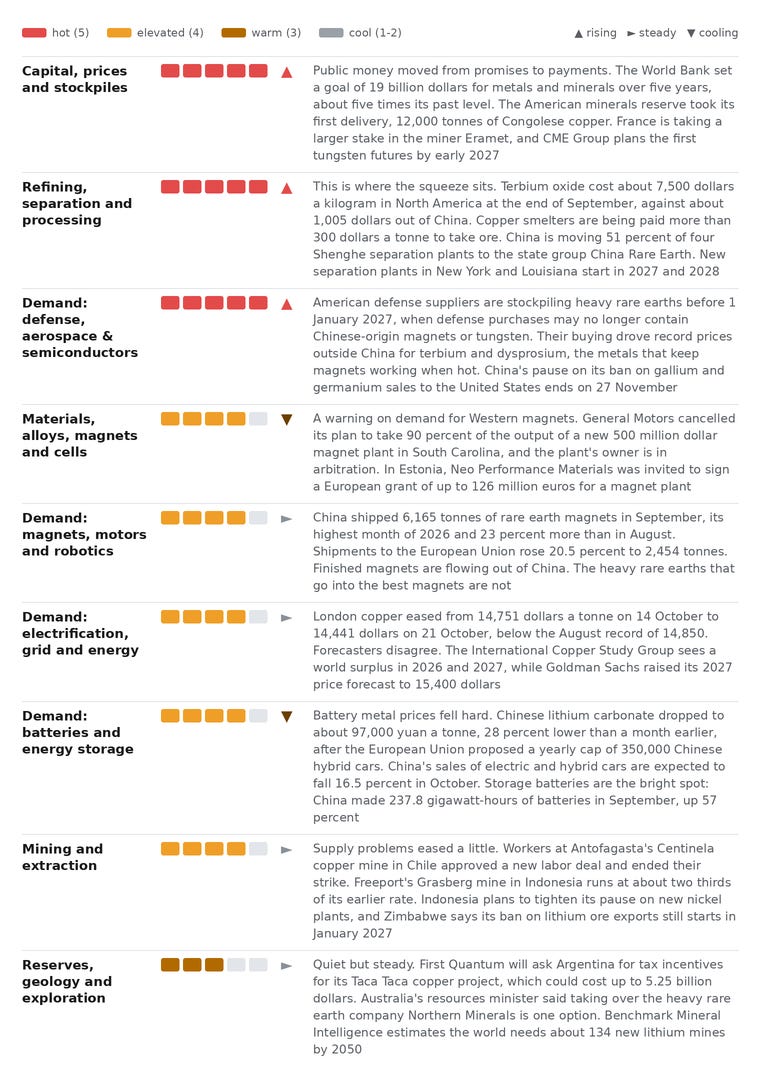
How to read this. Critical minerals are the metals modern industry cannot run without: rare earths for magnets, lithium, cobalt, nickel and graphite for batteries, copper for wiring and the electricity grid, tungsten and antimony for cutting tools and ammunition, and gallium and germanium for computer chips and night-vision equipment. Their value chain runs in four steps: mine the ore, refine and separate it (the hard part, where China dominates), turn it into materials such as magnets, battery cells and alloys, and ship those to end users. We track nine domains across that chain. Each gets a heat score from 1 (quiet) to 5 (very active) and a trend arrow for the direction of pressure over the past two weeks (▲ rising · ► steady · ▼ cooling). A mineral scorecard then scores each metal on its own. Every claim links to its source.
The chain read
The same rare earth now has two prices. At the end of September, terbium oxide delivered to North America cost about $7,500 a kilogram. The same oxide sold out of China for about $1,005 (S&P Global, 2026).
The gap comes from a date. From 1 January 2027, American defense purchases may not contain magnets or tungsten that were mined, refined or made in China (Defense purchasing rules, 2026). Defense suppliers are stockpiling heavy rare earths from outside China before that date, and China shipped no terbium or dysprosium at all in August (S&P Global, 2026).
Two more dates sit in front of that one. China’s pause on its widest rare-earth export rules ends on 10 November. The wider trade truce between China and the United States runs to 10 January, but China has published no notice that carries the rare-earth pause past November (Superhero, 2026).
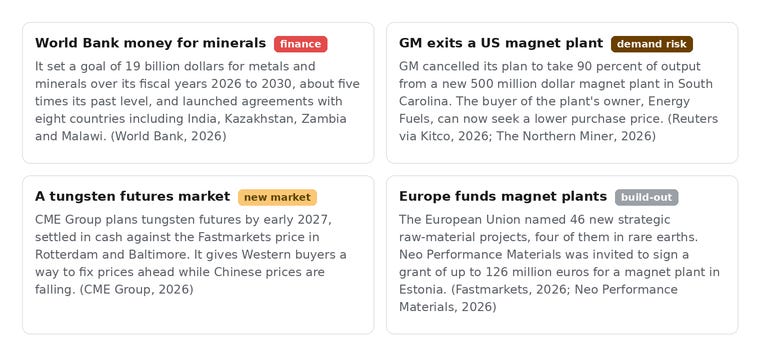
Elsewhere, prices fell. Chinese lithium carbonate lost 28 percent in a month, and Chinese tungsten is about two thirds below its March record. Public money moved the other way: the World Bank set a goal of $19 billion for metals and minerals over five years (World Bank, 2026). The theme of this period: the market is splitting into a China price and a non-China price, and policy money is paying the non-China price.
The heat map
The mineral scorecard
The same story, broken out by metal. Heat: 1 (quiet) to 5 (very active). Prices are estimates from markets with few buyers and sellers, so treat them as approximate, and note the date attached to each.
Rare earths (magnets)▲5 · Heavy rare earths outside China reached record prices. Fastmarkets’ 1 October assessment put terbium oxide at $5,000 to $8,000 a kilogram and dysprosium oxide at $2,500 to $3,500 (Fastmarkets, 2026). Inside China, neodymium-praseodymium oxide, the main magnet material, traded at 743,000 to 745,000 yuan a tonne on 15 October (Shanghai Metals Market, 2026). China exported 6,165 tonnes of magnets in September, its highest month of 2026 (Shanghai Metals Market, 2026).Copper►5 · London spot copper was $14,751 a tonne on 14 October and $14,441 on 21 October, below the record of $14,850 set on 17 August (Reporte Minero, 14 Oct 2026; Reporte Minero, 21 Oct 2026; Reporte Minero, 17 Aug 2026). Smelters paid Antofagasta $310 a tonne to take ore from its Centinela mine, a record for the company (Reuters via Kitco, 2026). The first metal delivered into the American minerals reserve was 12,000 tonnes of Congolese copper (S&P Global, 2026).Lithium▼4 · Chinese lithium carbonate, the white powder used in batteries, fell to 97,000 yuan a tonne in the week to 23 October, 28 percent lower than a month earlier. Spodumene, the ore it is made from, fell 31 percent in a month to $1,300 a tonne (CME Group, citing Shanghai Metals Market and Fastmarkets, 2026). Zimbabwe says its ban on lithium ore exports still starts in January 2027 (Shanghai Metals Market, 2026).Antimony, tungsten & defense minerals▼4 · Chinese ammonium paratungstate, the powder tungsten ore is refined into, was 500,000 yuan a tonne on 12 October, 67 percent below its 12 March record (Shanghai Metals Market, 2026). European offers slid to $2,500 to $3,100 a unit (Shanghai Metals Market, 2026). Chinese antimony fell 12.4 percent in a week to 92,000 yuan a tonne (Shanghai Metals Market, 2026), while the Rotterdam price held at $18,300 to $19,000 a tonne (Fastmarkets, 2026).Cobalt▼3 · Cobalt hydroxide, the semi-processed form Congo exports, was $14.63 a pound, 12 percent lower than a month earlier, and Chinese cobalt sulfate fell 22 percent in a month (CME Group, citing Fastmarkets and Shanghai Metals Market, 2026). Prices fell even though Congo limits exports to 96,600 tonnes a year (Ecofin Agency, 2026).Nickel▼3 · London three-month nickel was $15,125 a tonne in the week to 20 October, down 3 percent (Mysteel, 2026). Indonesia, the largest producer, plans to tighten its pause on new nickel plants that make semi-finished products (Mysteel, 2026; The Jakarta Post, 2026).Gallium & germanium►3 · Germanium ingot in China held at 27,250 yuan a kilogram on 9 October, and exports still need case-by-case approval (Shanghai Metals Market, 2026). We found no fresh gallium price this period. China’s pause on its ban on gallium and germanium sales to the United States ends on 27 November (China Briefing, 2025).Graphite►2 · Quiet. We found no new price, export figure or policy step for graphite, the battery anode material, this period.
Deep dive: heavy rare earths have two prices, and an American rule will keep them apart
Defense buyers must pay the non-China price. Car makers do not have to, and one just walked away.
Terbium oxide in North America rose 53 percent in September to about $7,500 a kilogram, and dysprosium oxide rose 41 percent to about $3,250, while the price out of China stayed flat (S&P Global, 2026). Terbium and dysprosium are the heavy rare earths that keep magnets working at high temperatures, in missiles, jet engines and electric motors.
The channel is a purchasing rule, and the lag is nine weeks. From 1 January 2027, American defense contracts may not include magnets or tungsten that were mined, refined or made in China (Defense purchasing rules, 2026). Suppliers are buying stock from outside China before that date. China cannot fill the gap even if it wanted to: it exported no terbium, dysprosium or scandium in August, and its exports of these metals to the United States and Japan were down 99 percent for January to August (S&P Global, 2026).
Who gains: the few producers of heavy rare earths outside China. Lynas agreed on 1 October to buy Meteoric Resources, whose Caldeira project in Brazil could produce 127 tonnes a year of dysprosium and terbium, against about 400 tonnes a year of demand outside China by Lynas’s estimate (Motley Fool, 2026). Aclara has a $750 million loan from the American export bank for a Louisiana plant, but its supply starts only at the end of 2028 (Fastmarkets, 2026). Who is hurt: defense suppliers, who pay about seven times the Chinese price.
Here is the effect a reader may not have connected. Finished magnets still leave China in large volumes: September’s 6,165 tonnes was the highest month of 2026 (Shanghai Metals Market, 2026). So commercial buyers can keep buying cheap Chinese magnets, and only defense buyers must pay the non-China price. That splits demand for Western magnet plants. On 23 October Reuters reported that General Motors had cancelled its plan to take 90 percent of the output of a new $500 million magnet plant in South Carolina (Reuters via Kitco, 2026). Western magnet plants may end up depending on defense orders, not car makers.
Base case, about three chances in five: the gap stays wide through the first half of 2027, because defense buying continues and new plants are two years away. Alternative, about one chance in four: China licenses more heavy rare earths to commercial buyers after 10 November, which helps car makers but not defense suppliers. What confirms this reading: China’s October customs data again showing no terbium or dysprosium exports. What breaks it: prices outside China falling in November once suppliers finish stockpiling.
Deep dive: copper is in surplus and in shortage at the same time
The world has enough copper. Too much of it is sitting in American warehouses.
On 14 October the International Copper Study Group, the industry’s forecasting body, projected a world surplus of refined copper of about 104,000 tonnes in 2026 and 368,000 tonnes in 2027 (Reuters via Capital.com, 2026). Six days later Goldman Sachs raised its 2027 price forecast to $15,400 a tonne, from $13,800 (Newsquawk, 2026).
The channel is where the metal sits. Stocks on the New York exchange were about 713,000 tonnes in mid-October, and banks estimate total American stocks at 1.5 to 2 million tonnes (Mining.com via IMA, 2026). Traders shipped copper to the United States ahead of a possible American import duty that has still not been decided, and one bank expects no decision before the 3 November elections (Mining.com via IMA, 2026). The new American minerals reserve now pulls in metal too: its first delivery was 12,000 tonnes of Congolese copper (Reuters via Kitco, 2026).
Who gains: miners. Normally a mine pays a smelter a fee, called a treatment charge, to process its ore. Now smelters pay the mines. Antofagasta sold ore from Centinela at minus $310 a tonne for November and ore from Los Pelambres at minus $330 or more for 2027 (Reuters via Kitco, 2026). Who is hurt: smelters, especially outside China, which lose money on every tonne. Robert Friedland of Ivanhoe Mines warned that miners and smelters may fail to agree a fee for 2027 at all (The Deep Dive, 2026).
Here is the second-order effect. If the United States drops the duty idea, part of that 1.5 to 2 million tonnes could flow back to world markets, and the paper surplus would become a real one. Copper held by the reserve will not flow back, because a reserve does not trade. Each tonne the reserve takes makes a sudden price fall less likely.
Base case, about three chances in five: no duty decision before the end of the year, metal stays in the United States, and smelter fees stay negative. Alternative, about one chance in four: the duty is ruled out and stocks flow out, which pushes prices down. What confirms the reading: New York stocks still rising in November. What breaks it: several weeks of falling New York stocks.
Deep dive: battery metals fell, and that weakens the export bans of resource states
A ban on ore exports works best when buyers are desperate. Right now they are not.
Chinese lithium carbonate fell to 97,000 yuan a tonne in the week to 23 October, 28 percent lower than a month before (CME Group, 2026). The fall sped up on 12 October, when the European Union proposed a yearly cap of 350,000 Chinese hybrid cars (Automotive World, 2026). Lithium futures in China fell 10.5 percent that day (CME Group, 2026).
The channel is car demand in China, with a lag of one to two months through battery orders. China’s car dealers’ association expects sales of electric and plug-in hybrid cars in October to be 16.5 percent lower than a year earlier (CnEVPost, 2026). Batteries for storing grid electricity soften the blow: China made 237.8 gigawatt-hours of batteries in September, 57 percent more than a year earlier, and sold 73.5 gigawatt-hours of storage batteries (Gasgoo, 2026).
Who gains: battery makers, who buy cheaper material. Who is hurt: higher-cost lithium miners, and governments that rely on mineral export revenue.
Here is the second-order effect. Two resource states are using export limits to capture more value at home, and both are meeting a weak market. Congo limits cobalt exports to 96,600 tonnes a year (Ecofin Agency, 2026), yet cobalt hydroxide fell 12 percent in a month (CME Group, 2026). Zimbabwe bans lithium ore exports from January 2027 (Shanghai Metals Market, 2026). Lithium earned Zimbabwe $2.159 billion from January to September, 45.6 percent of its mineral exports, but its largest planned processing plant, at Bikita, has moved its start to July 2027, after the ban begins (Shanghai Metals Market, 2026). In a weak market, the ban could cut Zimbabwe’s export income before it lifts world prices.
Base case, about three chances in five: lithium stays weak through the end of the year, with storage demand limiting the fall. Alternative, about one chance in four: Zimbabwe’s ban removes enough ore in early 2027 to lift prices. What confirms the reading: weak Chinese car sales for November. What breaks it: a sharp slowdown in storage battery sales.
Chain of the cycle
How an American purchasing rule turns into a record price for one metal, and why the squeeze sits at separation, not at the mine.
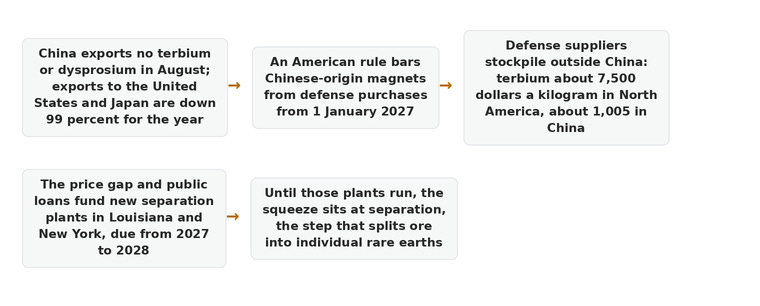
Each step is sourced above. The signal: the shortage is in the middle of the chain. Rare earth ore exists outside China, but very few plants can separate it into pure terbium or dysprosium. Phoenix Tailings announced a $375 million plant in Rochester, New York, to separate about 18,000 tonnes of rare earth material a year, with full output in 2028 (New York Governor’s Office, 2026). Meanwhile China is consolidating its own separation plants under state control: Shenghe Resources proposed moving 51 percent of four separation units to China Rare Earth Group for 1.66 to 1.81 billion yuan (Shanghai Metals Market, 2026).
This chain links to our sister newsletters. Germanium and gallium for chips tie it to the AI Signal. Congolese copper going into the American reserve, Congo’s cobalt quota, Zimbabwe’s lithium ban and the World Bank’s new mining agreements with Zambia and Malawi (World Bank, 2026) tie it to our Africa Signal. The pending copper duty ties it to our US Economy Signal.
Movers
What to watch next
3 November, the American midterm elections, with the copper import duty still undecided. One bank expects no decision before the vote. (Mining.com via IMA, 2026)
10 November, when China’s pause on its widest rare-earth export rules ends. Watch for a notice from China’s commerce ministry that carries the pause to 10 January, in line with the trade truce. (Superhero, 2026)
About 20 November, China’s October customs data. Two figures matter: terbium and dysprosium exports, and magnet exports against September’s record of 6,165 tonnes. (Shanghai Metals Market, 2026)
27 November, when China’s pause on its ban on gallium, germanium and antimony sales to the United States ends. (China Briefing, 2025)
1 December, the earliest start date reported for the European cap on Chinese hybrid cars. (Automotive World, 2026)
1 January 2027, when the American defense rule on Chinese-origin magnets and tungsten starts and Zimbabwe’s lithium ore export ban begins. (Defense purchasing rules, 2026; Shanghai Metals Market, 2026)
Sources
[9] Reporte Minero: copper price report, 21 Oct 2026: London spot 655.033 US cents/lb ($14,441/t).
[18] Fastmarkets: antimony market report, 15 Oct 2026: Rotterdam $18,300–19,000/t, flat since 4 Sep.
[20] Mysteel: nickel weekly, 20 Oct 2026: London three-month nickel $15,125/t, −3.04% on the week.
[48] ABC News: Australia’s resources minister open to nationalising Northern Minerals, 14 Oct 2026.
Every material claim is meant to rest on one primary source, one Tier-1 wire report, or two independent reputable sources. Where a figure rests on a single price publisher, the text says so. Prices for rare earths, tungsten, antimony, germanium and cobalt are estimates from markets with few buyers and sellers. Reuters items were read through Kitco, Capital.com and Mining.com.
***