


How to read this. Critical minerals are the metals modern industry can’t run without — rare earths for magnets, lithium and cobalt and nickel and graphite for batteries, copper for wiring and the grid, and gallium and germanium for chips and defense. Their value chain runs in four steps: mine the ore, refine and separate it (the hard part, where China dominates), turn it into materials — magnets, battery cells, alloys — and ship those to end users. We track nine domains across that chain, each scored for heat from 1 (quiet) to 5 (very active) with a trend arrow (▲ rising · ► steady · ▼ cooling), plus a mineral scorecard that scores each metal on its own. We lead with what moved and why it matters for a decision. Every claim links to its source.
The chain read
For years the price of tungsten in China and the price of tungsten everywhere else were the same number with a shipping cost added. This period, industry price reporters said out loud that they are now two different numbers, moving on their own.
Tungsten is a hard, dense metal used in cutting tools, armor-piercing ammunition and jet-engine parts. Since early 2025, China has required exporters to hold a license and has cut the list of firms allowed to sell abroad. The result, spelled out this period by the price service Fastmarkets, is a split market: Chinese domestic prices have actually stabilized or fallen, near $91,500 a tonne for the standard tungsten chemical, while the price Western buyers pay outside China stays far higher and moves to its own logic (Fastmarkets, 2026; Rare Earth Exchanges, 2026).
That split is the signal this newsletter exists to catch, and tungsten is not alone in it. The same gap has opened in antimony, a metal used in ammunition and flame retardants, where the European price is roughly $23,000 a tonne against about $16,000 inside China; in germanium, a chip-and-optics metal that jumped about 28% in a month inside China while Western material sat near double that price; and even in rare earths, where the magnet-metal benchmark outside China rose about 21% in a single month at the same moment China cut its own internal concentrate price for the first time in eight quarters (SMM benchmark via Rare Earth Mining, 2026; Shanghai Metals Market, 2026). One licensing decision in China no longer just raises a price. It cuts the wire between two markets — and this period the wire stayed cut, hardened by new enforcement and a fresh warning from the world’s main energy agency that the whole system has tipped from worrying about supply to worrying about access.
The heat map
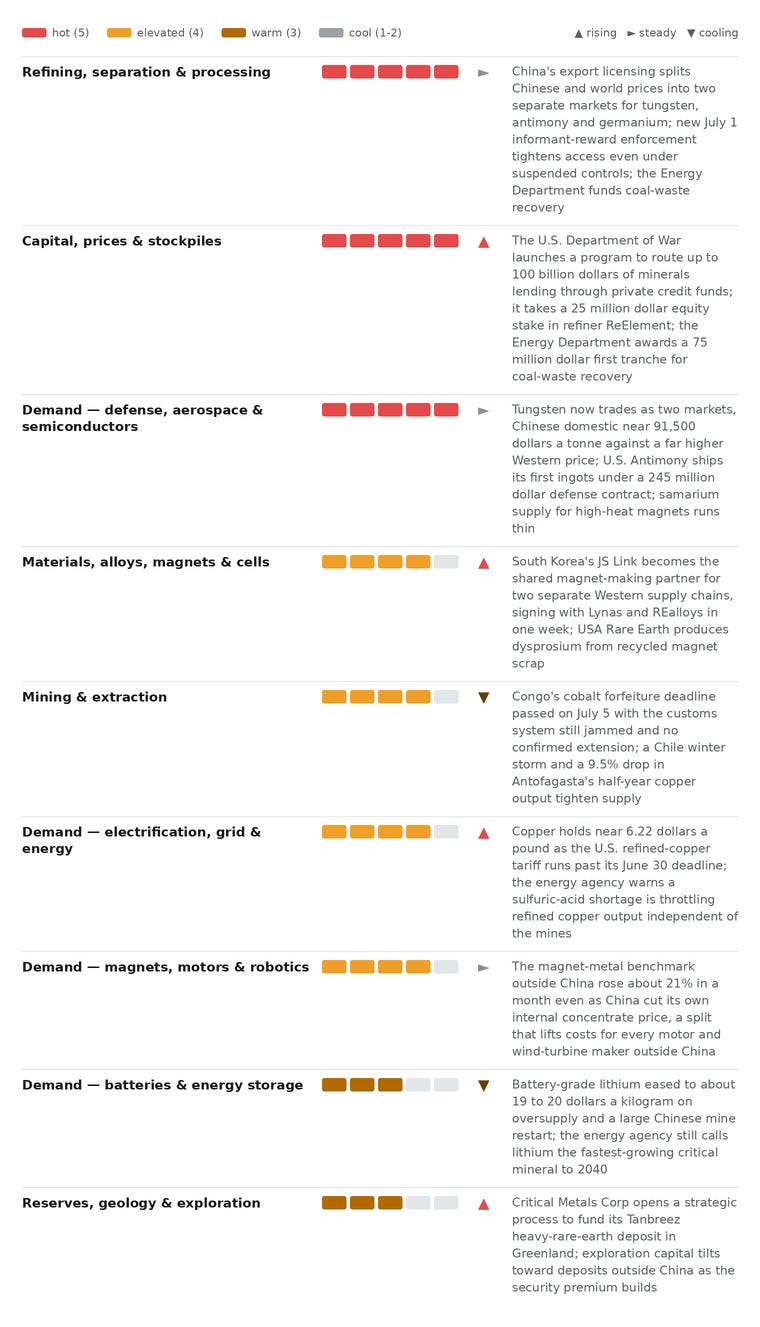
The mineral scorecard
The same story, broken out by metal. Jump to the one you follow. Heat: 1 (quiet) to 5 (very active). Prices are thin-market estimates, so treat them as approximate.
Rare earths (magnets)▲5 · The magnet-metal benchmark outside China (neodymium-praseodymium) near $133/kg, up about 21% in a month, while China cut its own internal concentrate price for the first time in eight quarters — the two-tier split in one metal.
Antimony, tungsten & defense minerals►5 · Tungsten now trades as two separate markets: Chinese domestic near $91,500/tonne against a far higher Western price; U.S. Antimony ships its first ingots under a $245 million defense contract at about $31.71/lb
Copper▲4 · Near $6.22/lb; the U.S. refined-copper tariff is still undecided past its own June 30 deadline; the International Energy Agency warns a sulfuric-acid shortage is throttling refined output on top of a Chile winter storm
Gallium & germanium▲4 · China germanium up about 28% in a month to roughly $3,417/kg while Western material holds near $6,250/kg; the U.S. Energy Department funds coal-based recovery; the ban stays paused to 27 November
Cobalt▼4 · Congo’s ship-or-forfeit export deadline passed on 5 July with the customs system still jammed and no confirmed extension; price about $26/lb, up roughly 130% since February 2025; the energy agency now sees the supply gap widening past 25%
Lithium▼3 · Battery-grade carbonate eased to about $19–20/kg on oversupply and the restart of a large Chinese mine; the energy agency still calls lithium the fastest-growing critical mineral to 2040
Nickel►3 · Indonesia’s 2026 quota cut and higher royalties work through a 31 July revision window; prices stay soft (single-source estimate)
Graphite►3 · Natural graphite pressured by a glut of the synthetic version, holding near $1,700–1,800/tonne; China’s suspended export limits still run to 27 November; Mozambique’s processing-first law adds country risk
Deep dive — the pricing firewall: one metal splits into two markets, and the rest follow
China’s export licenses have cut the wire that once linked its home prices to the world’s
This period, industry price reporters described tungsten as having split into two separate markets — a managed one inside China and a scarcity-priced one outside it — and named the same pattern forming in antimony, germanium and rare earths (Fastmarkets, 2026).
The mechanism is what traders call arbitrage, and it has stopped working. Normally, if a metal is cheaper in China than abroad, buyers ship it out until the two prices meet. China’s export-licensing rules block that flow, so a Chinese price that falls on weak domestic demand no longer drags the export price down with it. The channel is the refining and licensing chokepoint, and the effect is immediate: the moment a license is required, the two prices are free to drift apart, and this period they did (Rare Earth Exchanges, 2026).
Western buyers of these metals are the ones hurt, and directly: a defense contractor or toolmaker outside China can no longer use the cheaper Chinese price as a benchmark or a hedge, because it can’t actually buy at that price. The relative winners are producers outside China — a smaller Western tungsten miner, or U.S. Antimony, which shipped its first ingots this period under a $245 million defense contract at about $31.71 a pound — who now sell into a market where security of supply, not low cost, sets the price (Fastmarkets antimony assessment, 2026).
The second-order effect is the one a headline reader may miss. A split market quietly rewrites the business case for the entire Western build-out. As long as the world paid one Chinese-anchored price, a new Western refinery could never compete on cost. Once the export price detaches and stays high on its own, a Western plant only has to beat that higher outside price — which is exactly the gap that government price floors, such as the U.S. defense department’s $110-a-kilogram floor under rare-earth magnet metal, are designed to guarantee. The firewall is what makes the subsidy math close.
The base case is that the split persists and widens into the autumn, because the licensing rules that caused it are still in force. The softer scenario, perhaps one chance in three, is that a U.S.-China deal to extend the current truce narrows the gap by loosening licenses — talks toward exactly that were underway this period (The National, 2026). What confirms the reading: the two prices keep diverging through the 10 and 27 November control deadlines. What would break it: a truce extension that lets metal flow freely again and snaps the prices back together.
Deep dive — the enforcement turn: China puts teeth behind a “suspended” control
A new informant-reward rule means the paused export ban is biting anyway
Effective 1 July, China’s Commerce Ministry set up a public reporting system that pays informants who turn in companies for exporting strategic minerals without a license, mislabeling shipments, or routing them through a third country to dodge the rules (Morgan Lewis, 2026).
The channel here is enforcement, not new law, and that is what makes it matter. China’s outright export ban on gallium, germanium and antimony to the United States is officially suspended until 27 November, which markets have read as breathing room. But a licensing regime is only as tight as its policing, and this rule converts a paper requirement into an actively hunted one. The lag is short: Chinese suppliers, now exposed to informants and to the detentions and prosecutions already reported this year, respond within weeks by demanding far more end-use paperwork and walking away from any ambiguous order (Fastmarkets, 2026).
The exposure falls on any Western buyer that had been quietly sourcing these metals through gray channels or third-country middlemen — that route is closing. The relative winners are large, compliant buyers with clean paperwork and direct supplier relationships, who gain a measure of certainty while smaller and less formal buyers lose their workaround.
The second-order effect cuts against the market’s own comfort. Because the controls are already biting through enforcement, an extension of the “suspension” at the November deadlines would deliver less real relief than a relieved market expects — the availability of these metals is being throttled now, quietly, regardless of what the formal rule says on paper. The value at stake is not small: the energy agency’s own analysis this period put roughly $6.5 trillion of annual production outside China at risk if the controls were enforced in full (The National, 2026).
The base case is that enforcement keeps tightening into the November deadlines, so real-world access stays harder than the suspended-ban headline suggests. The alternative, roughly one chance in three, is a broad U.S.-China trade understanding that eases both the licenses and the policing at once. What confirms the reading: more detentions, prosecutions or supplier pullbacks in the weeks ahead. What would break it: a deal that visibly loosens end-use documentation demands.
Deep dive — the money changes shape: a $100 billion fund instead of a loan window
The U.S. defense department shifts from lending to companies to seeding the funds that lend to them
On 14 July the U.S. Department of War’s Office of Strategic Capital launched the National Security Fund Finance program, which routes federal minerals lending through private credit funds rather than straight to individual companies, with a target of mobilizing up to $100 billion (Department of War via GlobalSecurity, 2026).
The channel is the capital domain, and the change is structural, not just larger. Instead of underwriting one mine or refinery at a time, the government now puts federal dollars into private investment funds, which must add their own capital before deploying the combined pool. The lag is medium — it takes months to stand up funds and close deals — but the leverage is the point: a given federal dollar pulls private money in behind it, so the deployable total is a multiple of what a direct-loan window could reach (Defense Daily, 2026).
The most direct winners are junior miners and processors with bankable projects, who gain access to a far bigger capital pool. The subtler shift in exposure is that private credit managers become the new gatekeepers: a company that once lobbied a government loan office now has to satisfy a fund’s investment committee. This period also showed the harder edge of that discipline — the U.S. defense department put $25 million of equity into the refiner ReElement Technologies, a smaller, restructured stake that came after the same firm walked away from an $80 million federal loan last year when it could not clear the due-diligence bar (Reuters via U.S. News, 2026).
The second-order effect is that U.S. minerals policy is quietly becoming a capital-markets platform rather than a subsidy program. That can move far more money, far faster, than an appropriations line — but it also hands real allocation power to private managers and raises the question, already being asked on Capitol Hill, of who is accountable when the government is an investor. It is the clearest sign yet that the build-out’s binding constraint has moved from “is there money?” to “who decides where it goes?” This is the seam into our US Economy Signal, where industrial policy is the through-line.
The base case is that the first fund commitments close before year-end, since the framework and the appetite are both in place. The harder case is that the leverage model stalls on governance or oversight questions, which would matter because the Western supply chain still needs its capacity built before the 2028 window when several of China’s control suspensions could lapse. What confirms the reading: the first named credit managers qualifying under the program. What would break it: a Congressional move to rein the authority back in.
Charter Subscriber — 50% Off. Lock in 50% off your subscription for your first three months when you join by September 30, 2026.Claim the Charter rate →
Chain of the cycle
How one licensing rule in China splits a global price in two, and why the split is what finally makes the Western build-out pay: the cross-domain effect the model is built to trace.

Each step is sourced above. The signal: an export control meant to give China leverage over buyers also, by splitting the price, hands the West the one thing its refineries always lacked — a market price high enough to build against.
China’s near-term win is leverage: it can still choke access to metal the world needs;
its long-run risk is that the split price it created is exactly what finances the competitor being built to replace it.
This chain runs straight into our US Economy Signal newsletter, where the defense-minerals fund is an industrial-policy story; it feeds the hardware layer under our AI Signal newsletter, since gallium and germanium sit inside chips and the magnets inside cooling and motors; and the cobalt and copper producer threads below are the seam to our Africa Signal newsletter.
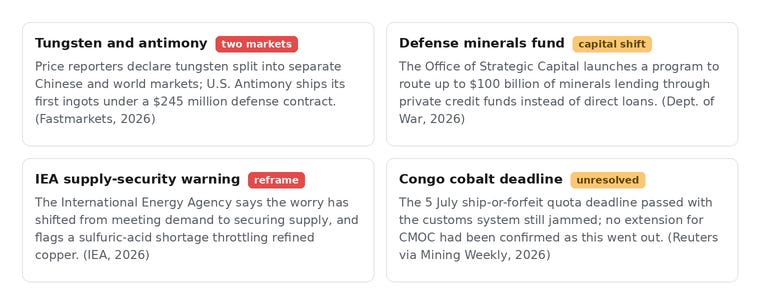
Movers
Subscribe to Critical Minerals & REE Signal →
What to watch next
Whether the gap between Chinese and world prices for tungsten, antimony and germanium keeps widening through the 10 and 27 November control deadlines, or a truce extension snaps it shut. (Fastmarkets, 2026)
The first private credit managers to qualify under the U.S. Department of War’s $100 billion National Security Fund Finance program, and any Congressional move to rein the authority in. (Defense Daily, 2026)
Whether Congo’s regulator grants CMOC the one-month extension it requested or lets the cobalt forfeitures into the state reserve stand. (Reuters via Kitco, 2026)
The still-pending U.S. decision on a phased refined-copper tariff — 15% in 2027 rising to 30% in 2028 — which ran past its own 30 June deadline. (ING, 2026)
Whether the U.S.-China talks on extending the rare-earth export truce produce a deal before the November deadlines. (The National, 2026)
The second tranche of U.S. Energy Department coal-waste recovery awards, already signaled after the $75 million first round, and Indonesia’s 31 July nickel quota revision window. (U.S. Department of Energy, 2026)
Sources
Every material claim is verified to one primary source or two independent reputable sources. Price figures are thin-market estimates and are stated as such; verify against a specialist benchmark before trading on them.
***