

Edition 02 · June 2026 · covering ~19–24 June 2026 · ~10 min read · Subscriber edition
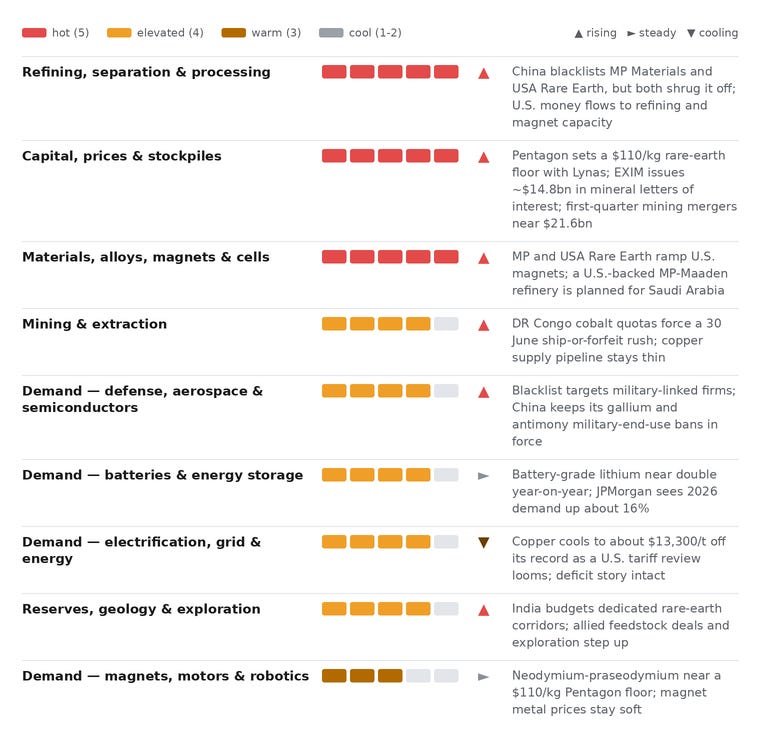
How to read this. Critical minerals are the metals modern industry can’t run without — rare earths for magnets, lithium and cobalt and nickel and graphite for batteries, copper for wiring and the grid, and gallium and germanium for chips and defense. Their value chain runs in four steps: mine the ore, refine and separate it (the hard part, where China dominates), turn it into materials — magnets, battery cells, alloys — and ship those to end users. We track nine domains across that chain, each scored for heat from 1 (quiet) to 5 (very active) with a trend arrow (▲ rising · ► steady · ▼ cooling), plus a mineral scorecard that scores each metal on its own. We lead with what moved and why it matters for a decision. Every claim links to its source.
The chain read
Beijing meant the blacklist as a punishment. The market read it as a compliment.
On 22 June, China added MP Materials and USA Rare Earth — the two companies at the heart of America’s effort to build a rare-earth supply chain outside China — to its export-control list. In the days after, the share prices barely flinched: MP was roughly flat and USA Rare Earth edged higher, and several analysts framed the move as Beijing effectively confirming which two firms it actually fears (Motley Fool, 2026; Seeking Alpha, 2026).
That reaction is the cycle’s real story. A control aimed at the two champions of the Western build-out landed in the same period that the build-out visibly sped up: a Pentagon supply deal with Australia’s Lynas, a U.S.-backed refinery taking shape in Saudi Arabia, new rare-earth corridors in India’s budget, and nearly $15 billion of U.S. export-finance financing for mineral projects (Tectonic Defense, 2026; Aviation Week, 2026). Underneath this, the metals split: cobalt climbed ahead of a 30 June export deadline in the Congo, while copper eased off its record before a looming U.S. tariff decision. For buyers and investors, the fight has moved from blocking supply to building a non-China alternative, meaning the refineries and magnet factories that would end China's grip, and that effort is now gathering speed on its own.
The heat map
The mineral scorecard
The same story, broken out by metal. Jump to the one you follow. Heat: 1 (quiet) to 5 (very active). Prices are thin-market estimates, so treat them as approximate.
Rare earths (magnets)▲5 · China blacklists the two U.S. champions, who shrug it off; Pentagon now sets a $110/kg neodymium-praseodymium floor with Lynas as well as MPCobalt►5 · DR Congo’s first-and-second-quarter quotas must ship by 30 June or be forfeited; hydroxide is up roughly 350% since the 2025 banCopper▼4 · Off the record to about $13,300/t as a U.S. copper-tariff review nears; structural deficit story intactLithium▲4 · Battery-grade carbonate near $26,000/t, roughly double a year ago; JPMorgan sees demand up 16% in 2026Graphite►4 · China still ~92% of anode material; U.S. controls suspended only to 27 November. Antimony, tungsten & defense minerals►4 · Export ban suspended, but the military-end-use restriction stays in forceNickel►3 · Indonesia still ~67% of mine supply; a quieter cycle for the metal. Gallium & germanium►3 · Ban paused to 27 November, but licensing and the military-end-use ban remain
Deep dive — the blacklist backfires: a punishment read as a badge
China names its two biggest threats, and the market thanks it
When China put MP Materials and USA Rare Earth on its export-control list on 22 June, the obvious expectation was a sell-off: two young companies cut off from Chinese equipment and inputs in an industry China still dominates. Instead the shares held. MP traded roughly flat and USA Rare Earth rose, and both remain sharply up on the year: USA Rare Earth more than doubled, MP up about a fifth (Yahoo Finance, 2026).
The reason is that investors likely read the listing as information, not just injury. By singling out these two firms, Beijing effectively confirmed they are the credible threats to its near-monopoly, sort of a back-handed seal of approval (Motley Fool, 2026). It helps that both are heavily insulated from China already: MP carries a roughly $400 million Defense Department equity stake, and USA Rare Earth has about $1.6 billion of Commerce Department backing, and both say their plants no longer rely on Chinese parts or materials. (Mining.com, 2026).
The decision-relevant read is about leverage, and where it is fading. China’s power in rare earths has always been in the midstream: refining and magnet-making dominance. Blacklisting typically works on firms that depend on that midstream and, in this case, aimed at companies built exactly to escape it. The move feels more like a signal than a sanction. For a manufacturer needing a magnet supplier, this sounds like being on Beijing’s list is a sign that Western suppliers are now real.
Deep dive — the counter-build accelerates: floors, refineries and corridors
The West stops talking about supply chains and starts buying them
At the same time the blacklist landed, the allied build-out moved from announcements to contracts. The Pentagon signed a four-year, $96 million deal with Lynas, the largest rare-earth producer outside China, to supply light and heavy rare-earth oxides, and crucially set a guaranteed floor price of $110 per kilogram for neodymium-praseodymium, the same floor it already gives MP Materials (Tectonic Defense, 2026). A price floor matters more than it sounds: it lets a Western producer invest without fear that China can flood the market and bankrupt it.
The map is widening, too:
A Pentagon-backed venture linking MP Materials with Saudi Arabia’s Maaden is set to build a rare-earth refinery in Saudi Arabia, structured to keep U.S. oversight;
India’s new national budget carved out dedicated rare-earth corridors across four states for mining, processing and magnet-making (Aviation Week, 2026; DataM Intelligence, 2026).
Money is following:
The U.S. Export-Import Bank issued about $14.8 billion of letters of interest for critical-mineral projects, including $455 million for domestic rare-earth processing and $400 million for lithium in Arkansas, and
First-quarter mining mergers hit roughly $21.6 billion, the busiest start to a year since 2023 (DataM Intelligence, 2026).
The catch is the clock. Refineries and magnet lines take years to build, while China still refines the overwhelming majority of these metals today and the export limits it put on hold can snap back in November. The alternative supply chain is now being financed, but anyone depending on it should assume a multi-year gap between the signing and the shipping.
Deep dive — the split price map: cobalt’s deadline, copper’s cooldown
Two metals, two opposite weeks
Cobalt is being driven almost entirely by one government: the Democratic Republic of the Congo (DRC), which mines most of the world’s supply. The DRC replaced its 2025 export ban with hard annual quotas of 96,600 tonnes (about 87,000 after a 10% national reserve) and set a sharp rule: unused first- and second-quarter allocations must ship by 30 June or be forfeited (Discovery Alert, 2026; Kitco, 2026). That squeeze has pushed cobalt hydroxide up roughly 350% from where it sat before the controls began (Benchmark Mineral Intelligence, 2026). The 30 June deadline is the next switch to watch.
Copper moved the other way. After surging past $13,800 a tonne for the first time, it eased down to about $13,300 on the London market and near $5.89 a pound in the U.S. by 23 June, partly as traders waited on a U.S. decision about whether to widen tariffs on imported copper (Goldman Sachs, 2026; Trading Economics, 2026). The longer-term story is unchanged: the energy and data-center build-out points to a structural shortage later this decade, but the near-term price is hostage to a policy calendar.
Lithium sits in between, grinding higher: battery-grade carbonate is near $26,000 a tonne, roughly double a year ago, and JPMorgan expects demand to rise about 16% in 2026, led by electric vehicles and grid storage (J.P. Morgan, 2026). The planning lesson repeats from last edition: there is no single “critical minerals” price. A Congolese quota, a U.S. tariff review and an electric-vehicle forecast are pulling three metals in different directions at once.
Charter Subscriber — 50% Off. Lock in 50% off your subscription for your first three months when you join by September 30, 2026.
Chain of the cycle
How a blacklist meant to wound ends up funding the alternative: the cross-domain effect the model is built to trace.
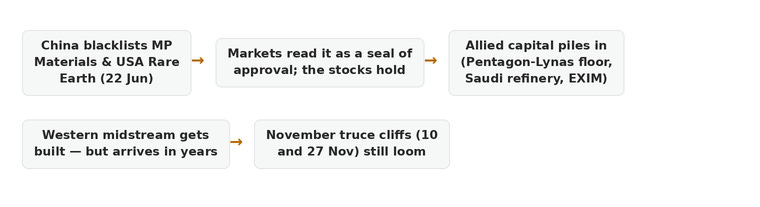
Each step is sourced above. The signal: China’s leverage is concentrated in the midstream (refining and magnets) and every move it makes there accelerates the spending designed to take that leverage away.
Washington’s answer is to underwrite refineries and guarantee prices
Beijing’s is to raise the friction of building them.
This chain zooms in on the raw-materials layer of our next AI Signal newsletter, the producer story in our Africa Signal newsletter, and the industrial-policy thread in our US Economy Signal newsletter.
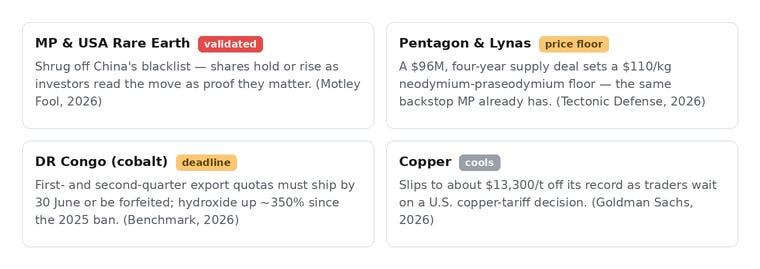
Movers
What to watch next
The 30 June Congo shipping deadline — whether a last-minute rush or a forfeiture squeeze sets cobalt’s next move. (Discovery Alert, 2026)
The pending U.S. copper-tariff review, the near-term switch on copper after its pullback from the record. (Goldman Sachs, 2026)
The November cliffs: whether China extends the suspended rare-earth, gallium and graphite controls past 10 and 27 November or lets them snap back. (Center for Strategic and International Studies, 2026)
Whether the blacklist actually disrupts MP and USA Rare Earth’s equipment and feedstock, or stays symbolic as the market now bets. (Mining.com, 2026)
Follow-through on the counter-build: the Saudi MP-Maaden refinery, India’s corridors, and how fast the Export-Import Bank money actually disburses. (Aviation Week, 2026)
Sources
Every material claim is verified to one primary source or two independent reputable sources. Price figures are thin-market estimates and are stated as such; verify against a specialist benchmark before trading on them.
***