

Edition 03June 2026 · covering ~20–29 June 2026~9 min readSubscriber edition
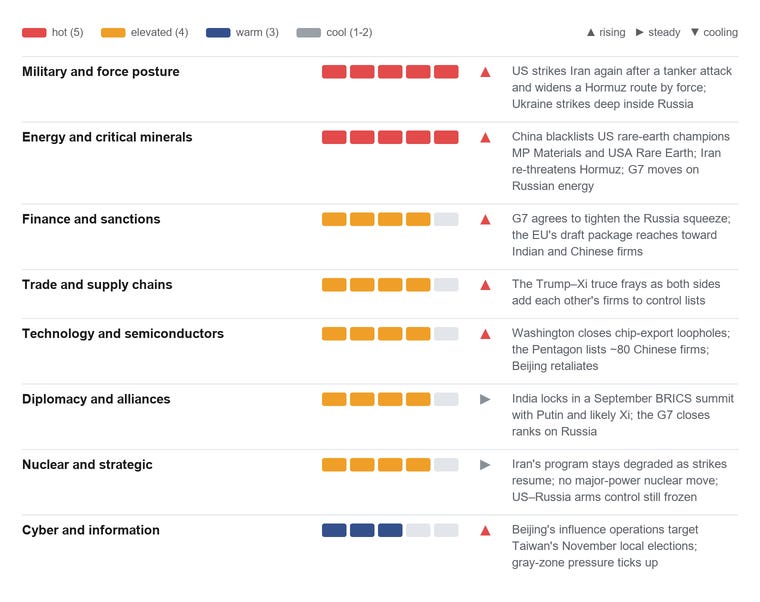
How to read this. We track the moves between the eight great powers — the United States, China, Russia, India, Japan, France, Germany, and the United Kingdom — across eight arenas of competition, from military force to trade, technology, energy, and diplomacy. Each arena gets a heat score from 1 (quiet) to 5 (very active) for the period, plus a trend arrow (▲ rising · ► steady · ▼ cooling). The edition leads with what moved, then traces how one power’s move pulls a response from the others. A map of who can pressure whom sits in the appendix at the end. Every claim links to its source.
The read across the powers
Two weeks ago the story was three confrontations cooling at once. This period, both of the big truces started to come undone — on the same logic that paused them.
The Iran ceasefire began to fray. The deal signed in mid-June was meant to hold for sixty days while the two sides negotiated; instead, by the end of the month the United States was striking Iranian targets again after Tehran attacked a commercial ship in the Strait of Hormuz, and Iran was hitting back toward the Gulf states (Fox News, 2026; CNN, 2026). The guns that went quiet on paper did not stay quiet.
The U.S.–China truce cracked too. On 22 June, Beijing put ten American firms — including the two companies Washington is counting on to build a rare-earth supply chain outside China, MP Materials and USA Rare Earth — on its export-control blacklist, retaliating for new U.S. moves against Chinese technology firms (Al Jazeera, 2026; South China Morning Post, 2026).
The pattern under both: leverage that was paused, not surrendered, came back early. China reached for its mineral lever months before the November deadline it had set. Washington kept tightening on technology and on Russian oil. The takeaway for a decision-maker is that this round of calm was a pause in pressure, not a settlement — and the pause is ending faster than the calendars implied.
The heat map
Deep dive — the Iran ceasefire frays, and the strait is contested again
The truce that was supposed to hold sixty days starts coming apart in ten
The single most important reversal of the period was the unraveling of the Iran ceasefire. The memorandum the American and Iranian presidents signed in mid-June was meant to freeze the fighting for sixty days while the two sides negotiated a permanent end to the war and a reopening of the Strait of Hormuz — the narrow channel at the mouth of the Gulf through which roughly a fifth of the world’s oil moves (NPR, 2026). Within ten days the freeze was breaking. On 20 June Iran declared the strait closed again, accusing Israel of violating the deal; the U.S. military denied any violation (Wikipedia, 2026).
Then it turned kinetic. After Iranian forces attacked a commercial vessel in the strait, the United States launched fresh strikes on Iranian targets, and President Trump warned that Iran “will no longer exist” if the attacks continued; Tehran threatened to walk away from the talks altogether (Fox News, 2026; CBS News, 2026). By 28 June the ceasefire was openly strained, with Iran reported to be striking toward Bahrain and Kuwait — pulling the Gulf states directly into the line of fire (CNN, 2026). The day before, the U.S. Navy had widened a shipping route through Hormuz near Oman, a move that asserted control over the waterway rather than ceding it to Tehran (Wikipedia, 2026).
Read through the model, this is the watch item from our last edition coming true: we flagged that the ceasefire was only days old and that whether it would harden was the first thing to watch. It did not harden. For a decision-maker, the signal is that the United States has chosen to keep the waterway open by force rather than by agreement — a posture that lowers the near-term oil risk but keeps the door to renewed war ajar. Watch whether the Gulf states, now being hit, press Washington for firmer protection or quietly hedge toward calming Tehran.
Deep dive — the rare-earth clash returns, before its own deadline
Beijing blacklists America’s two rare-earth champions; the truce holds only on paper
The second thread is the U.S.–China truce showing its first real cracks. On 22 June, China’s Ministry of Commerce added ten American firms to its export-control blacklist — and the names were pointed. Two of them, MP Materials and USA Rare Earth, are precisely the companies Washington is backing to build a supply of rare-earth metals and magnets outside China — the mines, refineries, and magnet plants that would loosen Beijing’s grip on the materials that go into electric motors, missiles, and wind turbines (Al Jazeera, 2026). Analysts read the move as retaliation for two recent U.S. steps: the Pentagon adding roughly eighty Chinese companies to its list of firms it deems tied to China’s military in early June, and Washington quietly closing loopholes in its chip-export rules (South China Morning Post, 2026).
What makes this notable is the timing. Beijing had paused its broadest rare-earth controls until 10 November as part of the spring truce. Instead of waiting for that deadline, China reached for a narrower, sharper tool now: a targeted blacklist aimed at the two firms that most threaten its long-term leverage. One group that monitors sanctions called the truce 'fragile.'; another framed this as a sign that Beijing and Washington are both trying to pull away from each other, truce or no truce (Bruegel, 2026).
This is the dynamic we keep flagging through our Powers system model: China's mineral leverage has a shelf life. The moment the United States and its partners succeed in refining these materials elsewhere, the lever loses its bite — so Beijing has every reason to use it now, while it still works, and to aim it squarely at the companies building the alternative. The catch is that hitting those firms is exactly what hardens Washington's resolve to fund them. The mineral and chip threads here feed directly into our sister briefs, REE Signal and AI Signal.
Deep dive — the vise on the swing states tightens
The West moves to squeeze Russia’s oil buyers while Russia itself weakens
The third thread runs through the middle powers, and above all India. At their summit on 17 June, the leaders of the Group of Seven major economies agreed it was “the right moment” to step up pressure on Russia’s war economy, including renewed measures against its energy exports (Atlantic Council, 2026). The toughest threat is a draft European sanctions package that, for the first time, would reach beyond Russia to penalize firms in third countries that help move its oil and money, with Indian and Chinese companies named among the targets (Steptoe, 2026; CSEP, 2026). India is one of the two largest buyers of Russian crude oil, so a credible threat to its banks and traders lands directly on New Delhi.
That squeeze arrives just as Russia looks weaker than it has in months: Ukraine has pushed the war deep into Russian territory, striking an oil refinery in Moscow on 18 June, repeatedly forcing the closure of an airport in the Urals more than 1,800 kilometers from the front, and President Putin has begun hinting at peace talks as the economy strains and city dwellers feel the war at home (Al Jazeera, 2026). A weaker Russia changes the math for every power keeping its options open with Russia.
India’s answer is to keep both doors open. New Delhi is preparing to host a summit of the BRICS (Brazil - Russia - India - China - South Africa) group of emerging economies in September, with Putin confirmed and Xi Jinping expected — which would be his first visit to India since 2019 (The Week, 2026). The model’s read: the swing states are being pressed harder than at any point this year, but the pressure is also pushing them to bank their alternatives — India deepening its ties to Russia and China even as it negotiates relief from Washington. Whether that vise closes or India slips it is the middle-power question for the second half of the year.
Move of the period
How a pair of American moves against Chinese technology firms pulled a sharp, early counter from Beijing — aimed at the very companies trying to break its grip.
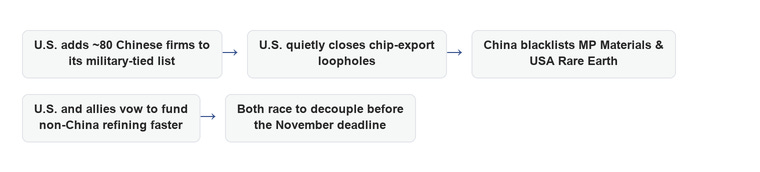
The chain shows why China struck back with minerals instead of chips. It cannot fight the United States on technology head-to-head — China is still the one being cut off from the most advanced chips. So it hits back where it is strongest: the raw materials it refines for the rest of the world (South China Morning Post, 2026). By aiming at the two firms Washington is funding to build an alternative supply of critical minerals, Beijing buys short-term leverage, but at the cost of stiffening the very resolve to replace it. That is the loop to keep in mind: every time China uses its mineral leverage, it pushes the rest of the world to build its own supply faster — so the more China leans on this weapon, the sooner it stops working. (War on the Rocks, 2026).
Power movers
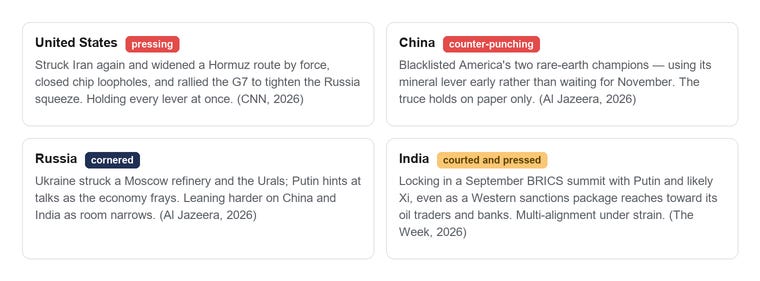
What to watch next
Whether the U.S.–Iran ceasefire survives the renewed strikes or collapses back into open war, and whether Iran’s hits on Bahrain and Kuwait pull the Gulf states off the fence. (CNN, 2026)
China’s next mineral move: does the targeted blacklist widen toward the broad rare-earth controls paused until 10 November, or stay a warning shot? (South China Morning Post, 2026)
The European Union’s draft sanctions package: does it formally name Indian and Chinese firms over Russian oil, and how do New Delhi and Beijing respond? (Steptoe, 2026)
The BRICS summit in New Delhi on 12–13 September: does Xi Jinping attend, and how far does the bloc tilt toward a Global-South, less dollar-dependent line? (The Week, 2026)
The NATO summit in Ankara in July: follow-through on Germany’s plan to spend roughly €650 billion over five years and the alliance’s path toward higher targets. (Atlantic Council, 2026)
Whether Putin’s hints at talks become real negotiations as Ukraine’s deep strikes and the oil squeeze bite. (Al Jazeera, 2026)
Sources
[2] Wikipedia — “2026 Iran war ceasefire,” 2026. en.wikipedia.org (accessed 29 Jun 2026).
[6] Wikipedia — “2026 Strait of Hormuz crisis,” 2026. en.wikipedia.org (accessed 29 Jun 2026).
[12] Steptoe — “Sanctions Update: June 22, 2026,” 22 Jun 2026. steptoe.com (accessed 29 Jun 2026).
Material claims are verified to the linked sources as of 29 June 2026. Several 2026 events remain fast-moving and dates may be revised as reporting develops.
Appendix — who can pressure whom
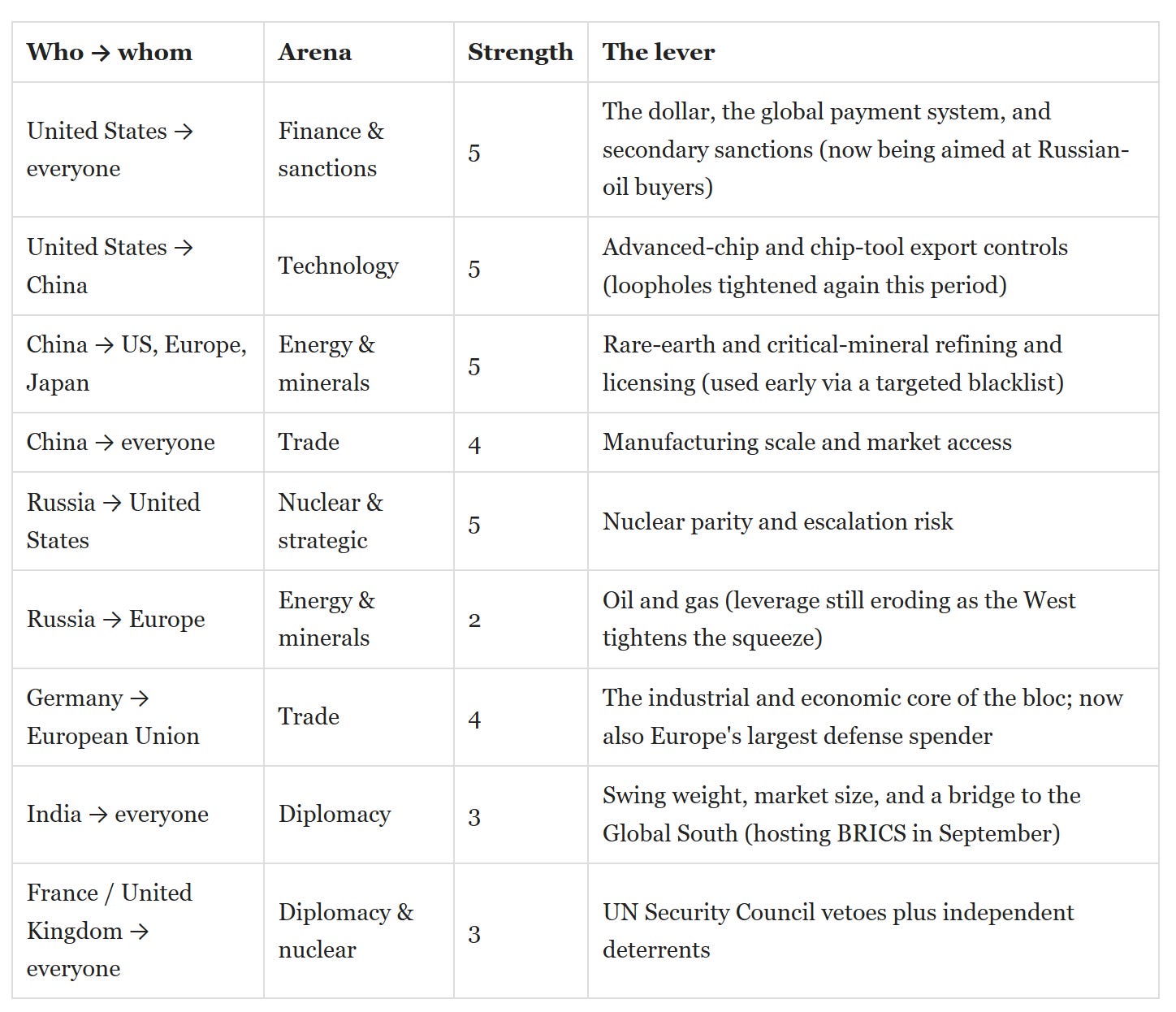
The model’s relationship map, kept at the back as reference: the load-bearing levers between the powers, with the arena each runs through and a strength from 1 (minor) to 5 (decisive). This is the standing picture; the developments above are this period’s movements within it.
Powers Signal is a twice-monthly systems brief from The Critical Post. Method: the moves between eight great powers, scored for intensity and direction across eight arenas, with each move’s likely cross-power responses traced through an interaction model. This edition covers ~20–29 June 2026; figures verified to the linked sources as of 29 June 2026. © 2026 The Critical Post.
***