

Edition 04 · July 2026 · covering ~29 June – 12 July 2026 · ~9 min read · Subscriber edition
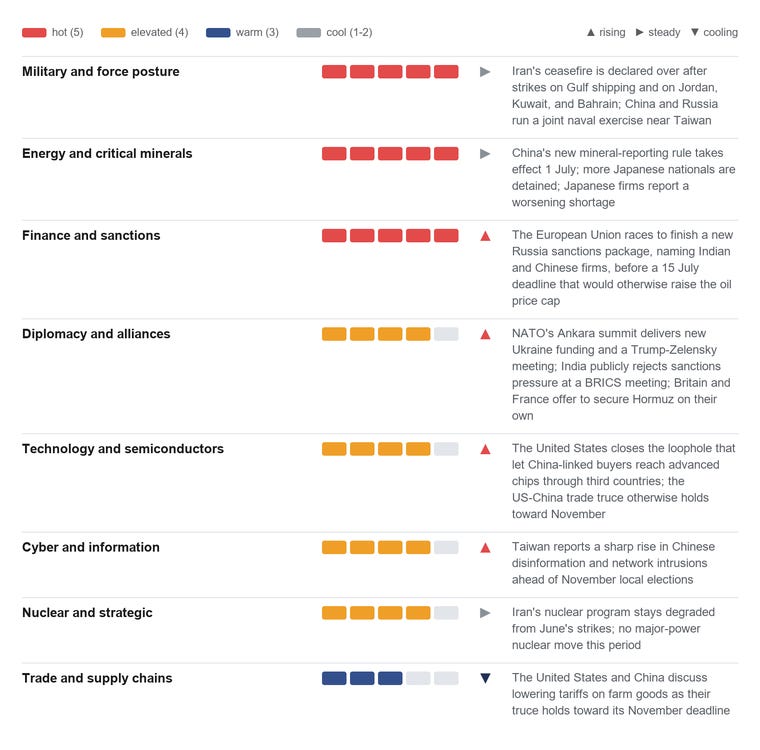
How to read this. We track the moves between the eight great powers, the United States, China, Russia, India, Japan, France, Germany, and the United Kingdom, across eight arenas of competition, from military force to trade, technology, energy, and diplomacy. Each arena gets a heat score from 1 (quiet) to 5 (very active) for the period, plus a trend arrow (▲ rising, ► steady, ▼ cooling). The edition leads with what moved, then traces how one power’s move pulls a response from the others. A map of who can pressure whom sits in the appendix at the end. Every claim links to its source.
The read across the powers
Two weeks ago the story was three agreements starting to fray. This period, the biggest one broke outright.
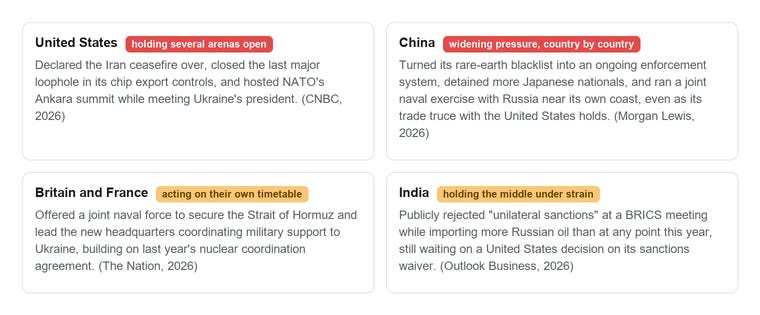
At the NATO summit in Turkey on 8 July, President Trump said the ceasefire with Iran was “over.” Iran had struck three commercial ships in the Strait of Hormuz; the United States answered with a second night of strikes it called offensive; Iran hit back at Jordan, Kuwait, and Bahrain, the Gulf states that host American forces. Britain and France responded not by waiting on the United States, but by offering their own naval force to keep the strait open (NPR, 2026; The Nation, 2026).
Everywhere else, the pattern from last edition held: pressure that was paused kept coming back early. China widened its rare-earth enforcement system on 1 July and detained more Japanese nationals, even as its trade truce with the United States held well enough for the two sides to discuss lowering tariffs on farm goods (Morgan Lewis, 2026; Bloomberg, 2026). The European Union raced to finish a new Russia sanctions package before a 15 July deadline that would otherwise let the price cap on Russian oil jump higher, a package that for the first time names companies in India and China directly (Euronews, 2026). India pushed back hard on that kind of pressure in public while still buying more Russian oil than at any point this year (Outlook Business, 2026).
The takeaway for a decision-maker: formal agreements, ceasefires, truces, and price caps, are proving to be the least reliable guide to what happens next. The enforcement mechanisms and the deployments are the better guide, and this period both moved faster than the paper agreements around them.
The heat map
Deep dive — the Iran ceasefire ends, and Europe moves without waiting on the United States
The Gulf war goes back to open strikes; the notable move is who else steps in
At the NATO summit in Turkey on 8 July, President Trump said the ceasefire with Iran is “over,” after Iran struck three commercial ships in the Strait of Hormuz and the United States answered with a second night of strikes it called offensive (CNBC, 2026).
This runs through the military and force posture arena, and it moves immediately, not over weeks. Once a ceasefire is declared dead in public, every actor near the Gulf adjusts within days: shippers reroute or raise insurance rates, and the states that host American forces brace for the next round.
That is exactly what happened. Iran retaliated by striking Jordan, Kuwait, and Bahrain, three countries that were not combatants but that host United States military bases (NPR, 2026). Those three states are the most directly exposed party here: they gain nothing from the fight and are being hit for hosting an ally. Global shipping through the strait, which carries roughly a fifth of the world’s oil, absorbs the next layer of risk.
The move worth watching is not in the Gulf itself. It is what Britain and France did the same week: they announced they are ready to deploy a joint naval force to keep the strait open (The Nation, 2026). That extends a pattern the two countries started last year, when they signed the Northwood Declaration to coordinate their independent nuclear deterrents (IISS, 2025). The Hormuz offer carries that same logic from deterrence into conventional force: Britain and France building their own capacity to keep oil moving, rather than depending entirely on the United States to decide how and when.
Base case: strikes continue at a reduced but real pace, since President Trump left his negotiators room to keep talking even while calling the ceasefire dead (medium-high confidence).
The scenario to watch: if the British-French force actually deploys and Iran treats it as a new provocation, that pulls Europe into a Gulf conflict it has mostly avoided directly for three years, a lower-probability but higher-consequence path.
What would confirm the reading: a firm deployment date from Britain and France.
What would break it: a new round of direct United States-Iran talks announced before the next edition.
Deep dive — China turns a rare-earth blacklist into a standing system, and Japan absorbs the weight
A single list becomes an enforcement machine, and it is aimed differently at each target
On 1 July, a new Chinese rule took effect that formalizes how the government reports and pursues violations of controls on strategic minerals, and Chinese authorities have detained at least two more Japanese nationals over rare-earth export rules, on top of the blacklist of American firms from the previous edition (Morgan Lewis, 2026; Nikkei Asia, 2026).
This runs through the energy and critical minerals arena, and unlike a single blacklist announcement, a reporting and enforcement system moves slowly and compounds. It does not hit once. It creates an ongoing incentive to keep finding new violations, so the pressure builds over months rather than fading after one news cycle.
Japan is now the most exposed economy in this arena, more than the United States. China cut off certain mineral shipments to Japan after Japan’s prime minister said an attack on Taiwan could count as an existential threat justifying a Japanese military response, and Japanese companies are now issuing a rising number of formal warnings about the shortage reaching their production lines (Mining Weekly, 2026).
The easy story is China against the United States. The harder-to-see story is that China is running two separate campaigns on the same lever at once. Against the United States it uses a targeted blacklist naming specific companies. Against Japan it uses a blunter, unannounced cutoff tied to a single political statement. The mineral lever is not one policy; it is a menu China adjusts country by country, which makes it harder for any single country to predict when it comes next.
Base case: China keeps the Japan cutoff in place and widens formal enforcement gradually rather than announcing new broad controls (medium-high confidence). Scenario: if Japan’s government softens its public language on Taiwan, mineral flows could ease within weeks, since the trigger was a specific statement rather than a structural policy; a separate, lower-probability scenario is the new reporting rule catching a larger company and forcing a diplomatic response.
What would confirm the reading: a public statement from Japan’s government adjusting its Taiwan language.
What would break it: China widening these same rules into the broad mineral controls it has paused until November, doing to Japan what it has so far only threatened against the United States.
Deep dive — China and Russia drill near Taiwan while a leadership purge may be slowing the harder option
The pressure campaign and the invasion option are separating, not merging
China and Russia ran the “Joint Sea-2026” naval exercise near the port city of Qingdao from 6 to 13 July, while Chinese coast guard vessels kept asserting jurisdiction over commercial ships east of Taiwan, and Taiwan’s National Security Bureau reported a sharp rise in Chinese disinformation and network intrusions ahead of Taiwan’s November local elections (CGTN, 2026; The Record, 2026).
This runs through the military and force posture arena and the cyber and information arena at the same time, and both move on a slow, steady lag built up over months of drills and daily pressure, not a single trigger.
Taiwan bears the direct cost, funding its own defense buildup and civil-defense drills while absorbing what its security officials call an unprecedented scale of disinformation (StratNews Global, 2026). The United States and Japan are exposed at one remove: any change in the credibility of Taiwan’s defenses changes the credibility of their own commitments in the region.
Our reading of the more interesting signal sits underneath the drills. One outside analysis argues that a leadership purge inside China’s military command has pushed back China’s own internal timetable for taking Taiwan by force, even as the daily pressure campaign continues (East Asia Forum, 2026); this is one analyst’s interpretation, not a confirmed fact, and we flag it as such. If that reading holds, this period’s message is not that an invasion is close. It is that China is separating its two Taiwan tools: turning up the pressure campaign, drills, coast guard assertions, disinformation, in part because the harder military option is, for now, less ready than the pressure alone would suggest.
Base case: continued pressure short of direct confrontation, drills, disinformation, coast guard assertions, without a move toward direct confrontation before the next edition (medium-high confidence).
Scenario: if the purge reporting is wrong or reverses, the drills could shift from routine to a rehearsal with shorter notice, a lower-probability but higher-consequence path.
What would confirm the reading: further reporting on the purge’s scope, or a pause in drill tempo.
What would break it: a joint exercise that includes a live blockade rehearsal near Taiwan itself, not near Qingdao.
Move of the period
How a tanker strike in the Strait of Hormuz pulled the ceasefire’s collapse, a second round of Iranian strikes on the Gulf states hosting American forces, and an independent European offer to secure the waterway, all inside two weeks.

The chain shows why the response spread past the original two parties. Once Iran struck states that host American forces rather than American assets directly, the United States had to answer to its allies as well as to Iran, which is part of why President Trump made his statement at a NATO summit rather than on its own (NBC News, 2026). Britain and France read the signal the model would flag: the United States is treating safe passage through the strait as something to secure by force rather than by agreement, and that leaves an opening for European powers to add their own capacity rather than depend on a single guarantor. The loop to watch: if a European force actually deploys, it becomes a second party Iran has to decide whether to strike, and a second party that has to decide how far to escalate if it is hit.
Power movers
What to watch next
Whether the European Union finishes its new Russia sanctions package before the 15 July deadline, avoiding an automatic jump in the price cap on Russian oil from $44.10 to $58 a barrel. (Euronews, 2026)
Whether Britain and France’s offer to secure the Strait of Hormuz becomes an actual deployment, and how Iran responds to a foreign naval presence in the strait. (The Nation, 2026)
Whether the direct talks the United States’ negotiators want with Iran resume, or whether the “over” declaration holds and strikes continue. (CNBC, 2026)
Whether China’s new mineral reporting rule produces more detentions or export denials involving Japanese, South Korean, or other firms before the next edition. (Nikkei Asia, 2026)
Whether the meeting between President Trump and Ukraine’s president in Ankara leads to a new round of talks with Russia, or stalls the way December’s near-deal did. (CFR, 2026)
The United States Trade Representative’s 20 July deadline on proposed tariffs covering 46 countries, including China; whether it proceeds on schedule. (Tariffs Tool, 2026)
Sources
[2] NPR — “Trump, NATO, Iran strikes press conference,” 8 Jul 2026. npr.org (accessed 12 Jul 2026).
Material claims are verified to the linked sources as of 12 July 2026. Several items (the East Asia Forum purge reading; single-source detail on China’s 1 July mineral-reporting rule) rest on one analysis or outlet and are flagged as such in the text; treat them with more caution than the multiply-sourced items. Several 2026 events remain fast-moving and dates may be revised as reporting develops.